The Neocultural Consumer: Reaching Second-Generation Canadians Who Don't Read the Community Paper (But Their Parents Do)
By Ethnique Media · October 23, 2026
Summary
Multicultural marketing in Canada has a default setting, and it is the newcomer: someone who arrived recently, prefers their heritage language, and gets their news from community media. That default is accurate for a large and valuable audience, and it is why in-language print, radio, television and digital remain the backbone of our media plans. It leaves out the fastest-growing part of every community: the people who were born here. Between 2001 and 2021, the second generation grew faster than any other segment of Canada's racialised population, and in the largest communities its share is higher and rising. Strategy magazine has called this audience "neocultural" — a useful word for a group that does not fit the newcomer template: fluent in English or French, often less fluent in the heritage language, culturally proud, and living in a hybrid of mainstream and heritage media. This article is about how to plan media for them, and why the answer is not "drop the ethnic media and buy mainstream."
1. Who the neocultural consumer is
Three facts frame the audience.
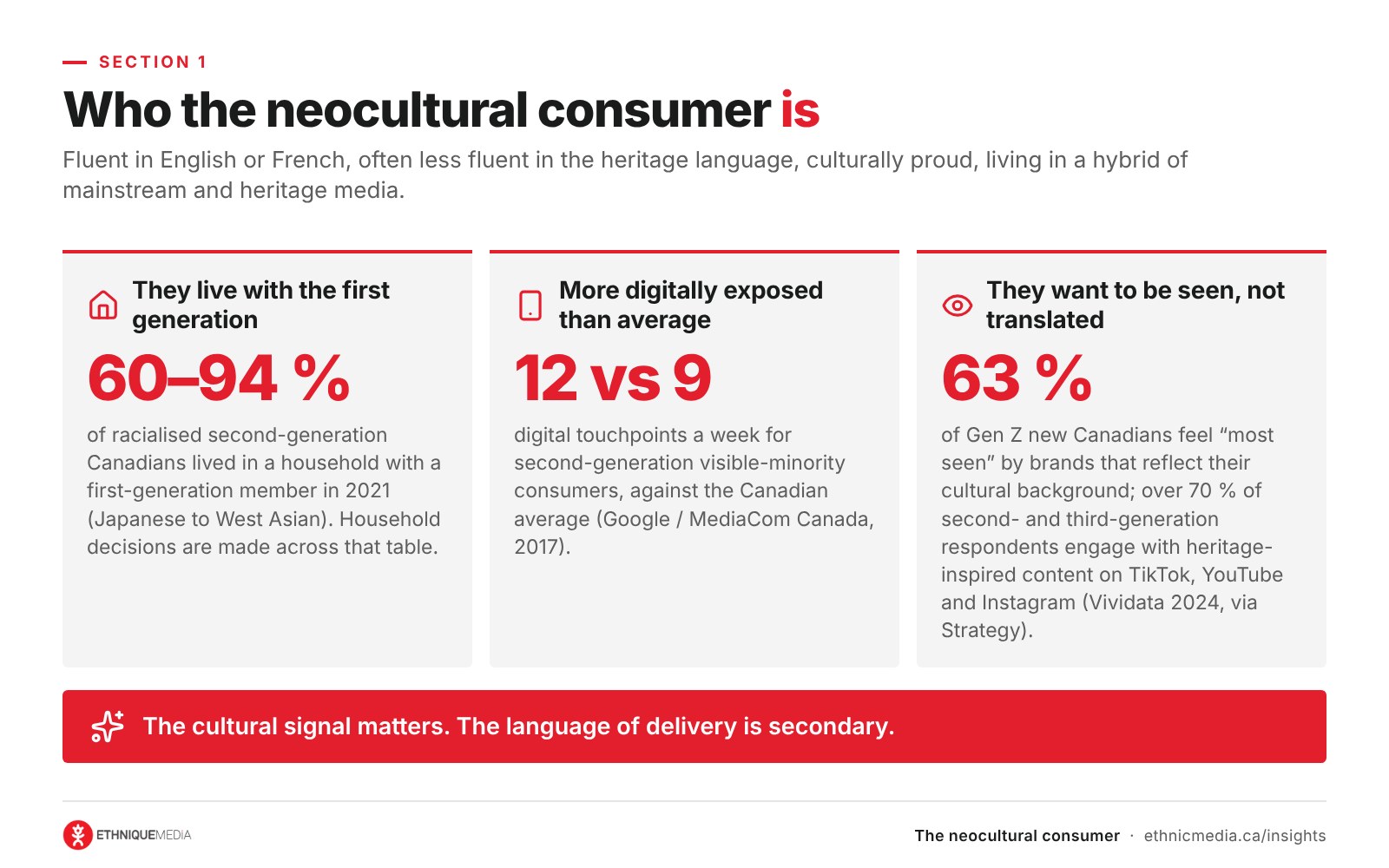
They live with the first generation. In 2021, between 60 per cent (Japanese) and 94 per cent (West Asian) of racialised second-generation Canadians lived in households that included a first-generation member. The second generation is not a separate audience in a separate home; it is the adult child, the teenager, the young parent sharing a kitchen table with people who still read the community paper and listen to in-language radio. Household decisions, from cars to mortgages to insurance, are made across that table.
They are more digitally exposed than the average Canadian. For the first generation, in-language media is about fitting in and getting information; for the second, heritage content is about staying connected to identity. Google and MediaCom's Canadian multicultural research found second-generation visible-minority consumers reporting around 12 digital touchpoints a week against nine for the average Canadian. The research dates from 2017 and the gap has, if anything, widened since.
They want to be seen, not translated. Vividata's 2024 Multicultural Consumer Study, as reported in Strategy, found that 63 per cent of Gen Z new Canadians feel "most seen" by brands that reflect their cultural background, and that more than 70 per cent of second- and third-generation respondents actively engage with heritage-inspired content on TikTok, YouTube and Instagram. The cultural signal matters; the language of delivery is secondary.
2. The planning mistake: treating generation as a channel switch
The common response to this audience is binary: newcomers get ethnic media, the Canadian-born get mainstream media with a diverse cast. That misreads how the audience lives.
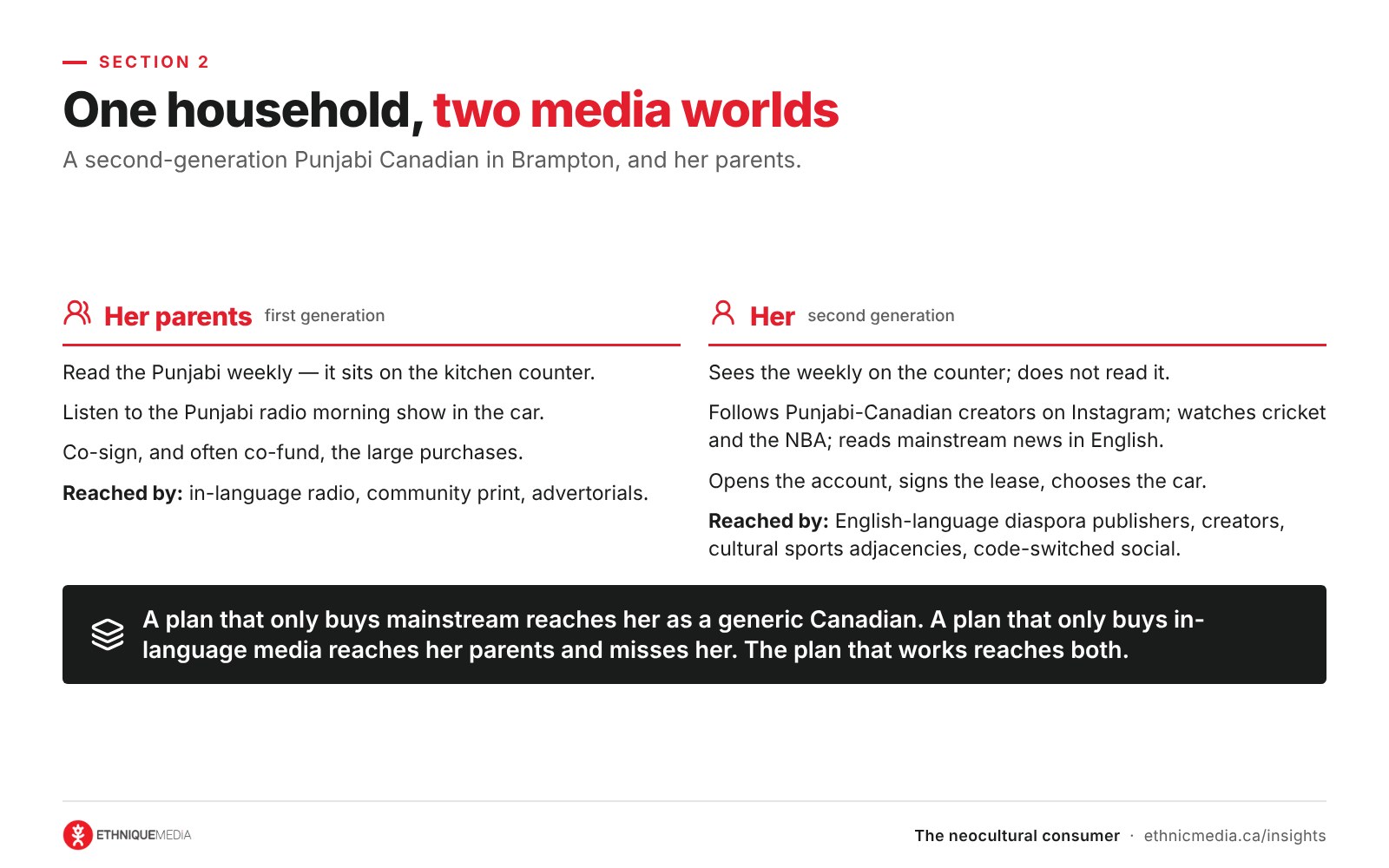
A second-generation Punjabi Canadian in Brampton does not read the Punjabi weekly, but her parents do, and she sees it on the counter. She does not listen to the Punjabi radio morning show, but it is on in her father's car. She follows Punjabi-Canadian creators on Instagram, watches cricket and the NBA, and reads mainstream news in English. A plan that only buys mainstream reaches her as a generic Canadian; a plan that only buys in-language media reaches her parents and misses her. The plan that works reaches both, with creative that the household recognises as its own.
3. Four principles for neocultural media planning
3.1 Plan the household, not the individual
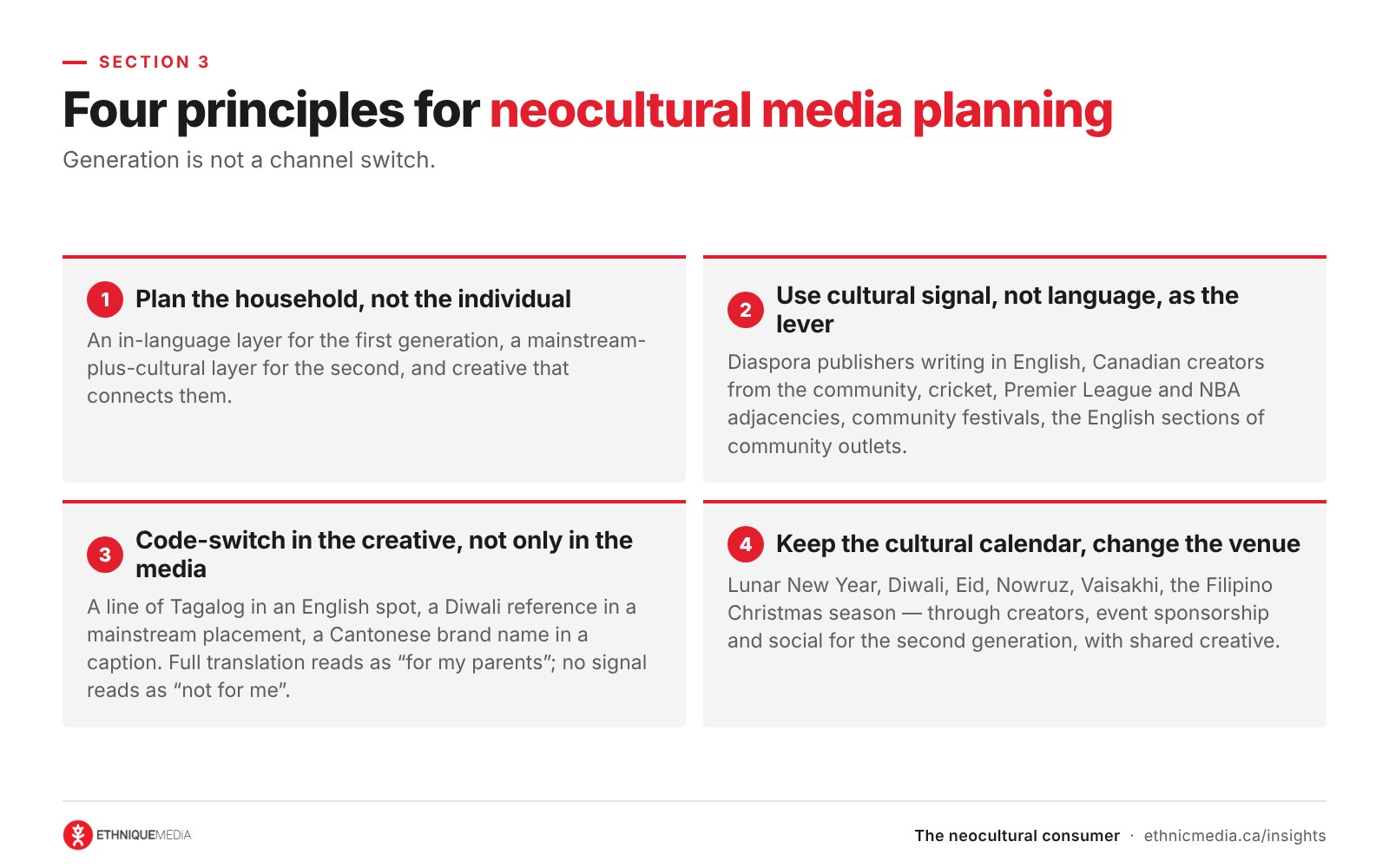
For most considered purchases, the household is the buying unit, and most racialised households in Canada contain two generations. Build plans with an in-language layer for the first generation and a mainstream-plus-cultural layer for the second, and let the creative connect them. Ethnic media is the layer that makes the brand present in the home; mainstream media is the layer that makes it present in the second generation's feed.
3.2 Use cultural signal, not language, as the targeting lever
For the second generation, the right media is where heritage culture lives in English or French: diaspora-run digital publishers that write in English, Canadian creators from the community, culturally rooted sports (cricket, Premier League, NBA), community festivals and their media partners, and the English-language sections of community outlets. Our outlet directory tags each publication by language, and a growing number of digital outlets serving Chinese, South Asian, Filipino and Arab Canadians publish in English or bilingually. Those are the neocultural placements.
3.3 Code-switch in the creative, not only in the media
The audience moves between languages and references in a single sentence, and advertising that does the same reads as authentic. A line of Tagalog in an English spot, a Diwali reference in a mainstream placement, a Cantonese brand name in a TikTok caption: these are the cues that generate the "most seen" response Vividata measured. Full translation reads as "for my parents"; no cultural signal reads as "not for me."
3.4 Keep the cultural calendar, change the venue
The same moments that drive first-generation media — Lunar New Year, Diwali, Eid, Nowruz, Vaisakhi, the Filipino Christmas season — drive second-generation engagement, but through different media: creator content, event sponsorship, culturally themed mainstream placements, and social. A Lunar New Year plan that runs community print and radio for the first generation and creator and social for the second, with shared creative, reaches the whole household at the moment the household is paying attention.
4. A worked example
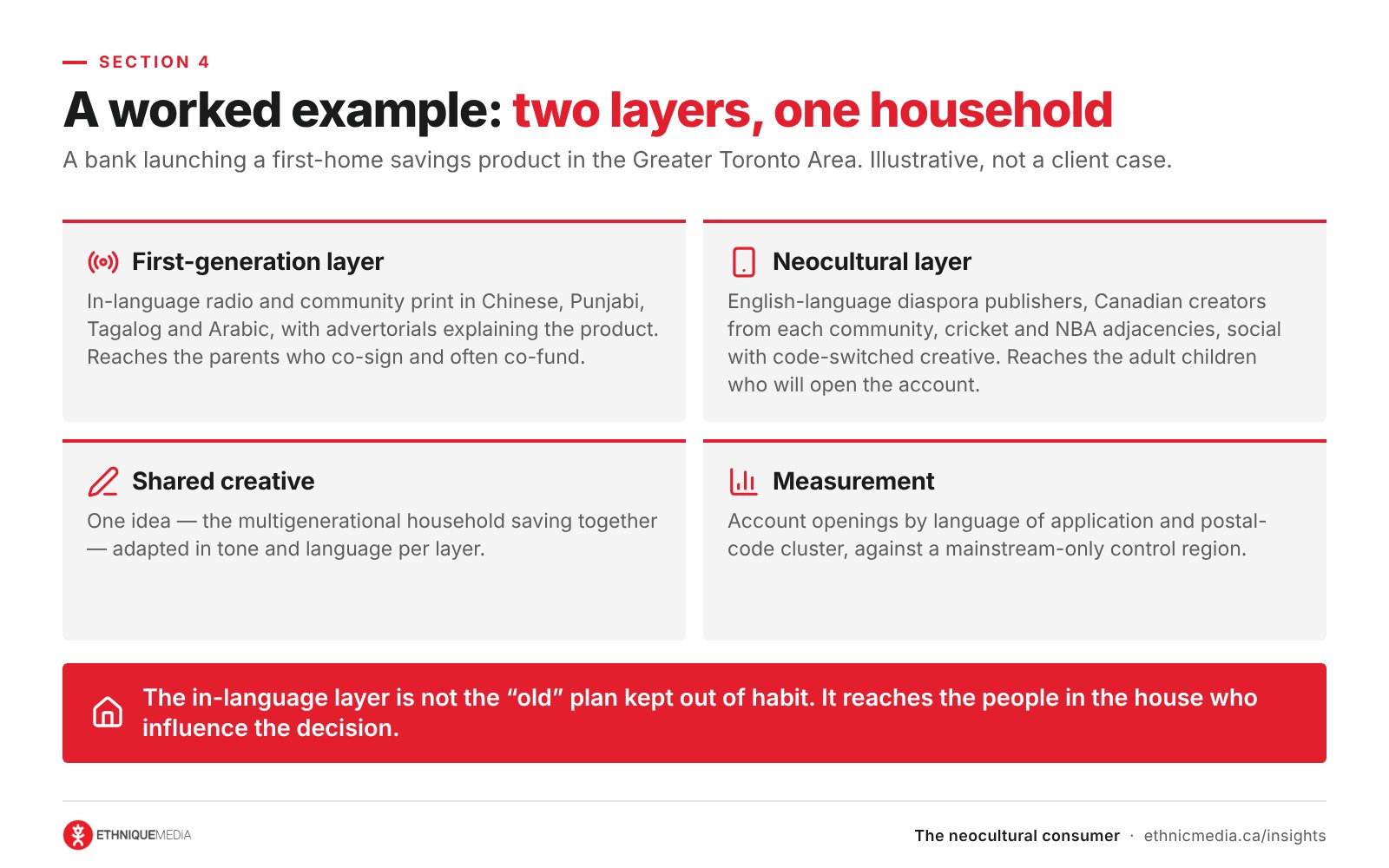
Consider a bank launching a first-home savings product in the Greater Toronto Area, where first- and second-generation Canadians together make up about four fifths of the population. The example is illustrative rather than a client case.
- First-generation layer: in-language radio and community print in Chinese, Punjabi, Tagalog and Arabic, with advertorials explaining the product. This reaches the parents who co-sign and often co-fund.
- Neocultural layer: English-language diaspora digital publishers, Canadian creators from each community, cricket and NBA adjacencies, and social with code-switched creative. This reaches the adult children who will open the account.
- Shared creative: one campaign idea, built around the multigenerational household saving together, adapted in tone and language per layer.
- Measurement: account openings by language of application and by postal-code cluster, compared against a mainstream-only control region.
The in-language layer is not the "old" plan kept out of habit. It is the part of the plan that reaches the people in the house who influence the decision.
5. Why this matters now
The 2026–2028 immigration levels plan holds permanent-resident admissions flat and cuts temporary arrivals sharply. Growth in Canada's multicultural communities over the next decade will come less from arrivals and more from the Canadian-born children of earlier arrivals. The newcomer audience stays important, and the media that serves it stays essential. But the brands that learn to plan for the whole household, first and second generation together, will be planning for where the audience is going rather than where it was. Our community profiles include generational breakdowns for 19 communities across Ontario, British Columbia, Alberta and Quebec; our earlier post on the 2021 Census sets out the underlying demographics.
Sources
- Tsoi, J. (2025, 3 April). Is neocultural the new multicultural? Strategy. [Source for the term and for the Vividata 2024 Multicultural Consumer Study figures.]
- Hou, F., Schimmele, C., & Stick, M. (2023). Changing demographics of racialized people in Canada. Statistics Canada, Economic and Social Reports.
- Statistics Canada, Canada at a Glance, 2023.
- Environics Analytics (2022). Census 2021: Canada's cultural diversity continues to increase.
- Think with Google and MediaCom Canada (2017). Marketing across Canada's multicultural landscape.