Fewer Newcomers, Deeper Audiences: Media Planning After the 2026 Immigration Caps
By Ethnique Media · October 13, 2026
Summary
For most of the past decade, multicultural media planning in Canada had a tailwind that nobody wrote into the brief: every year brought more newcomers than the year before. Telecoms, banks, insurers and retailers could treat arrivals as a renewable pipeline of first-time customers, plan around the airport, the first SIM card, the first bank account and the first winter coat, and let volume take care of the rest. The 2026–2028 Immigration Levels Plan removes that tailwind. Permanent-resident admissions are held flat and the flow of new temporary residents is cut by more than two fifths. This is not a reason to spend less on multicultural media. It is a reason to spend it differently. What follows sets out what changed, what it means for the audiences a plan is buying, and six adjustments to make in 2026 plans.
1. What changed
Three sets of numbers matter for anyone planning a 2026 campaign. All are taken from IRCC's published plan and its November 2025 student-cap notice.
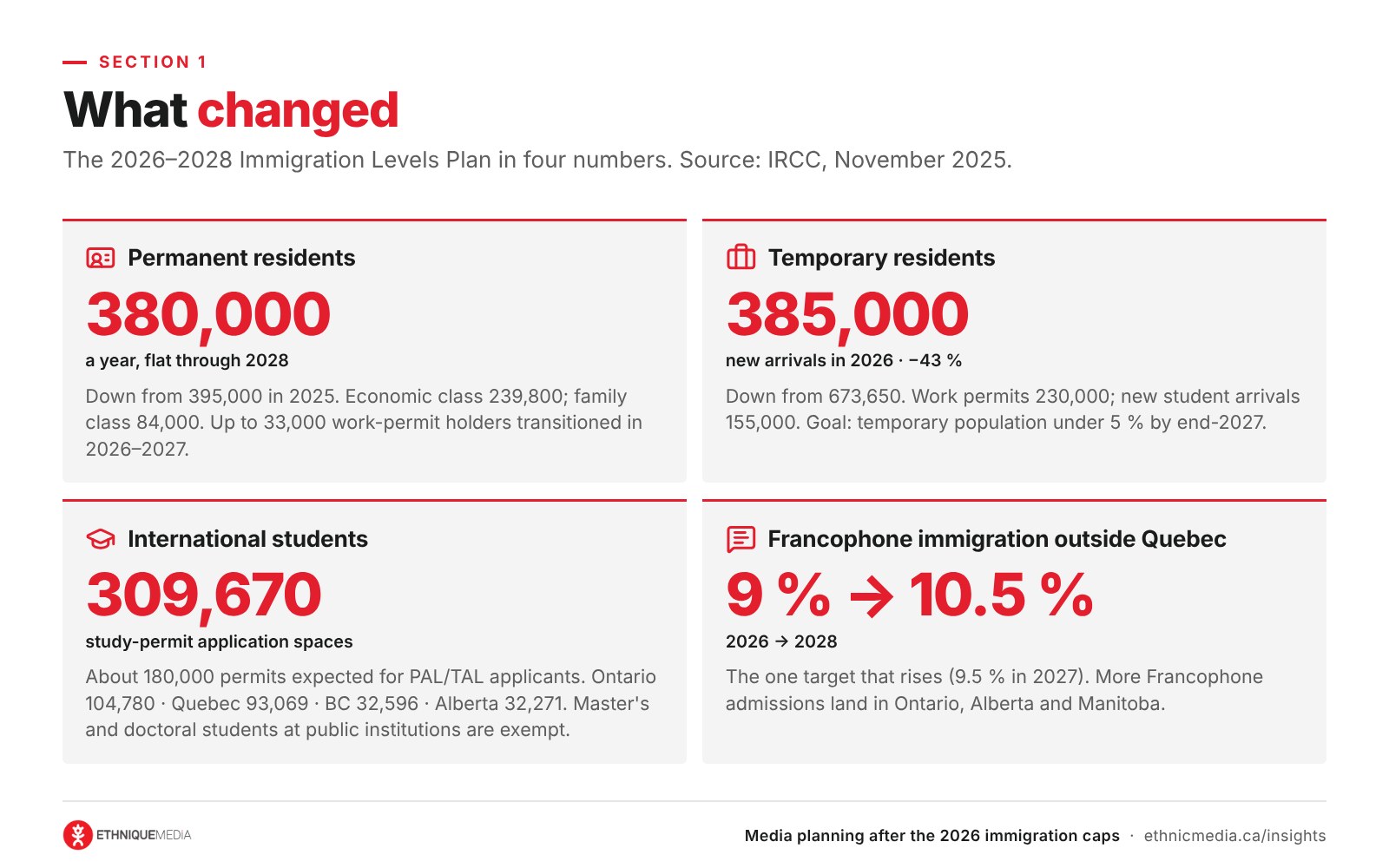
Permanent residents: 380,000 a year, flat through 2028. That is down from 395,000 in 2025, and the first time in years that the target does not rise. Economic immigrants remain the largest group (239,800 in 2026), followed by family-class admissions (84,000). The plan's stated priority is to transition people who are already in Canada, with Canadian work experience, to permanent status; a one-time measure moves up to 33,000 work-permit holders toward permanent residence in 2026 and 2027.
Temporary residents: 385,000 new arrivals in 2026, down 43 per cent. The 2025 target was 673,650. Work permits fall to 230,000 and new international-student arrivals to 155,000, with 370,000 total arrivals pencilled in for 2027 and 2028 (IRCC describes those later figures as notional). The government's goal is to bring the temporary population below five per cent of Canada's total by the end of 2027.
International students: a hard cap on applications. IRCC will accept 309,670 study-permit applications from students who need a provincial attestation letter in 2026, which it expects to turn into roughly 180,000 permits. Ontario receives 104,780 application spaces, Quebec 93,069, British Columbia 32,596 and Alberta 32,271. Master's and doctoral students at public institutions are exempt from the attestation requirement, so the student intake will skew older and toward graduate programmes. (Including extensions and exempt groups, IRCC expects to issue about 408,000 study permits in total; the 155,000 figure above is new arrivals only.)
Francophone immigration outside Quebec is the one target that rises: nine per cent of admissions in 2026, 9.5 per cent in 2027 and 10.5 per cent by 2028.
2. What it means for the audience a plan is buying
The newcomer segment is not disappearing. At 380,000 permanent residents a year, a city the size of Halifax still arrives annually. But the mix shifts, and the mix is what media planning is built on.
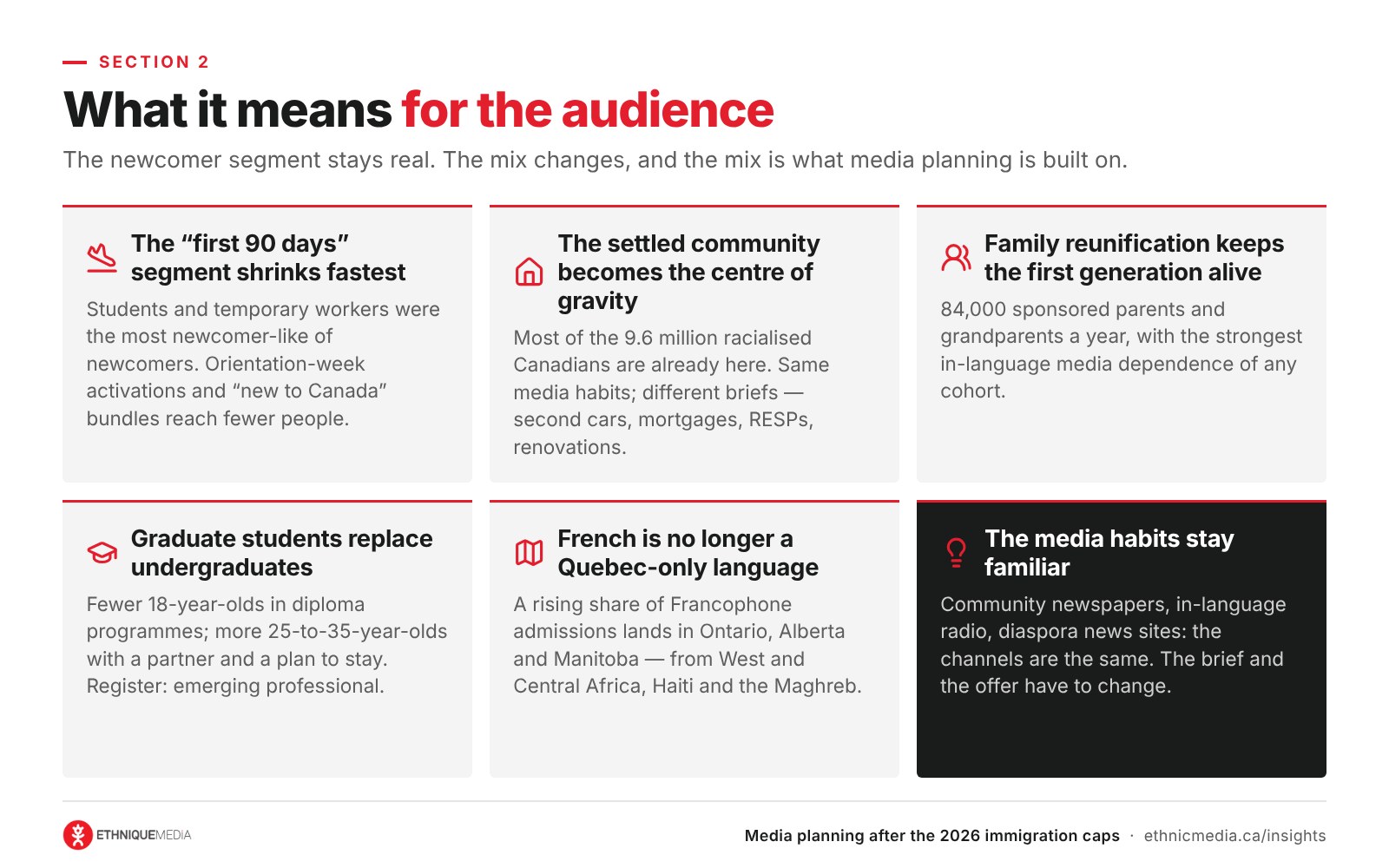
The "first 90 days" segment shrinks fastest. International students and temporary workers were the most newcomer-like of newcomers: young, arriving with nothing set up, highly responsive to in-language offers. A 43 per cent cut to temporary arrivals removes a large part of that segment. Campaigns built around orientation-week activations, student-portal takeovers and "new to Canada" bundles will reach fewer people, and those people will be a smaller share of the community.
The settled community becomes the centre of gravity. Most of the 9.6 million racialised Canadians counted in the 2021 Census are already here, and most of them have been here for years. They still read community newspapers, listen to in-language radio and follow diaspora news sites, but they are buying second cars, mortgages, RESPs and renovations, not first phones. The media habits are the same; the briefs have to change.
Family reunification keeps the first-generation audience alive. Parents and grandparents sponsored under the family class arrive with the strongest in-language media dependence of any cohort, and they are the audience community print and radio serve best. Eighty-four thousand family-class admissions a year is a meaningful, stable flow for health, pharmacy, financial-services and government communicators.
Graduate students replace undergraduates. The exemption for master's and doctoral students changes who walks onto campus: fewer 18-year-olds in diploma programmes, more 25-to-35-year-olds with a partner, a research stipend and a plan to stay. For banks, telecoms and auto brands, the right register is emerging professional, not budget survival.
French is no longer a Quebec-only language. A rising share of Francophone admissions is landing in Ontario, Alberta and Manitoba, many from West and Central Africa, Haiti and the Maghreb. Media plans that equate "French" with "Montréal" will miss them.
3. Six adjustments to make in 2026 plans
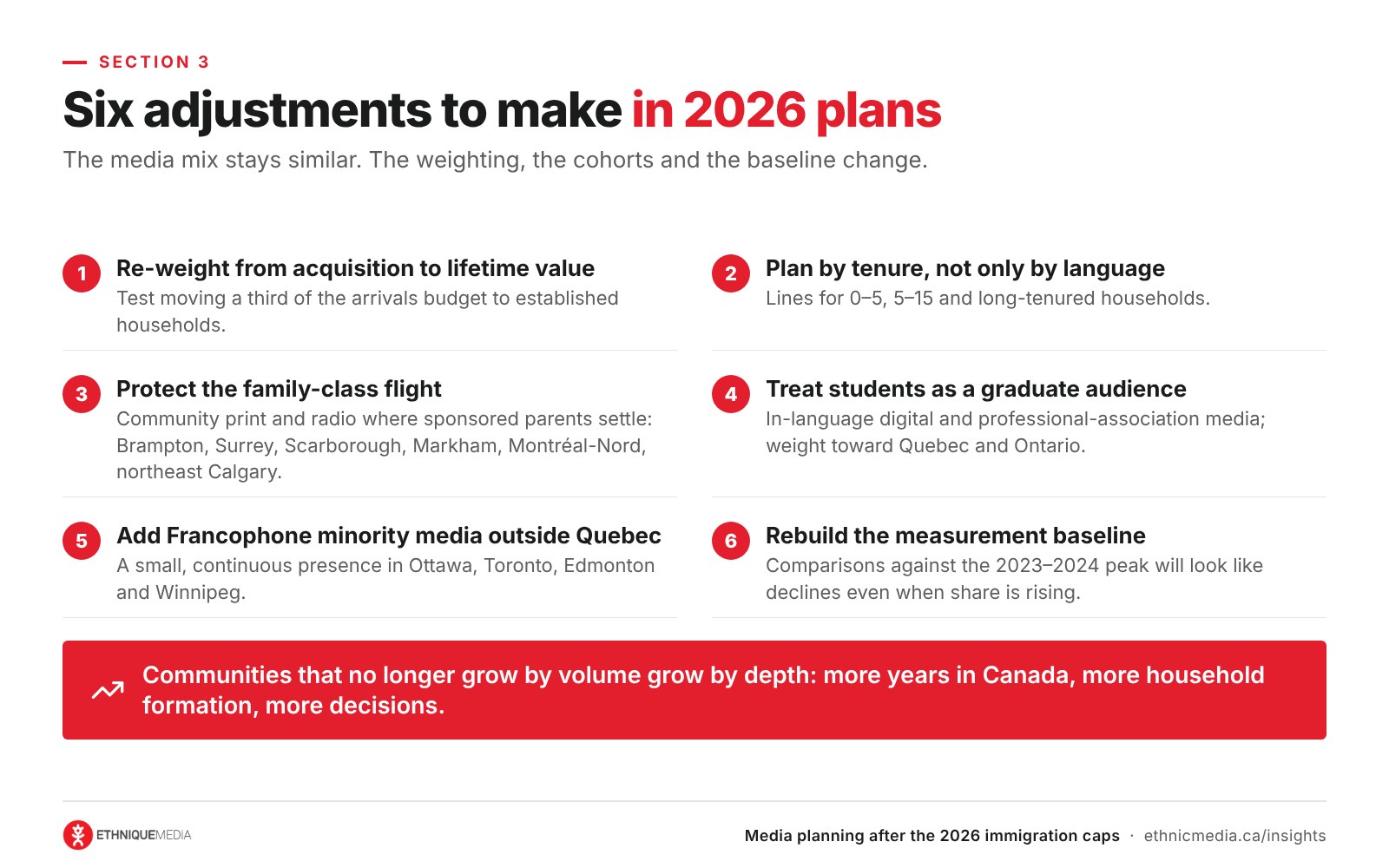
- Re-weight from acquisition to lifetime value. Where 60 per cent of last year's multicultural budget was aimed at arrivals, test moving a third of it to established households. The media mix stays similar; the offer and the creative change.
- Plan by tenure, not only by language. Build audience lines for newcomers (0–5 years), established households (5–15 years) and long-tenured households. Our community profiles for 19 communities show where each cohort lives and which outlets they trust.
- Protect the family-class flight. Keep a steady presence in community print and in-language radio in the markets where sponsored parents settle: Brampton, Surrey, Scarborough, Markham, Montréal-Nord, northeast Calgary. These are the channels sponsors use to help their parents navigate Canada.
- Treat students as a graduate audience. Shift from campus posters and student-union partnerships toward in-language digital, professional-association media and the diaspora news sites that graduate students read. Weight toward Quebec and Ontario, which hold two thirds of the 2026 application spaces.
- Add Francophone minority media outside Quebec. Francophone African and Haitian communities in Ottawa, Toronto, Edmonton and Winnipeg have their own community outlets and radio programmes. Budget a small, continuous presence rather than a Quebec-only French buy.
- Rebuild the measurement baseline. Year-over-year comparisons against 2023–2024, the peak arrival years, will look like declines even when share is rising. Reset benchmarks to a stable-admissions world before the first-quarter report lands.
4. The opportunity
Flat admissions mean a flat pool of first-time buyers, and that makes every brand's existing multicultural customers worth more. Communities that no longer grow by volume grow by depth: more years in Canada, more household formation, more income, more decisions. The media that reaches those households has not changed. Our directory of more than 200 outlets still carries the same community newspapers, radio programmes, television channels and news sites, with audiences that are now more settled and more valuable. The planners who adjust first will find that a smaller newcomer wave is a better customer base.
Sources
- Immigration, Refugees and Citizenship Canada, Supplementary Information for the 2026–2028 Immigration Levels Plan (November 2025).
- Immigration, Refugees and Citizenship Canada, 2026 provincial and territorial allocations under the international student cap (25 November 2025).
- Statistics Canada, Canada at a Glance, 2023 — racialised population, 2021 Census.
- Hou, F., Schimmele, C., & Stick, M. (2023). Changing demographics of racialized people in Canada. Statistics Canada, Economic and Social Reports.