WeChat or Xiaohongshu: Which One Reaches Your Audience?
By Ethnique Media · October 5, 2026
Summary
Most of our clients reach Chinese-Canadian audiences without owning anything on either platform. What follows sets out the two placements that make this possible, what each one actually delivers, and why they are not interchangeable. Readers who want to build and run their own presence on Xiaohongshu will find that covered in Part 1 and Part 2 of our Xiaohongshu playbook; this article is about buying placement from publishers who already have one.
1. Two ways to buy placement on WeChat
WeChat advertising can be bought two ways, and which one applies depends on what the advertiser already holds.
The platform's own product. Tencent sells an in-article banner through the Official Account backend and the Tencent advertising portal. It is opened by companies with a Chinese business registration, or by foreign companies through manual authorisation from Tencent's customer service, and it comes with targeting options and platform-reported delivery. For an advertiser with a corporate presence in China, this is the straightforward route.
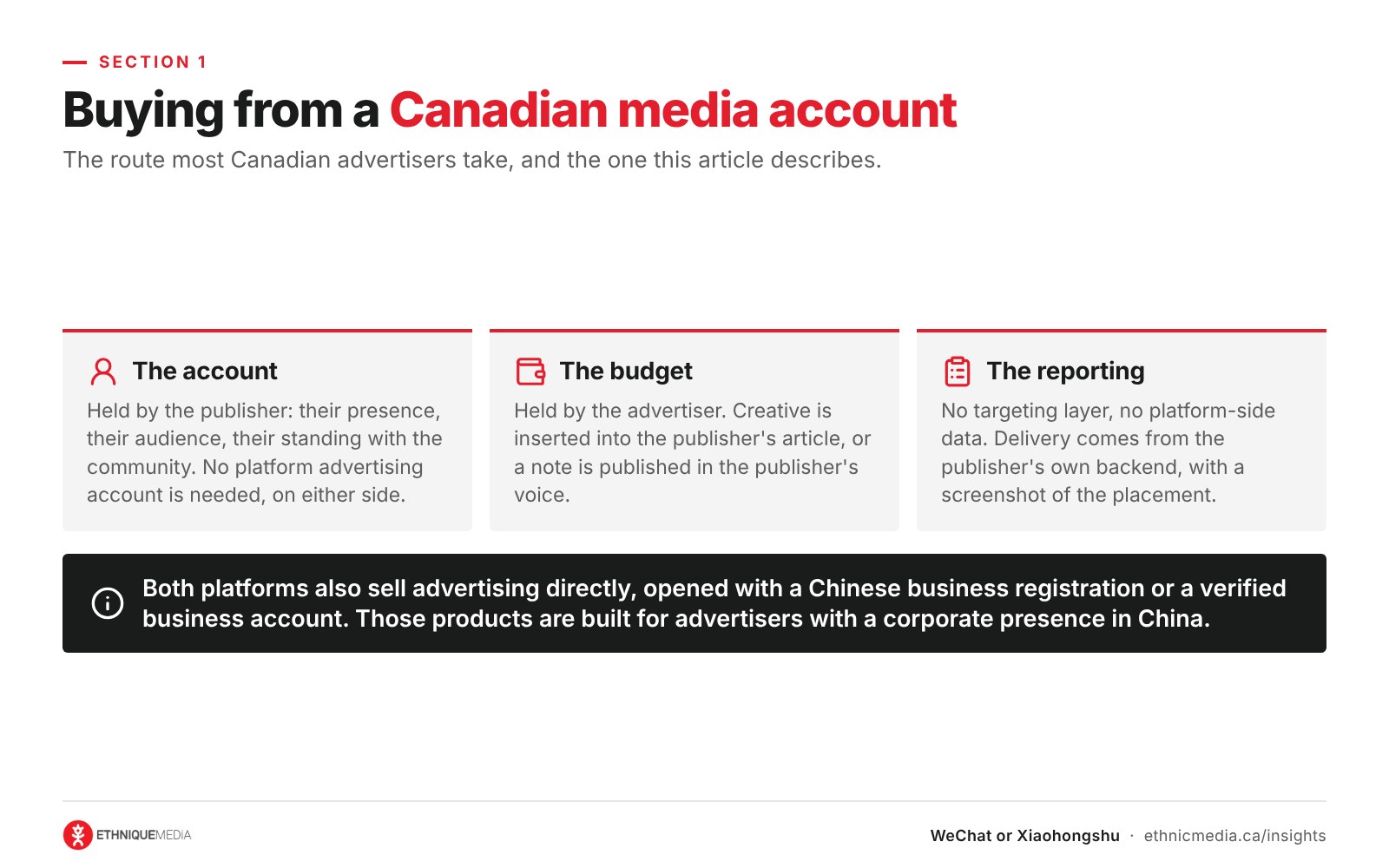
Direct from a Canadian media account. The second option is to buy placement from a Chinese-language media account operating here, which already holds the account, the audience and the standing with the community. The publisher inserts supplied creative into the body or foot of an article published by their own account. No platform advertising account is required at any point, in either direction.
The second option is the one most Canadian advertisers use, not as a substitute for the first but because it matches how they are set up. It is also a materially different product: the publisher is the ad server, there is no targeting layer and no platform-side reporting, and delivery comes from the publisher's own backend with a screenshot of the placement. The rest of this article describes that buy, and its Xiaohongshu equivalent — a note published by the same kind of account in its own voice.
A word on names. Xiaohongshu (小红书) is known in English as Little Red Book and, since early 2025, as RedNote. We use Xiaohongshu throughout, as in the rest of this site.
2. What is actually being bought
On WeChat, two formats.
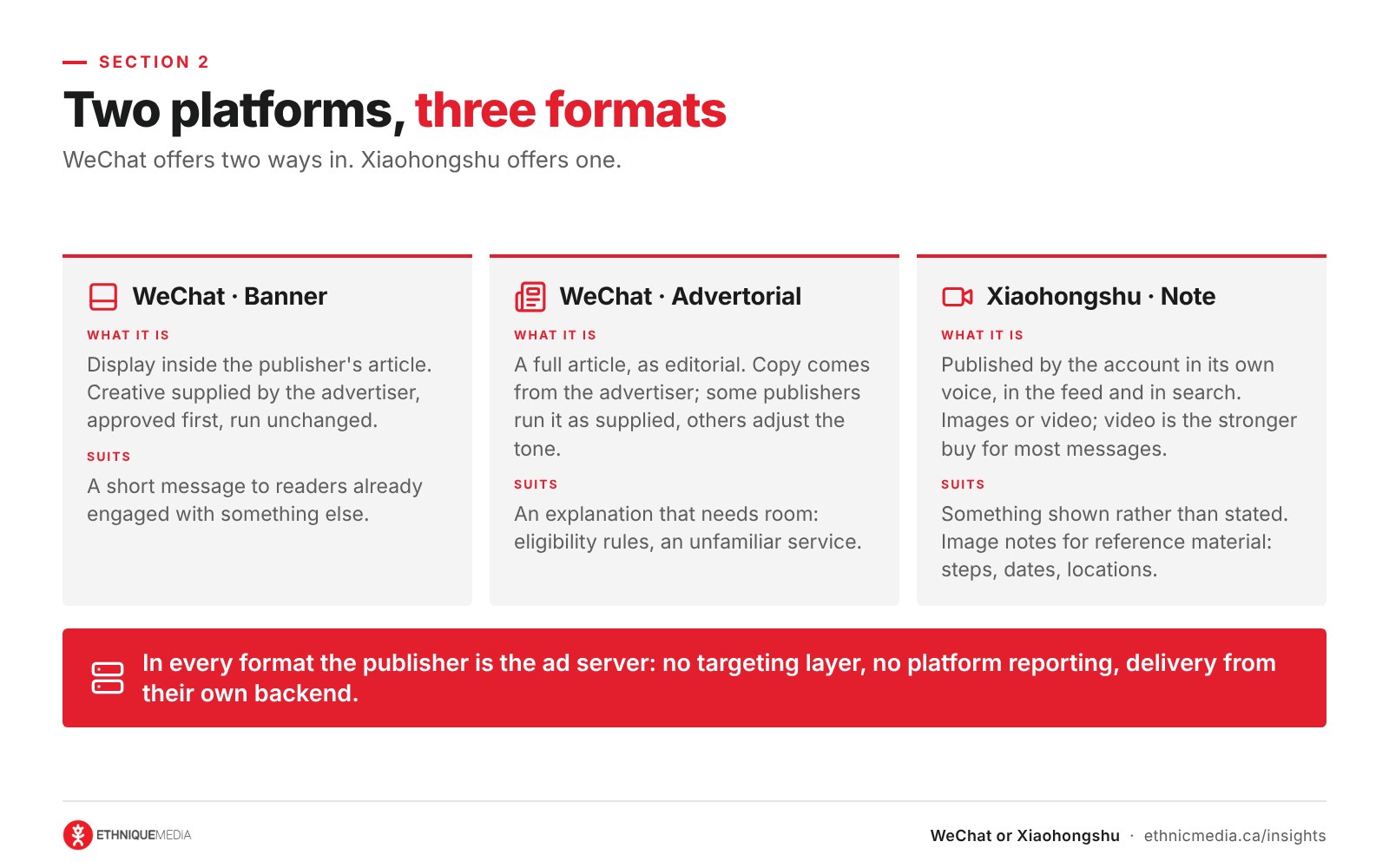
The first is a banner insertion. Creative supplied by the advertiser is placed by the publisher into the body or the foot of an article published by their own account. The article itself is the publisher's editorial; the advertiser occupies a defined space inside it. The creative is approved before placement and runs unchanged, which makes it the simpler of the two to clear through a review cycle.
The second is an advertorial: a full article written and published as editorial, about the advertiser's subject, in the publisher's own voice and format. It occupies the whole piece rather than a space within one, carries the publisher's framing, and is read the way their other articles are read. It requires drafting, review and agreement on how the commercial relationship is disclosed, and it asks considerably more of both parties than a banner does.
The two formats answer different briefs. A banner carries a short message to readers already engaged with something else. An advertorial carries an explanation that needs room — a programme with eligibility rules, a service people do not yet understand, an announcement that requires context before it makes sense.
On Xiaohongshu, notes — and video first.
A note may be images or video, and both are bought the same way: published by the media account in its own voice, appearing in the feed and in search alongside organic content.
Video is the format worth recommending. It holds attention longer in a feed built for it, it carries tone and personality in a way a static image cannot, and it suits the platform's register, where audiences respond to something demonstrated rather than stated. Image notes still have a role — they perform where the content is reference material a reader wants to scan or return to, such as a list of steps, dates or locations — but for most campaign messages the video note is the stronger buy.
In both WeChat formats and both Xiaohongshu formats, the publisher is the ad server. There is no targeting layer and no platform-side reporting. Delivery comes from the publisher's own backend, supported by a screenshot of the published placement.
3. The two placements reach readers in different modes
Both placements reach Chinese-Canadian audiences, and it is tempting to file them as alternatives serving the same purpose. They do not.
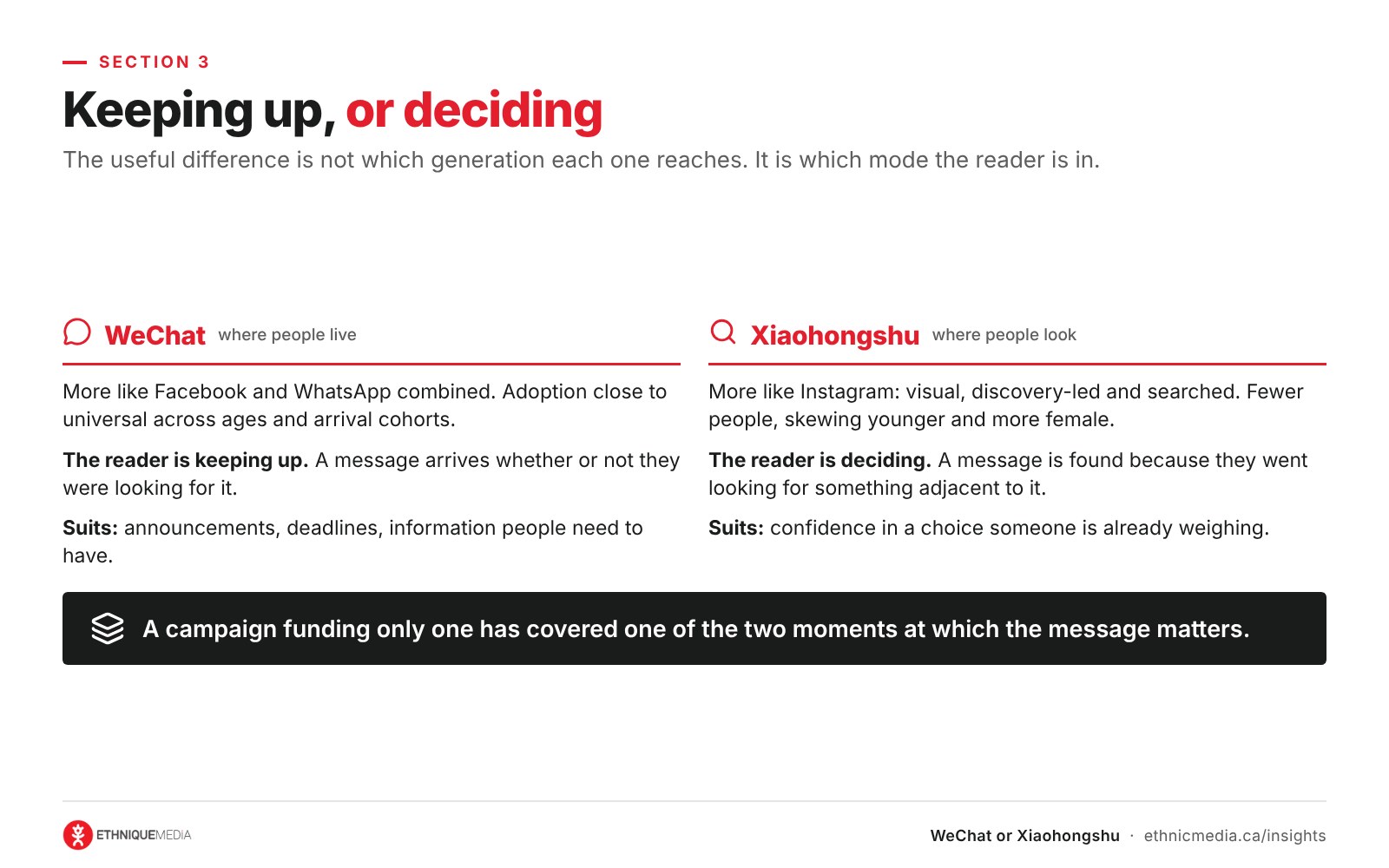
The quickest way to orient is by comparison. WeChat is more like a combination of the functions of Facebook and WhatsApp: messaging with family and colleagues, a feed of posts, news from accounts people follow, payments, and much of the administrative business of daily life. Xiaohongshu is more like Instagram — visual, discovery-led, used to browse and to search rather than to keep in touch.
The comparison is approximate and should be used as a starting point rather than a description, but it conveys the thing that matters: one is where people live, and the other is where people look.
WeChat's adoption is close to universal across ages and arrival cohorts, which makes it the nearest equivalent the community has to a mass medium. An article from a Chinese-language news account is read the way people read any news, as part of keeping up, alongside everything else arriving in the same app. Reach there is broad rather than selective. The audience is not a segment of the community; it is substantially the community, encountered while they are doing something else.
Xiaohongshu reaches fewer people and reaches them differently. It is consulted before a decision rather than for keeping up, and its user base skews younger and more female. People open it to find out whether something is worth doing, where to go, what to expect — and they search it, which is the behaviour that distinguishes it most sharply from a feed.
The useful distinction is therefore not which generation each placement reaches. It is which mode the reader is in.
On WeChat the reader is keeping up. A message arrives whether or not they were looking for it, which suits announcements, deadlines, and information people need to have rather than information they are seeking.
On Xiaohongshu the reader is deciding. A message is found because they went looking for something adjacent to it, which suits building confidence in a choice someone is already weighing.
The planning consequence follows directly. The two are not substitutes, and a campaign funding only one has not reached a smaller version of the same audience — it has covered one of the two moments at which the message matters. Where budget allows, WeChat carries the reach and the deadline, and Xiaohongshu waits in search for the person who heard the message and went looking for more.
4. Interruption versus content
The WeChat banner is display advertising inside an editorial environment. The advertiser's own creative, the advertiser's own words, encountered while the reader is doing something else. It interrupts.
The Xiaohongshu note is the content. It is not encountered alongside the thing the audience came for; it is the thing the audience came for.
This single distinction drives the differences in control, credibility, approval workload and compliance risk set out below.
5. Lifespan: a push and a searchable asset
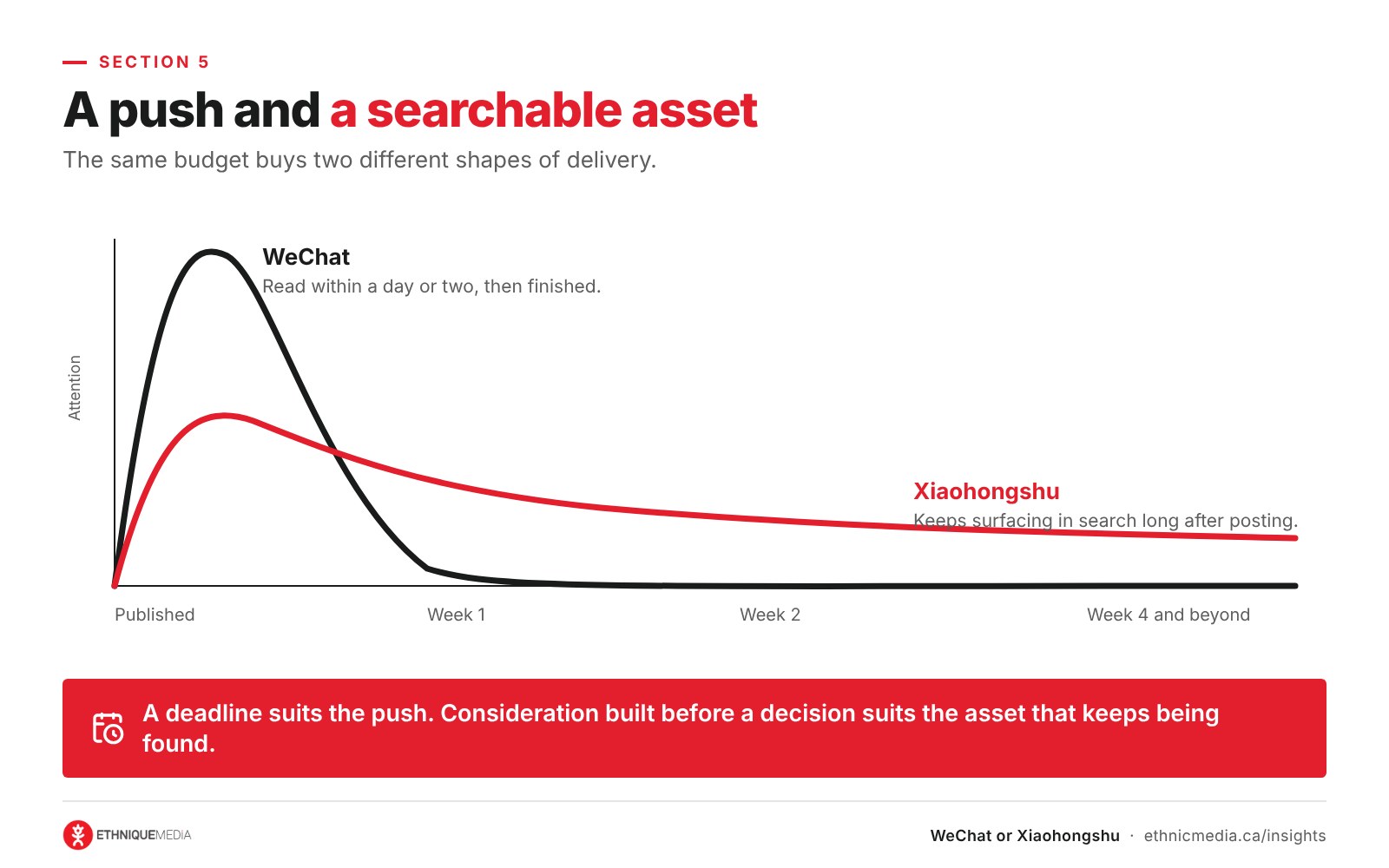
A WeChat article is a push. It is delivered, read within a short window, and then effectively finished. Archives are rarely browsed.
A Xiaohongshu note is discoverable. It persists in the feed and then in search, where the platform's users actively look for recommendations before making decisions — often weeks or months after publication.
The same budget therefore buys a concentrated spike in one case and a shorter spike with a long tail in the other.
This maps cleanly onto campaign type. Where a campaign has a deadline — an application window, an enrolment date, a registration period, an event — the push model fits the shape of the task. Where a campaign builds consideration for something audiences research before acting, the searchable asset is worth more than its initial impressions suggest.
6. Control against credibility
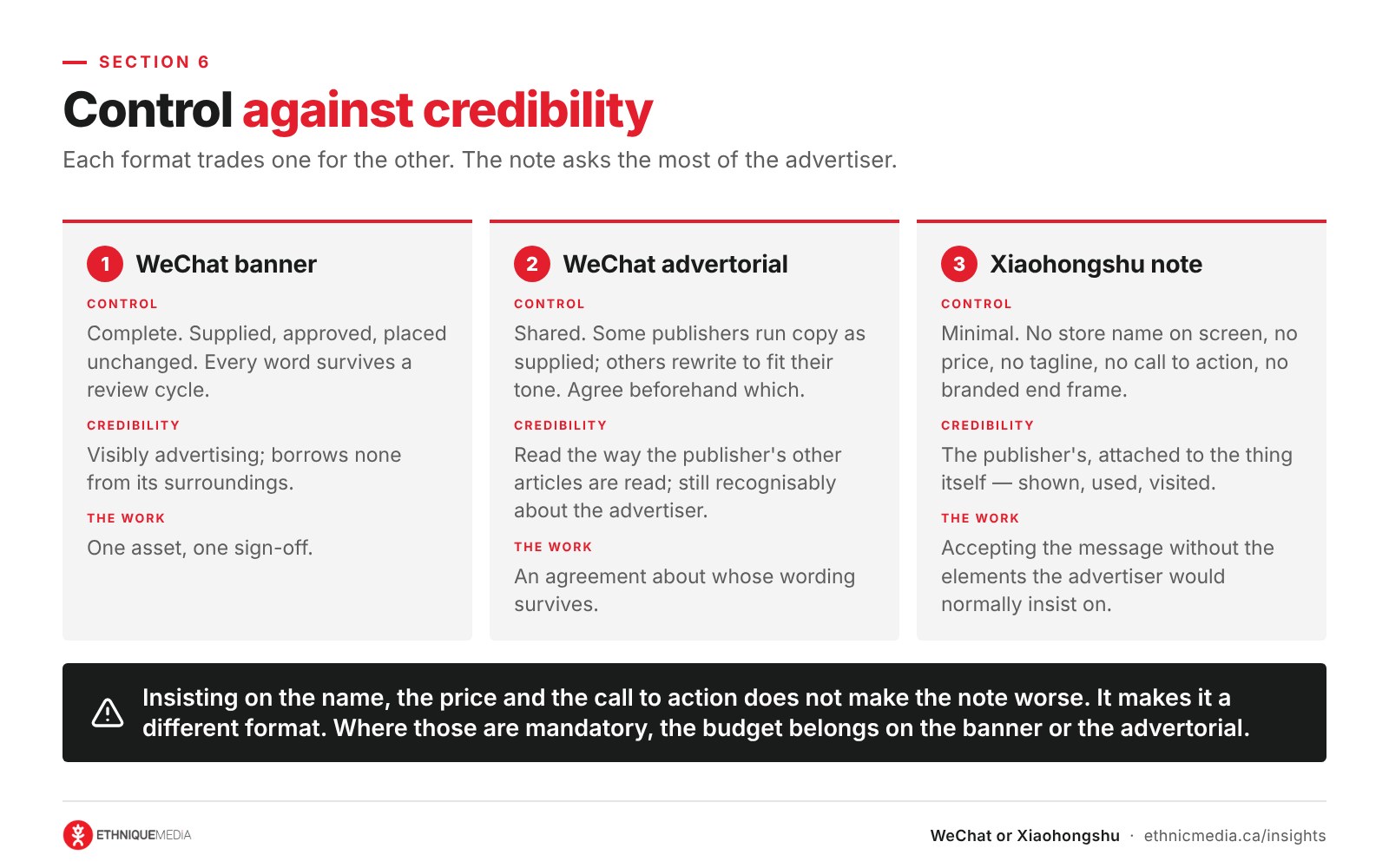
The WeChat banner offers complete creative control. The creative is supplied, approved and placed unchanged. For government and regulated advertisers, where every word passes a review cycle, this matters more than any performance consideration. The cost is that it is visibly advertising, and borrows no credibility from its surroundings.
The WeChat advertorial sits in the middle. The article comes from the advertiser. Some publishers run it as supplied; others rewrite it to fit the tone of their own account. Either way it remains recognisably a piece about the advertiser, and the brand, the offer and the details can appear in it plainly.
How much a publisher will rewrite is not uniform, and for an advertiser whose copy has already cleared a legal or government review, "rewritten to fit the tone" is a problem rather than a service. Where approved wording must survive intact, that should be agreed with the publisher before the article is submitted, rather than discovered when it publishes.
Xiaohongshu sits at the far end, and the constraint is more severe than clients expect.
A Xiaohongshu note has to read as something a person filmed and posted, not as something an advertiser commissioned. In practice that means no store name on screen, no price, no tagline, no call to action, no branded end frame — none of the elements a marketing team would consider the minimum content of an advertisement. The video has to look like someone happened to be there, found it worth sharing, and shared it.
This is not a stylistic preference. It is what the format requires in order to work. The platform's own guidance is that advertising should be visually indistinguishable from high-performing organic content rather than polished brand collateral, and its users punish hard-sell framing directly, by scrolling past.
The consequence for planning is worth stating plainly, because it is where client conversations tend to break down. An advertiser who insists on the name, the price and the call to action has not made the note worse. They have made it a different format, which the platform will treat accordingly. Where those elements are mandatory, the budget belongs on the banner or the advertorial instead.
What remains available on Xiaohongshu is the thing itself — shown, used, visited, experienced — with the publisher's credibility attached to it. The brand is identified through disclosure labelling rather than through branding, and the viewer who wants the name searches for it. On a platform people use for research before deciding, that is a real path to action. It is slower, and it cannot be forced.
For approval-heavy advertisers, each format therefore carries a different kind of work. The banner requires one asset and one sign-off. The advertorial requires an agreement about whose wording survives. The note requires accepting that the approved message will appear without the elements the advertiser would normally insist on.
7. Compliance is not symmetrical
A banner is self-evidently an advertisement, so disclosure is inherent in the format.
A sponsored note is not, and both the platform and the applicable law have tightened around exactly this. Xiaohongshu requires sponsored content to be disclosed using 广告 (advertisement) or 合作 (collaboration) labels, consistent with requirements that advertising be clearly identifiable and distinguishable from organic content. Creator posts bought through the platform's official marketplace still require honest disclosure; looking organic is not a legal strategy.
Enforcement is active. The platform requires AI-generated content, scripted scenarios and reposted material to be declared through platform functions, and its periodic enforcement notices report thousands of non-compliant notes handled and accounts restricted or closed for undeclared commercial content.
Content restrictions apply alongside disclosure. Superlative claims such as "best", "highest level" or "national level" are prohibited under China's Advertising Law, advertising in pharmaceutical, medical device and health food categories requires regulatory approval before publication, and education advertising may not guarantee outcomes or qualifications.
Canadian disclosure obligations apply in addition, because the audience is here. The practical rule is simple: label it, in both languages' conventions, every time.
8. What each placement can and cannot deliver
Neither placement should be planned as a traffic driver.
WeChat's restrictions on external links are long-standing and well documented, covering both the content of links and their source, and platform guidance is that advertising directing users to external websites tends to underperform compared with advertising that keeps users inside the ecosystem, because of the friction involved. In practice the response path is a QR code in the creative, a link at the foot of the article, or no direct path at all — the reader remembers the brand and searches for it later.
Neither placement carries third-party verification. No independent impression count, no viewability measurement, no fraud detection. WeChat delivers a publisher-reported read count and a screenshot of the published placement. Xiaohongshu delivers views and engagement, where saves are a more meaningful signal than likes because a save records intent to act later.
The reporting expectation therefore has to be set before the campaign rather than defended afterwards. These are reach, recall and search-lift placements, measured through publisher-reported delivery, engagement quality and branded search activity. They are not measured through sessions in the advertiser's own analytics, and a plan that implies otherwise creates a dispute it could have avoided.
9. Choosing between them
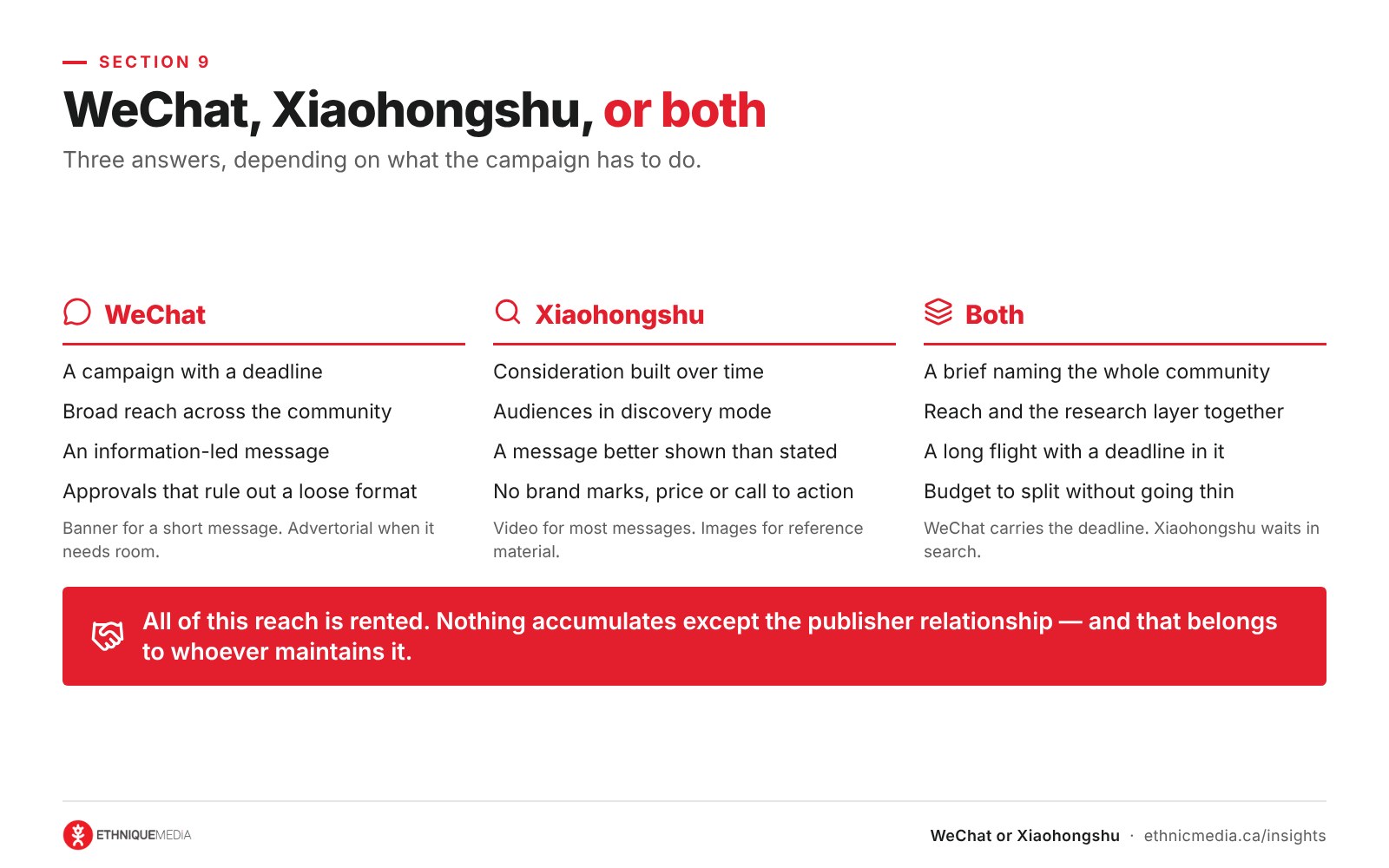
The WeChat banner suits campaigns with a deadline, broad reach across the community rather than a particular segment of it, information-led messages, and advertisers whose approval requirements make a loosely controlled format impractical.
The WeChat advertorial suits messages that need room to explain — eligibility rules, a service people don't yet understand, an announcement requiring context — where the advertiser supplies the copy and wants it to read as editorial.
The Xiaohongshu note suits consideration built over time, audiences in discovery mode, messages better shown than stated, and advertisers who can accept their message appearing without brand marks, price or a call to action.
Running them together suits any campaign whose brief names the community as a whole, because WeChat delivers the reach and Xiaohongshu delivers the research layer people consult before acting.
10. Conclusion
WeChat and Xiaohongshu are not two versions of the same buy. WeChat reaches the community broadly, while people are keeping up with the day, and offers two formats with different amounts of room: a banner for a short message, an advertorial for one that needs explaining. Xiaohongshu reaches fewer people, in a different moment — when they are researching a decision — and asks the advertiser to give up the brand marks, the price and the call to action in exchange for being believed.
Choosing between them is a question about what the campaign has to do, not about which platform is larger. A deadline wants WeChat. A decision being weighed wants Xiaohongshu. A brief naming the community as a whole wants both, because it has described two moments and will otherwise fund one.
One reminder worth carrying into the next plan. All of this reach is rented. Neither placement builds anything the advertiser keeps: no followers accumulate, no owned content remains, no audience can be retargeted, and the next campaign starts from the same position as this one.
What does persist is the relationship with the publisher — their account, their audience, their willingness to run copy as approved, and their track record of delivering what they said they would. That relationship is the asset, and it belongs to whoever maintains it rather than to whoever paid for the last placement.
For advertisers who will return to these communities repeatedly — governments, health authorities, educational institutions, financial services — that is worth recognising at the planning stage rather than at the fourth campaign.
Sources
- Tencent, WeChat Official Account advertising access requirements and external link guidance.
- Xiaohongshu advertising and creative documentation; disclosure, declaration and enforcement notices.
- Advertising Law of the People's Republic of China: provisions on identifiability, prohibited claims and restricted categories.
- Competition Bureau Canada and Ad Standards, guidance on influencer marketing and disclosure.