Part 2. Growing Your Brand on Xiaohongshu: Advanced Strategies for Canadian Businesses
By Ethnique Media · September 23, 2026
This is the second installment of our Little Red Book strategy series, tailored for Canadian marketing teams. Part 1 covered Xiaohongshu’s basics and why it matters; Part 2 dives into practical steps for account setup, influencer collaborations, advertising tools, analytics, common pitfalls, and advanced tactics.
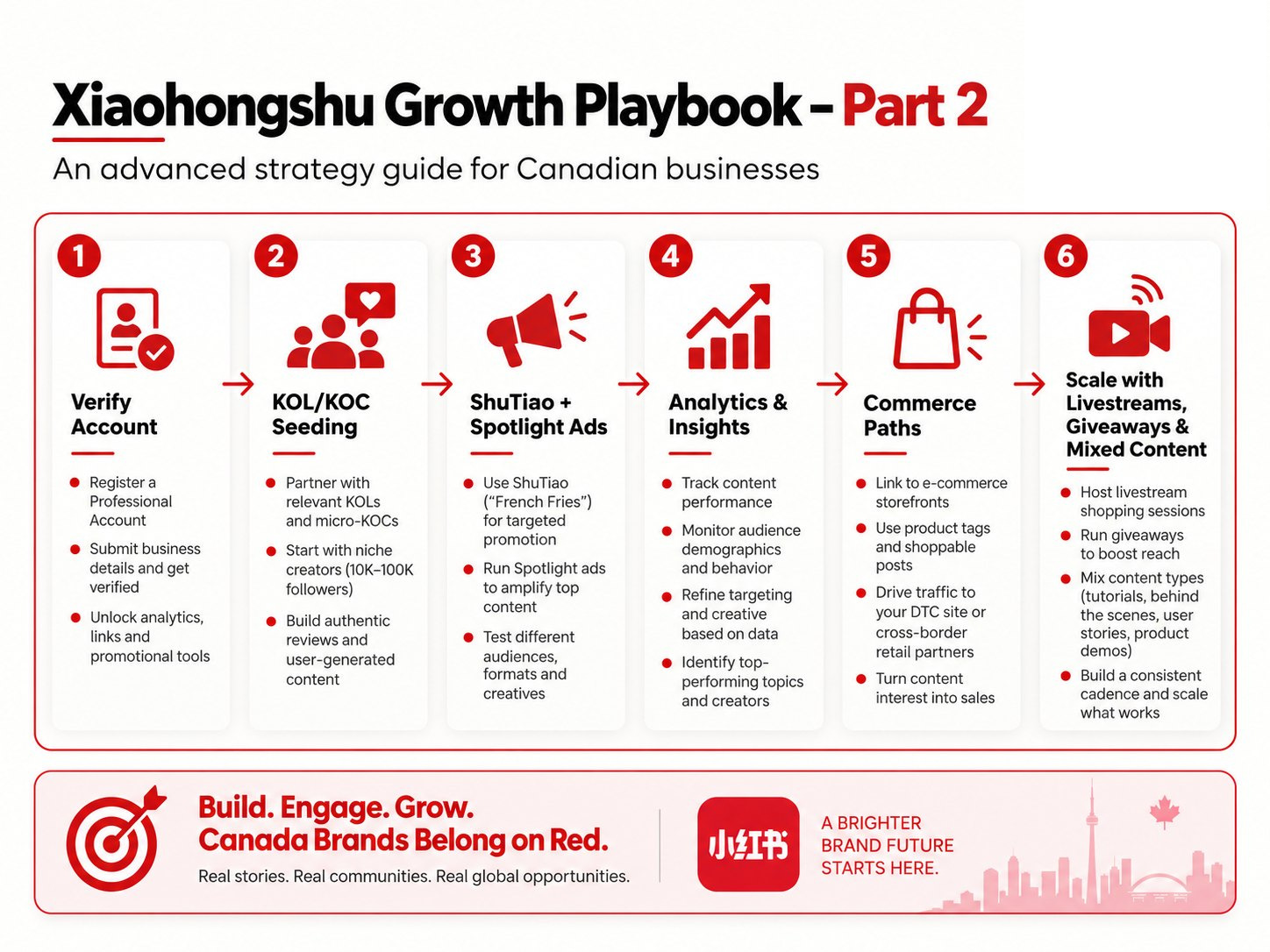
1. Account Verification for Canadian Brands
Before leveraging Xiaohongshu’s full potential, Canadian brands should upgrade to a verified Business Account (often called a “Professional” account, denoted by a blue badge). Verification unlocks crucial features – e.g. access to ads, in-app shops, analytics, and giveaway tools – that regular personal accounts lack. Here’s how to get verified and what you’ll need:
- No Chinese Business License? No Problem: Xiaohongshu does allow foreign business licenses for verification. A Chinese business registration is not mandatory – you can submit your Canadian (or other foreign) business license to register your brand account. In other words, Canadian companies can apply directly using their local incorporation documents.
- No Chinese Phone Number Needed: You can sign up with an international phone number. When registering your personal account in the app, simply select your country code (e.g. Canada +1) and enter your number to receive a verification SMS. Many overseas users have successfully created accounts with foreign numbers (e.g. a Canadian mobile) without issue.
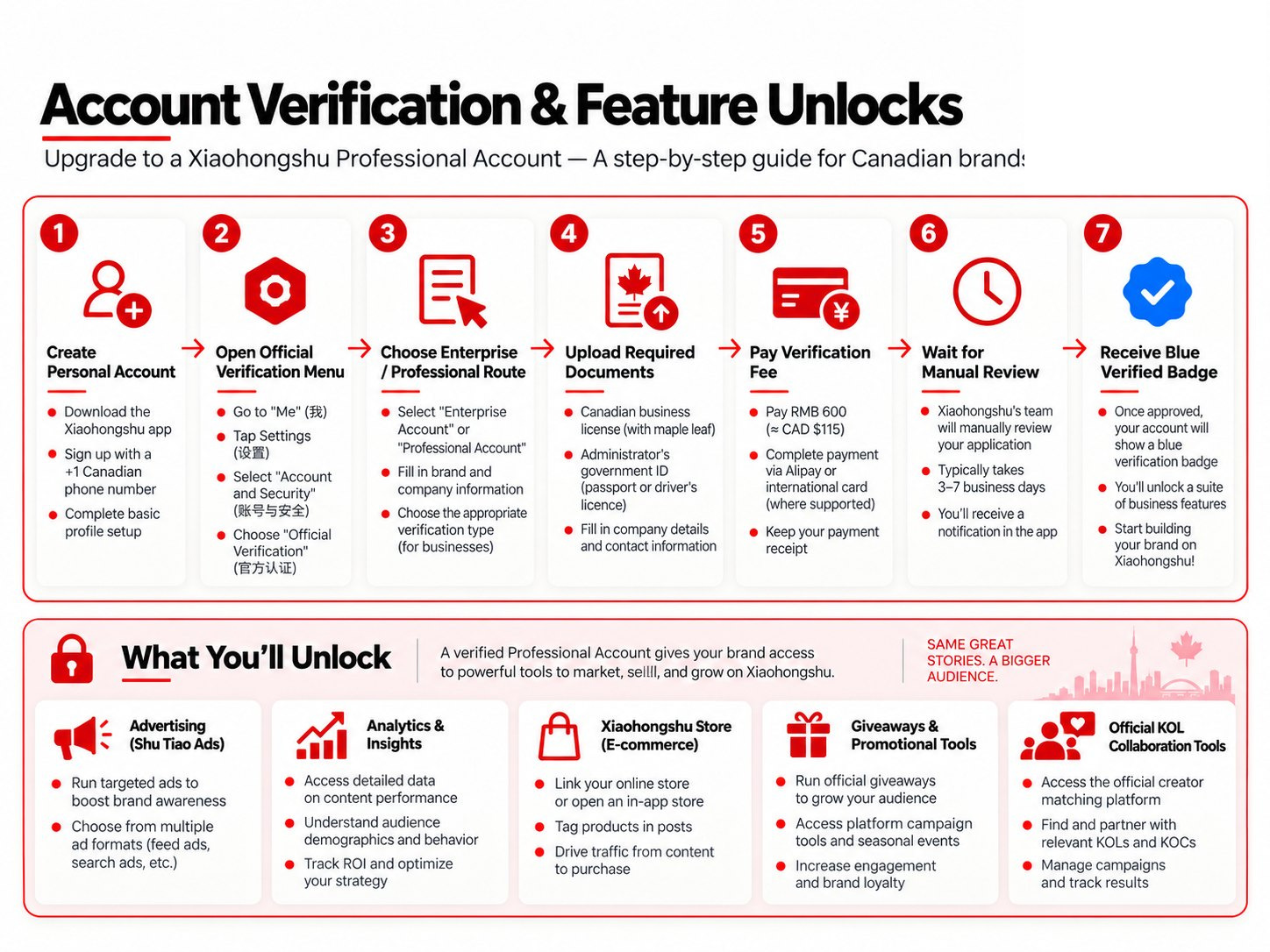
Step-by-Step Verification Process (done via the Xiaohongshu mobile app):
- Create a Personal Account: Download the Xiaohongshu app and sign up (via phone, Apple ID, WeChat, etc.). Using your phone number is recommended for simplicity. After basic onboarding (gender, age, interests, etc.), you’ll have a personal account.
- Access Verification Menu: In your profile, go to Settings → Account Security → Official Verification. This is where you start the upgrade to a professional account.
- Choose Account Type: You’ll see options depending on your entity. Select the appropriate category for your brand. For example, companies (enterprises) choose the “Enterprise” verification option (individual influencers would use a different path). Overseas attractions or organizations have their own category as well.
- Select Features Needed: Xiaohongshu may ask your purpose – e.g. do you plan to open an Xiaohongshu store, run promotions, or both? Choose based on your needs. (You can opt for both e-commerce and content promotion capabilities if relevant.)
- Submit Documents & Fee: Fill in your brand information and upload the required documents. Typically this includes your business license (yes, a Canadian business license is acceptable) and an official identity document for the account owner/admin. Once everything is filled, you’ll pay a verification fee of RMB 600 (about $120 CAD). Payment can usually be made in-app via accepted methods (some brands use a Chinese bank card or ask an agency to help with this fee if they cannot pay directly).
- Approval Waiting Time: Verification is a manual review process. Expect it to take up to a few weeks (Dragon Trail notes it “will take no longer than a month”, but often it’s a couple of weeks in practice). During this period, Xiaohongshu may vet your documents and online presence.
- Profile Setup: Once approved, your account will sport a blue “V” badge indicating a verified business. At this stage, complete your profile with a brand-appropriate name and bio (note: your account name should match your official company/brand name; overt marketing phrases or external links are not allowed in the name/bio). You can now also add a profile picture (usually brand logo) and other details. Tip: Keep the bio in Chinese, succinct, and informative – e.g. brand tagline or key products – but avoid putting any URLs or external handles here, as Xiaohongshu profiles cannot include clickable external links and may remove obvious link text.
With a verified account, you now hold a “ticket” to commercial activity on Xiaohongshu. This means you can:
- Run Ads and Promotions: Your account can utilize paid advertising tools and boost posts (details in Section 3).
- Open a Xiaohongshu Store: Verified businesses can apply to set up an in-app shop to sell products directly. (Note: certain regulated categories like cosmetics or health require additional Chinese certifications – if you plan to sell those, ensure you obtain the necessary permits.)
- Access Analytics: You’ll unlock the business analytics dashboard to track performance (see Section 4).
- Host Giveaways/Lucky Draws: Business accounts gain the ability to run official giveaway campaigns (抽奖) to engage followers.
- Collaborate Officially with KOLs: You can use Xiaohongshu’s influencer collaboration platform once verified (covered next).
For tourism boards or government entities: There may be a separate verification route. For example, tourism boards have an “overseas government” verification process before upgrading to Business Pro. If you represent such an entity, be prepared for possibly extra steps (often involving proof of government status).
Overall, Canadian brands should prioritize verification early. Not only does the blue badge lend credibility, it’s essentially required to fully market on the platform. Without it, many functions are off-limits, and you’d be stuck as a basic user with no ability to run ads or open a store. Invest the time and the ~$120 – it’s a one-time cost to unlock Xiaohongshu’s business features.
2. Collaborating with Influencers (KOLs/KOCs) on Xiaohongshu
Influencer marketing is the heart of Xiaohongshu success. As covered in Part 1, users on this platform trust peer recommendations far more than brand-direct content. Key Opinion Leaders (KOLs) and Key Opinion Consumers (KOCs) drive trends and product “seeding” (“种草”, literally “planting grass”, meaning to spark desire) on RED. Brands – especially new entrants – should leverage these creators to build awareness and credibility.
Why KOLs/KOCs matter: Users often search Xiaohongshu for real reviews and experiences. They “don’t want to hear from brands; users want to hear from users”. In practice, a consumer considering your product will likely scroll through dozens of influencer posts and user comments about it before even visiting your official page. Personal endorsements feel more authentic than any corporate ad. This makes influencer collaborations essential, not optional, for Western brands entering this Chinese social community.
KOL vs. KOC: A quick recap of terms:
- KOLs are influential creators with large followings (think macro-influencers or celebrities in a niche). They can reach huge audiences and make a splash, but often at higher cost.
- KOCs are micro-influencers or even ordinary users who produce content. They have smaller follower counts but their content comes off as more relatable and grassroots. Audiences often perceive KOC posts as genuine personal shares rather than ads, which can foster higher trust. Many KOCs have a tight-knit follower base and higher engagement relative to their size.
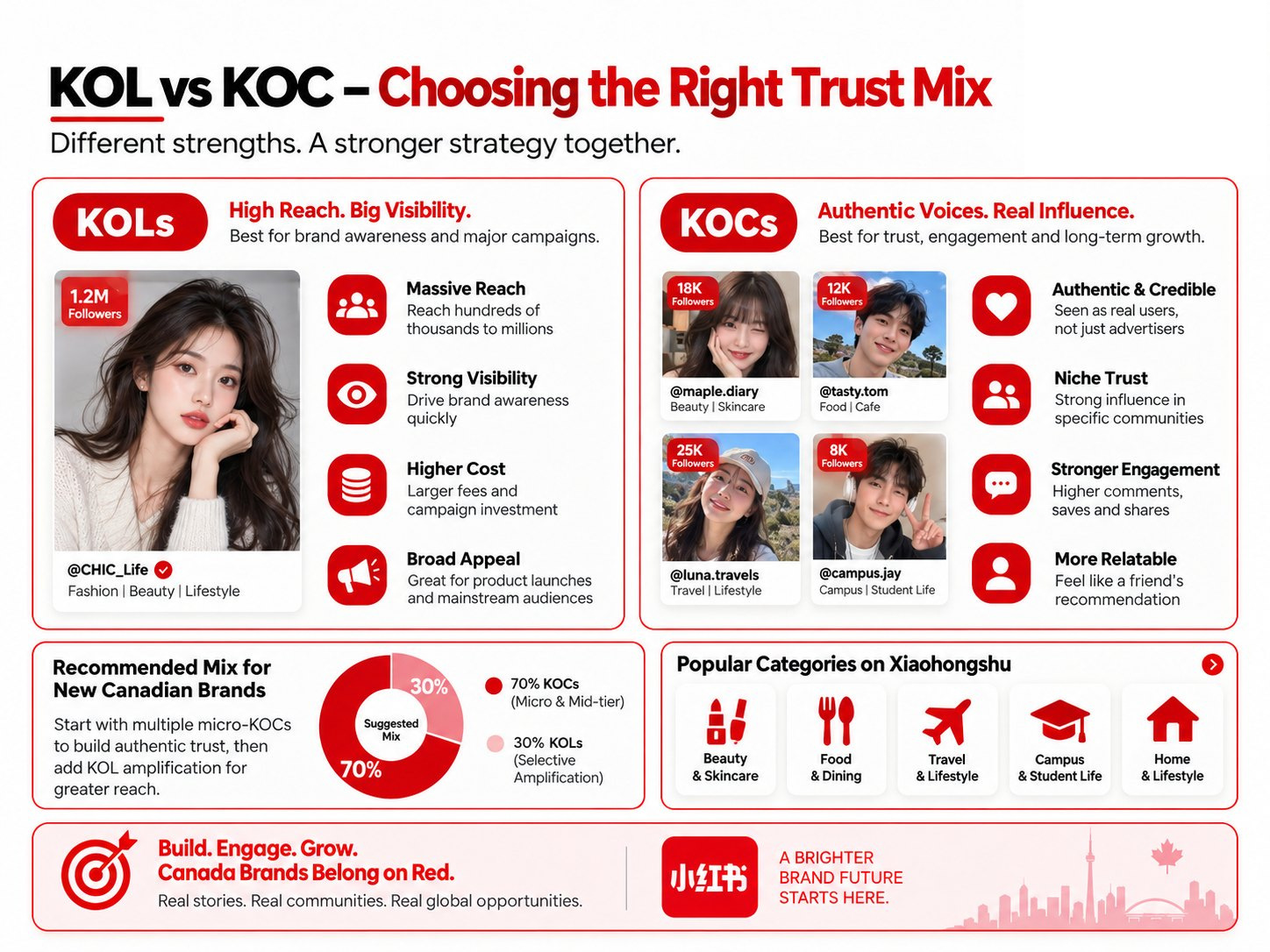
Interestingly, on Xiaohongshu, bigger isn’t always better – “prominent KOLs…lack the relatability of grassroots influencers”, and a rising micro-influencer with only ~5k followers can sometimes generate more genuine buzz and trust. For Canadian brands on a budget, collaborating with several micro KOCs can deliver a better ROI than a single big name, as noted by experts.
Finding the Right Influencers: To find suitable influencers, you can:
- Research In-App: Use Xiaohongshu’s search to look up keywords related to your product or industry (in Chinese). See which creators frequently post on those topics. For example, if you sell skincare, search for “秋冬保湿推荐” (autumn/winter hydration recommendations) and note the authors of popular notes.
- Leverage Dandelion (蒲公英) – Xiaohongshu’s official KOL platform: As a verified brand, you gain access to “Dandelion” (Pugongying). This is a matchmaking and campaign management platform for brands and influencers. All official collaborations are supposed to be conducted through Dandelion per platform rules. (Off-platform paid collaborations are technically against policy and can lead to penalties.) On Dandelion, you can browse influencer profiles complete with metrics like follower count, demographics, average views, engagement rate, and even their past collaboration performance. You can filter creators by category and sometimes by location, which is useful if you specifically want, say, a foodie KOL based in Canada.
- Bilingual or Canada-based KOLs: If your campaign aims to reach Chinese audiences in Canada (e.g. students, immigrants, or tourists in Canada) or you want content featuring Canadian locales, consider influencers who are overseas Chinese or bilingual creators. Such influencers might showcase life in Canada in Chinese, effectively bridging cultures. For example: LAT Multilingual notes popular North America-based RED creators like “@樱桃叽歪酱” (a foodie) and “@孜罗拉” (comedy, campus life) – these are Chinese content creators living abroad. Partnering with a diaspora KOL can be powerful: they understand Western products/culture (making coordination with your team easier) while communicating naturally with Chinese audiences. Dandelion can help identify these folks, or you can manually search for city tags (e.g. search “温哥华 美食” to find Vancouver food bloggers on XHS).
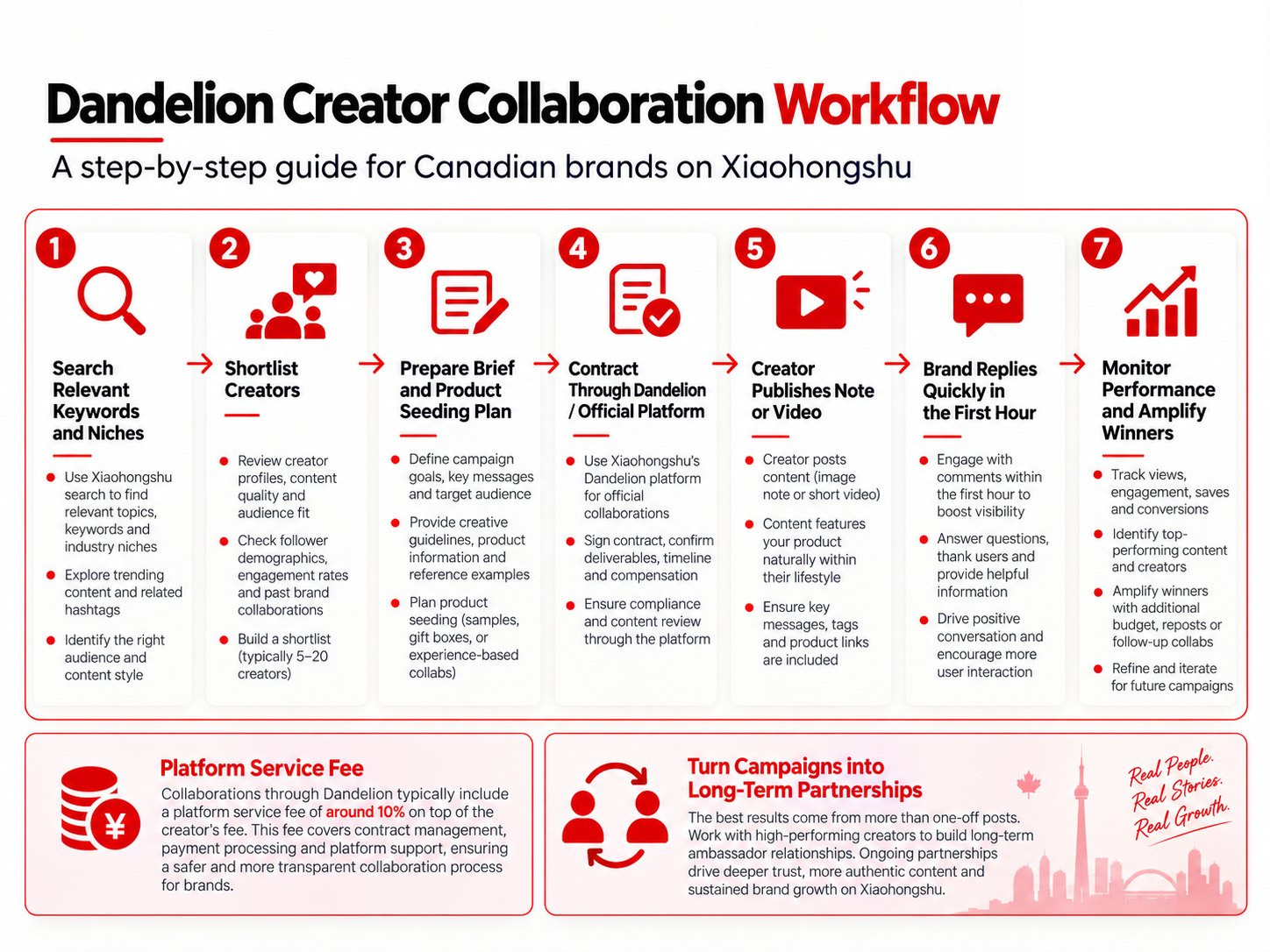
How to Collaborate (Process):
- Initial Outreach: On Dandelion, you can send collaboration invitations to chosen KOLs/KOCs. Typically you’ll outline the campaign brief – e.g. what product or message, deliverables (how many posts or perhaps a video), timeline, and compensation. Many micro-KOCs might accept free products (product seeding) as payment or a modest fee, whereas established KOLs will have rate cards.
- Negotiation & Agreement: Discuss and agree on the content angle. It’s crucial to give influencers creative freedom to maintain authenticity. Provide key points about your product, but avoid dictating a hard-sell script. Creators know what resonates with their followers. (Often, the best practice is to ask the influencer to try the product and then share their honest experience in their own style – guiding them to highlight your intended selling points, but in a natural way.)
- Platform Contracting: Dandelion will formalize the collaboration. Both parties confirm the terms on the platform. Remember, Xiaohongshu takes a 10% commission from both sides as a service fee. This means if you pay an influencer ¥10,000 for a campaign, the platform will charge you ¥11,000 and give the influencer ¥9,000 (effectively, the platform keeps ¥1k from you and ¥1k from the KOL). Budget an extra 10% to account for this fee.
- Content Creation and Posting: The influencer creates the content. There may be an option to review drafts, but try not to censor too much unless there are factual errors. When the KOL publishes the post, it will usually carry a tag indicating it’s a paid partnership or some form of advertising (to keep things transparent). Important: As the brand, use your official account to engage immediately when the post goes live – like and leave a genuine comment (e.g. thanking them or answering questions) to help boost the note in the algorithm. This also signals to users that your brand is attentive. (One recommended tactic is to coordinate the posting time and have your team ready to respond within the first hour – early engagement can help a post trend.)
- Monitor Performance: Through Dandelion, you can track metrics of the collaboration in real-time – views, likes, saves, comment sentiment, etc. This data helps you evaluate ROI. If the post is doing extremely well, consider amplifying it using ads (more on this in Section 3). If it’s underperforming, you might discuss a contingency with the KOL (sometimes they can do an extra follow-up post or mention in a livestream to make up for results, depending on your deal).
- Foster Ongoing Relationships: If a KOL or KOC delivered good results, keep the relationship warm. Brands often build long-term partnerships where an influencer becomes an ambassador for the brand, creating content over months. This consistency can cement your brand’s presence on Xiaohongshu. Also, monitor any organic mentions of your brand – sometimes regular users might post about you on their own; those could be future KOCs to officially partner with (i.e. recruit your happy customers to become advocates).
Example – MAC Cosmetics: The Canadian beauty brand MAC joined Xiaohongshu and quickly collaborated with KOLs to boost their following, reaching 339k followers by pairing their own content (product posts, tutorials) with influencer-driven buzz. This mix of brand posts and KOL posts created a steady stream of exposure. MAC’s audience on XHS frequently asks about product details and reviews in comments, showing that the influencer recommendations successfully drove users to engage with the brand directly.
Example – Tourism Collaboration: Destination Canada (the national tourism board) is on Xiaohongshu, and while they produce official travel content, they could amplify it by working with travel KOLs – e.g. Chinese students in Canada who vlog about local attractions. A tourism board might invite such influencers on a trip or give exclusive access to scenic spots, generating authentic vlogs that inspire others to visit. (Chinese travel influencers often do itinerary posts that are highly saved by users.) The key is that an influencer’s story (“I went to Banff and here’s what I loved…”) will likely have more impact than the tourism board’s own post, but together the messages reinforce each other.
Caution: Ensure any collaboration is disclosed and genuine. Do not engage in hiring “fake influencers” or paying underground agencies to spam content. Xiaohongshu has been cracking down on false marketing where brands use networks of ghostwriters to post overly positive “user” reviews. Big brands like Nivea and Neutrogena learned this the hard way when XHS blacklisted them for astroturfing, causing their official accounts to be practically undiscoverable in search. The lesson: work with real creators who truly like or at least fairly evaluate your product – transparency is a must.
In summary, influencer collaboration is arguably the most critical strategy for Western brands on RED. Allocate a significant portion of your China marketing budget and effort here. A common approach is to spend the initial 2-3 months on Xiaohongshu primarily on seeding content via KOLs/KOCs before expecting your official account to gain followers. Build that buzz first. Then, once users have seen your product recommended organically in their feed, they will follow your official account which now has credible context. This two-step approach (influencer seeding → official account engagement) is proven to accelerate growth on Xiaohongshu.
3. Advertising on Xiaohongshu: “Fries Ads” (Shu Tiao 薯条) vs. “Spotlight/Aurora Ads” (Juguang 聚光)
Xiaohongshu offers paid advertising tools to amplify your reach, but they come in two very different flavors. Marketers often colloquially refer to these as “Shu Tiao” (meaning French fries in Chinese!) and “Juguang” (meaning spotlight or “Aurora”) ads. Think of Shu Tiao as a quick boost for your content within the app, whereas Juguang (Spotlight/Aurora) is a more robust ad platform for targeted campaigns. Canadian brands should understand both, including their costs, use cases, and any targeting limitations for reaching the desired audience.
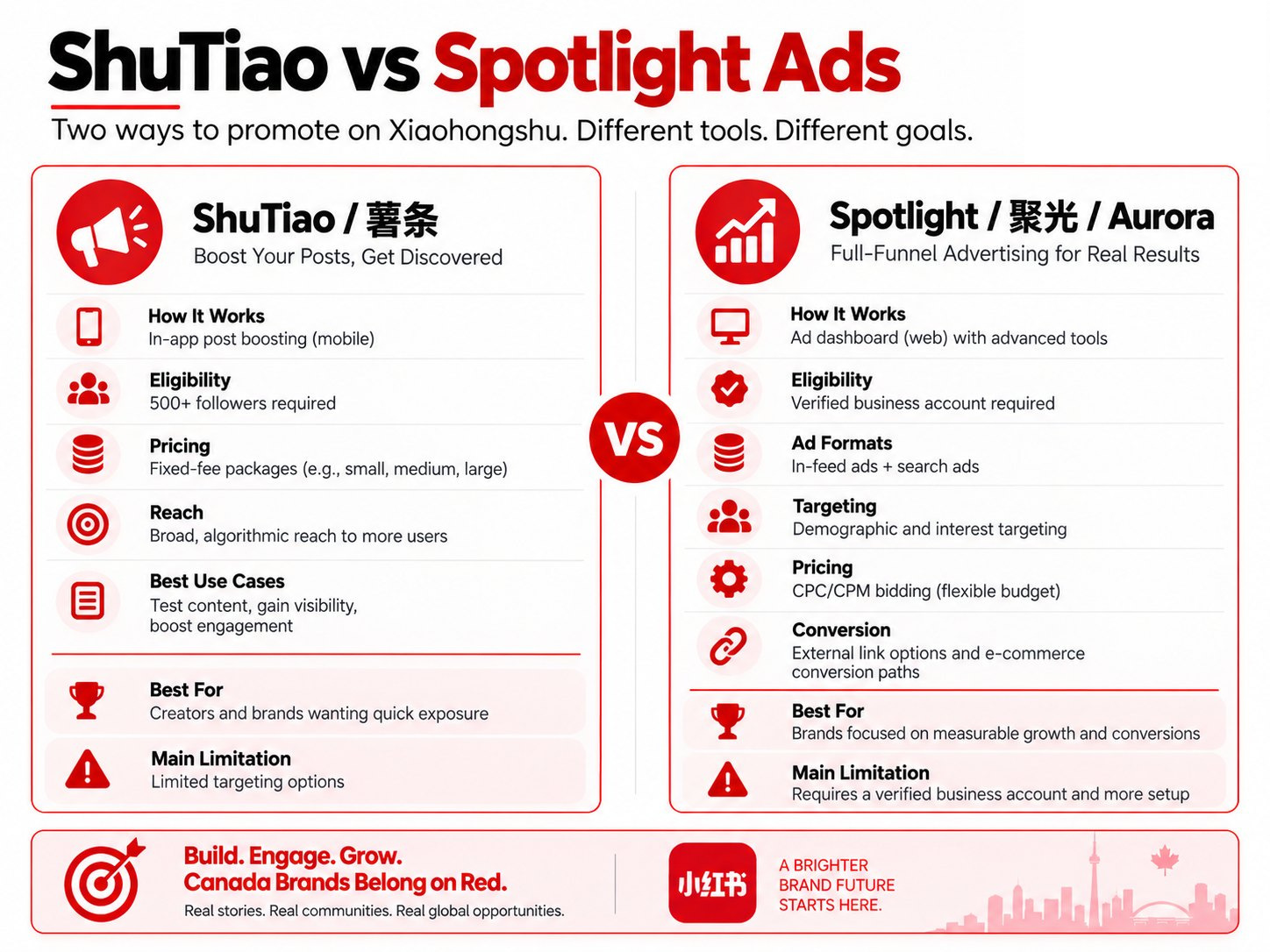
Shu Tiao (薯条) – In-App Boosting Tool for Posts
What is Shu Tiao? In simple terms, Shu Tiao is Xiaohongshu’s native post promotion feature – essentially a “boost post” button available within the app. It’s nicknamed after french fries, keeping with Xiaohongshu’s quirky terminology (the platform’s community sometimes calls itself “小红薯” or little red potato, as a pun on “小红书”). Shu Tiao promotions cause your selected post (a “note”) to be distributed to more users’ discovery feeds than the algorithm would organically, thereby increasing its impressions.
Who can use it: Shu Tiao is open to all account types (personal or business), but with a key requirement: your account must have at least 500 followers to unlock this feature. This threshold ensures users have some established content before they can pay to promote. Many individuals hit 500 followers and become “Personal Professional” accounts which then gain access to Shu Tiao. For a new brand account, this means you should first build up ~500 followers (likely via KOC seeding and a few initial good posts) – after that, you can start using Shu Tiao to accelerate growth further.
How to set it up: Shu Tiao is managed on the mobile app itself (no separate ad dashboard needed). In your Creator Center or post options, you’ll find “薯条” or “Promote” (brands or creators can navigate to Creator Center → All Services → ShuTiao Promotion) – select the post you want to boost and choose a promotion plan. Notably, Shu Tiao offers different objective-based plans: you can focus on maximizing views, gaining likes, increasing followers, or just overall note exposure. The UI will guide you through setting a goal. For example, you might choose “Gain Followers” if your aim is to convert new viewers into permanent fans.
Targeting and reach: Shu Tiao does not let you hand-pick a target audience; it relies on Xiaohongshu’s algorithm to broadly distribute your content to relevant users. Targeting is essentially “general audience” – the platform will show it to users it thinks might be interested, but you cannot, say, target only 25-30 year old females in Beijing with Shu Tiao. This is in line with its purpose as a content boost tool rather than a full ad system. The promotion is also time-bound (e.g. it might run for a day or a few days as per the plan you purchase, and only on relatively recent posts – you can only boost content that was posted within the last 90 days).
Cost and budget: Shu Tiao works on a fixed-fee package model (usually priced in RMB). It is very accessible even for small budgets. Plans start around ¥75 RMB (approximately $15 CAD) which might guarantee ~5,000 impressions from new viewers. Essentially, you pay for a certain number of exposures (this is akin to a CPM model – cost per thousand impressions – in that you buy a block of eyeballs). You can choose larger packages for wider reach; the price scales with how many users you want to reach or depending on the goal (for example, a plan optimized for gaining followers may cost more than one just for views, because converting followers is harder). The self-service interface will show options like “Promote to 10k people” for a certain fee, etc. There is no bidding – it’s fixed price. This simplicity and low entry cost make Shu Tiao a great tool for testing the waters.
Use cases for Shu Tiao:
- Content Testing & Optimization: Try boosting a variety of content to see what resonates. For instance, you might promote one note that’s a product unboxing video and another that’s a how-to guide, each with a small budget, and watch which gets better engagement (comments/saves). Shu Tiao is ideal for “testing and optimizing new content” because it ensures enough people see it to give you a meaningful read on performance. Posts that do well organically will get an extra lift, and posts that flop will at least gather data for you to learn from.
- Kickstarting Visibility: When you’re new on RED and don’t yet have massive followers, even great content might struggle to surface. Shu Tiao can kickstart the virality by giving a note an initial boost of impressions. This can help overcome the cold start and possibly lead to organic spread if the content is indeed high-quality (think of it as giving your post a push out of the nest). It’s especially useful for campaigns where timing is key – e.g., you have a limited-time offer or seasonal campaign and you need many eyeballs quickly.
- Follower Growth: If gaining followers is a priority (likely for brands building their base), using the “increase followers” promotion option will show your note to users and encourage them to follow. It basically advertises your content to people who don’t follow you yet. Brands have used this tactically around campaign launches – e.g., run a Shu Tiao right after a giveaway announcement to capture those interested.
One targeting limitation for Canadian campaigns to note: because Shu Tiao doesn’t allow location targeting, if you hoped to specifically reach Chinese users in Canada or in a certain region, you cannot direct it that narrowly. The algorithm might naturally show your content to some overseas users if the content is about overseas life (since it deduces interest), but you can’t explicitly say “only show to users currently in Toronto” for example. Shu Tiao will mostly tap into the Mainland Chinese user base, which is the majority on XHS. If your goal is to reach the Chinese diaspora in Canada for local store visits, Shu Tiao is a bit of a blunt instrument – you might reach those users, but also many in China. (For diaspora targeting, content and timing can help: e.g., using Simplified Chinese language but featuring Canada themes might attract those abroad or planning travel.)
Important: Shu Tiao boosts your content as-is. This means if the post is clearly an advertisement or not engaging, pushing it to more people won’t magically fix it – in fact, it could lead to low engagement rates which aren’t great for the algorithm. So ensure the note you promote is high-quality, platform-appropriate content (informative or entertaining, with good visuals). Shu Tiao is best used on posts that are already showing promising organic interaction (or ones you strongly believe will resonate).
Spotlight/Aurora (Juguang 聚光) – Advanced Advertising Platform
While Shu Tiao is like a snack-sized promo, Xiaohongshu’s “Spotlight” ads (internally called the Juguang or Aurora platform) are the full-course meal for advertisers. This is comparable to running Facebook or Instagram ads with detailed targeting – except within the RED ecosystem. A verified business account is required to use this platform.
What is Spotlight (Juguang/Aurora)? It’s the professional advertising system that Xiaohongshu offers to brands, separate from organic “notes.” Through a web-based interface (often referred to as the Juguang/Aurora ad console), brands can create In-Feed Ads, Search Ads, and even Opening Splash Ads to reach users in a more controlled, targeted manner. These ads appear with an “广告” (Advertisement) label or “Sponsored” tag on them, clearly distinguishing them from normal user posts. In essence, Spotlight/Aurora allows you to run true ad campaigns with defined objectives, similar to ads on other social platforms.
Ad formats available:
- In-Feed Ads: These appear in users’ home feed (the discovery feed) as they scroll, blending in with regular posts except for the small “sponsored” label. They can be single image, carousel, or video, and often look just like a normal Xiaohongshu note at first glance. In-feed ads are great for native feeling campaigns – you want the user to engage with it as if it were another piece of content. They can drive various actions: follow the account, click to a store or product page, or open a chat. For example, an in-feed ad for a Canadian maple syrup brand might show a tempting pancake photo and on click, take users to the brand’s product page within XHS or a landing page.
- Search Ads: These appear when a user searches for a keyword on Xiaohongshu. Normally, search results show relevant user notes; with Search Ads, your sponsored result can show up high on the list. Specifically, ads typically occupy the 3rd result position (and then more ads every 10 results after that) in the search results page. If the search is within the “RED Mall” (Xiaohongshu’s shopping section), ads can even appear as the top result. This is useful for keyword targeting – e.g., a Canadian cosmetics brand might bid on “补水面霜” (hydrating face cream) so that anyone searching that sees their ad among the first results. It captures users with intent (they’re actively looking for something related).
- Splash/Pop-up Ads: A more expensive, premium option – this is a full-screen takeover when the app is opened. It can be a 3-5 second static or animated image. Only one brand per day per category gets this slot (exclusivity). It’s the highest reach format (every user opening the app that day in your target segment sees it). However, it’s broad and not interactive beyond an optional click-through. Typically only big campaigns use this (think luxury brand launch or a tourism board campaign for Golden Week).
(Most small-to-mid advertisers will focus on In-Feed and Search ads, as splash ads are pricey and not as targeted.)
Targeting capabilities: This is where Spotlight/Aurora shines compared to Shu Tiao. The ad platform offers granular targeting options:
- Demographics: Target by age, gender, location, device, etc. Want to hit women in Tier-1 Chinese cities aged 18-30? You can set that. Want to target users in Guangdong province specifically? Location targeting allows that (though note: targeting outside of China is limited – more on that in a moment).
- Interests: Xiaohongshu’s algorithmic tags (based on user behavior) let you target interests (beauty, fitness, luxury, mommy & baby, etc.). They have predefined interest segments (around a few dozen categories).
- Keywords: You can target users who have searched for or engaged with specific keywords. For example, target those who interacted with content tagged “滑雪” (skiing) if you are promoting a ski resort. This often goes hand-in-hand with search ads.
- Lookalike Audiences: If you have a set of followers or customer data, the platform can find similar users (though Xiaohongshu’s lookalike feature is less developed than Facebook’s, it exists in some form).
- Behavior/Intent: Some more advanced targeting can include users who engaged with certain kinds of posts, or fans of certain big accounts, etc.
In general, you can pinpoint much more than Shu Tiao. For Canadian brands, this means if your main target is Mainland Chinese consumers, you can focus on that audience (likely by interests relevant to your product, and possibly excluding overseas regions if desired). If your target is Chinese tourists or students in North America, the challenge is greater: Xiaohongshu does allow location targeting by country/region, but the majority of users are in China. You might set location = “North America” or specific cities like “Toronto/多伦多” but the reach will be relatively small. Ensure your budget matches the reachable size. Many brands in Canada actually still target Chinese in China (to influence their decisions before traveling or to build brand awareness that spills over to diaspora communities), using interests like travel, overseas study, etc., rather than trying to isolate only those physically in Canada.
Costs and bidding: The Spotlight/Aurora platform uses a bidding model with CPC (cost per click) or sometimes CPM optimization. You will set a budget and a bid for your ads. The good news: you only pay when users click (for feed/search ads). If your ad is served but scrolled past, that impression doesn’t deduct from your budget (it does, however, mean your ad wasn’t compelling enough to click, which is a creative issue to monitor). You can control daily budgets, total campaign budgets, and bids for each targeting segment or keyword.
Real cost figures are hard to generalize because it depends on competition in targeting. Xiaohongshu’s ad traffic is still less saturated than WeChat or Weibo, so CPCs can be quite reasonable (often a few RMB per click – say ¥2-6 per click in many cases, though high-demand keywords could be more). Some anecdotal data: brands might spend on the order of ¥30,000-¥50,000 (~$6k-$10k CAD) for a month-long campaign that yields hundreds of thousands of impressions and a few thousand clicks, but your mileage will vary. Importantly, Xiaohongshu’s ad system is not yet as advanced as Facebook/Google, so one should not overspend without careful testing. In fact, marketing agencies often suggest only a modest portion of budget go to paid ads on RED. WalktheChat (a China digital firm) suggests brands spend no more than ~15% of their Xiaohongshu budget on ads, because of the platform’s targeting limitations and relatively smaller reach – the bulk should still go to content/KOLs.
Spotlight Ads and External Links: One big advantage of using the ad platform is the ability to link out to external websites or landing pages. For example, an in-feed ad can include a button or swipe-up that opens your own e-commerce site or a special landing page outside Xiaohongshu. Verified accounts that run ads gain this privilege, which otherwise is disallowed on the platform. For a Canadian brand, this means you could run a campaign where the user taps “Shop Now” and is directed to your Canadian website’s Chinese landing page or to a global e-store – capturing direct conversions. This is extremely valuable if you want to measure sales directly attributable to XHS. Note: Make sure the external link is optimized for Chinese users (fast loading in China or overseas if targeting diaspora, Chinese language, and ideally accepts payment methods they use). Spotlight’s tools will track how many users clicked through, so you can gauge ROI.
If you prefer to keep users in the ecosystem, you can also link Spotlight ads to your Xiaohongshu Store or a lead form or Xiaohongshu private message. For instance, a “Learn More” ad could open a form where interested users submit their email/WeChat to get more info (lead generation), or an ad could prompt users to send your account a message (which is a common objective for brands doing high-consideration products or services – get the conversation going). The platform allows these choices when setting up the campaign.
Limitations and best practices:
- As mentioned, the targeting, while good, is not as granular as Western ad platforms. There are only so many interest categories (WalktheChat noted <20 interest groups) and no retargeting or re-engagement funnels yet (e.g. you can’t target users who watched 50% of your video ad with a second ad – that sophistication isn’t there). Nor can you integrate external tracking pixels easily across platforms. So, use Spotlight ads mainly for broad targeting and awareness or simple conversions, not for complex multi-touch remarketing campaigns.
- Geo-targeting overseas: If your aim is reaching Chinese in Canada specifically, test carefully. The volume might be low. One approach is to target globally but tailor the content to speak to those abroad (the people for whom it’s relevant will engage, others might ignore). For example, an ad about “Visit Canada’s beautiful national parks this summer” in Chinese will naturally appeal to Chinese travelers or students who can go to Canada, rather than those who can’t, even if it appears in some feeds in China. But you could also target by location = “Canada” in the ad set to narrow it (assuming the platform offers country selection – if not now, possibly in the near future as RED begins eyeing overseas users).
- Compliance: Ads go through review. Ensure your ad creative follows Chinese advertising laws (no extreme claims like “#1 best in the world” if not substantiated, no sensitive political or inappropriate content). Also, any ad that links out must not link to a blocked site (e.g., a YouTube video or Facebook page – those won’t open in China). For safety, link to your official site or a Chinese-approved e-commerce page.
- Costs control: Start with a modest budget to gauge results. Because Xiaohongshu’s strength is word-of-mouth, many brands find that ads are a supporting tool rather than the main driver. One strategy is to use Spotlight ads to amplify what’s already working – for example, if you have an influencer campaign that did well or an organic post that went viral, you can turn that content (or similar content) into an ad to squeeze more juice from it. The paid ads will “further enhance the reach” of content that has proven appeal.
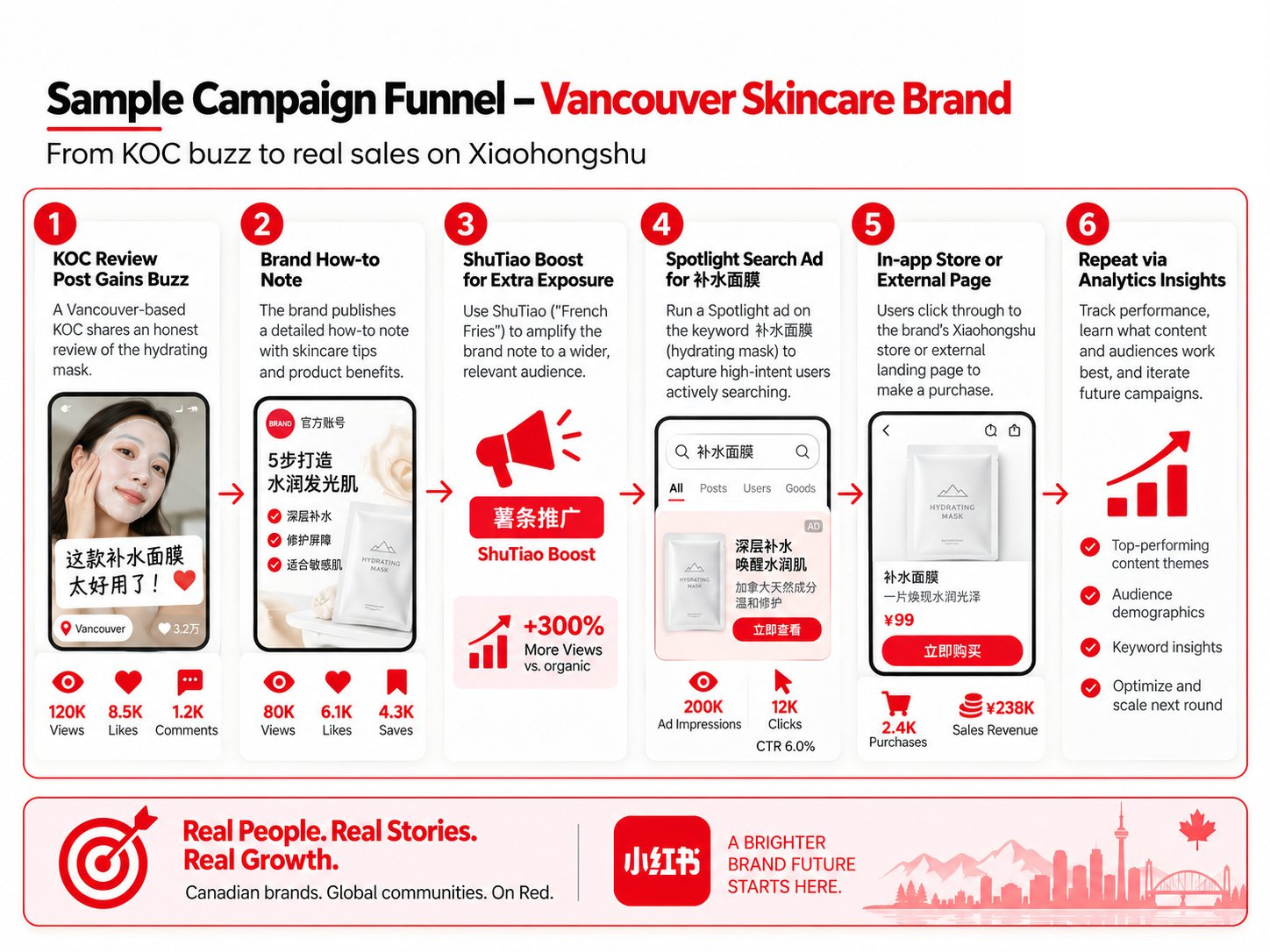
Example – “Fries” vs “Spotlight” in practice: Let’s say a Vancouver-based skincare brand has a hero product (hydrating mask). They write a great how-to post and also get a KOC to review it. The KOC post starts trending with good engagement. The brand could use Shu Tiao to boost their own how-to note to piggyback on the interest (general boost to get more eyes, maybe gaining some followers from those who saw the KOC and now see the brand’s note). Simultaneously, the brand could launch a Spotlight search ad for the keyword “补水面膜” (hydrating mask) so that anyone searching that on XHS sees the brand’s sponsored post or product link at the top, leading to their store with a special discount. They might also run an in-feed ad targeting skincare enthusiasts, linking to an external site where Canadian orders can be placed. Shu Tiao in this case feeds the algorithm and community side, while Spotlight ads cover those not reached and provide a direct conversion path. By combining both, the brand maximizes its touchpoints.
In short, use Shu Tiao for broad exposure and content testing within Xiaohongshu’s community, and use Spotlight/Aurora ads for precision targeting and driving concrete actions (website visits, sales, etc.). Canadian marketers should plan for both: a bit of budget in Shu Tiao to ensure your hard-crafted content doesn’t go unseen, and a chunk in Spotlight ads to accelerate campaigns and link to your sales funnel. And always, track results and adjust – Xiaohongshu marketing is iterative.
(Note: As of 2024/2025, Xiaohongshu has been paying more attention to overseas markets and could introduce more ad features or support for cross-border targeting. Keep an eye on platform updates or consider working with a local agency partner who has direct lines to the RED ad team to stay updated on new opportunities.)
4. Xiaohongshu Analytics & External Linking to E-Commerce
One of the benefits of a verified brand account is gaining access to Xiaohongshu’s analytics dashboard (often via the Creator Center or a desktop business backend). Understanding the data is vital for refining your strategy. Equally important is figuring out how to translate Xiaohongshu traffic into tangible business results – which often means guiding users to an e-commerce platform where they can purchase your product or learn more. However, linking out on Xiaohongshu is tricky due to its walled-garden nature. Let’s unpack what metrics matter on RED and how you can (and can’t) drive external traffic.
Analytics Dashboard: What to Measure and When It’s Available
Once your account is verified and set as a business account, you’ll have access to detailed analytics beyond the basic view counts that regular users see. Typically, you can access analytics either in the mobile app’s Creator Center (专业号中心) or via a web dashboard for Xiaohongshu business accounts.
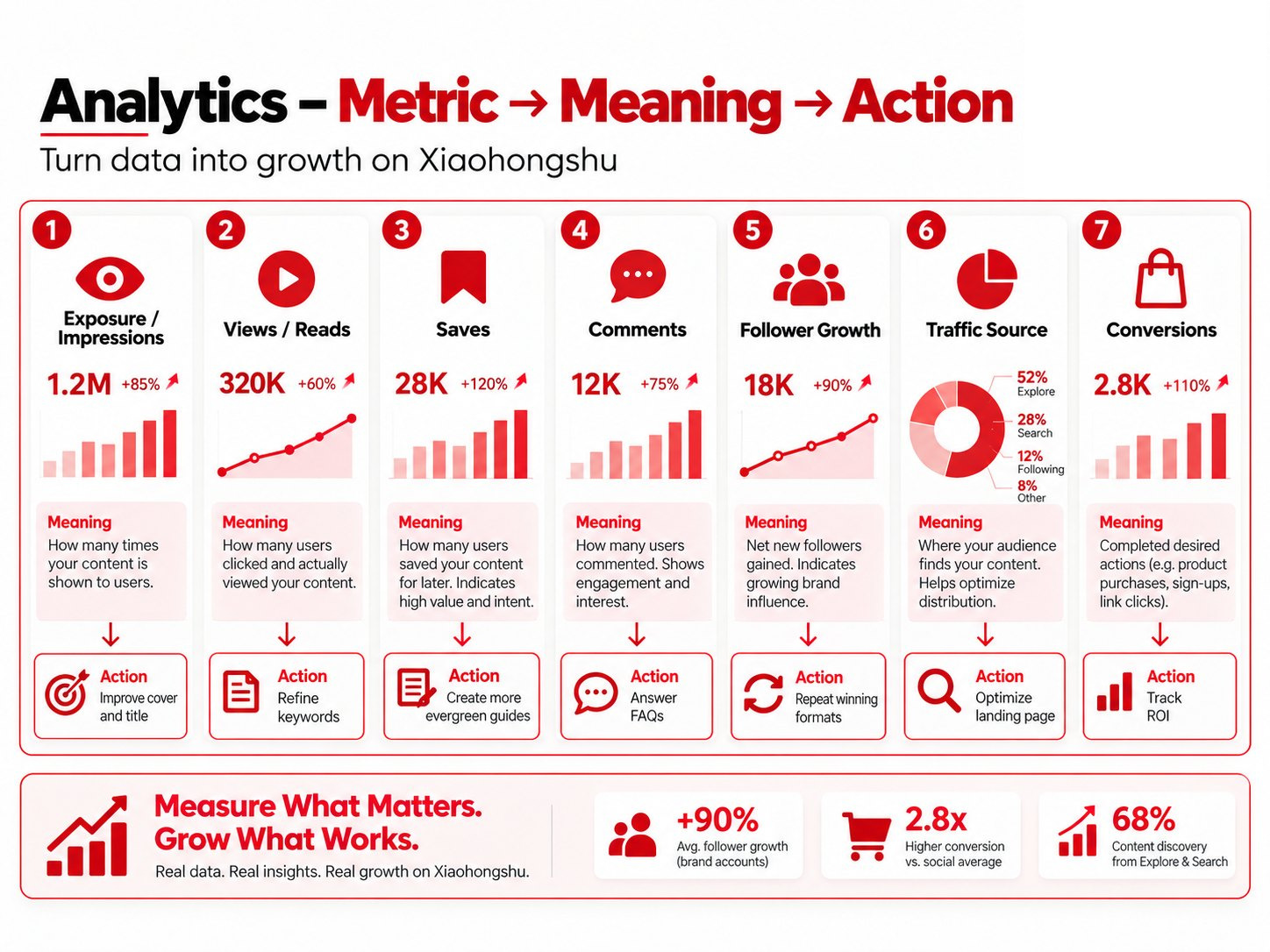
Key Metrics and Features:
- Impressions/Exposure (曝光量): How many times your content was shown (in feeds, search, etc.). This tells you your reach. A higher exposure means the algorithm is giving you love or you boosted the content. Monitor this to see if your reach is growing organically over time or if certain posts got a big boost.
- Clicks/Views (点击/阅读数): On each post, how many people actually clicked in to view it fully. The ratio of views to impressions can indicate the stopping power of your cover image and title. If a post had 100k impressions but only 5k views, the thumbnail/title may not be enticing. On the other hand, a high view count means people were intrigued (a good sign for content format/topic choice).
- Engagements: This includes likes (点赞), comments, shares (转发), and saves/favorites (收藏). These are crucial on XHS:
- Likes are a basic indicator of content appreciation.
- Comments are gold – they show deeper engagement. Pay attention not just to the number of comments, but what people are saying. Are there questions (which you should answer), praise, or criticisms?
- Shares (people forwarding your post to others or to their chats) amplify your content.
- Saves (when users bookmark your note to their favorites) are particularly valuable on Xiaohongshu because it often means your post is seen as a useful reference (e.g., a recipe, a travel guide, a product recommendation they want to try later). Posts with high “收藏” often have long-term traffic as people revisit them.
- Engagement Rate: Many marketers calculate engagement rate = (likes+comments+shares)/views * 100%. A 10%+ engagement rate on a post is considered excellent on Xiaohongshu, and 5-10% is good. If your posts consistently hit that, you’re doing something right content-wise.
- Follower Growth: You can see how your follower count grows over time, sometimes broken down by days or even by which content drove follows. For instance, the dashboard might show that in the past week you gained X new followers, and which posts or KOL collaborations contributed to that. This helps identify what content converts viewers into followers. If a certain post format yields lots of follows, replicate that style.
- Audience Demographics: The analytics often provide a profile of your followers – age distribution, gender split, and location (which cities or provinces your followers are in). For a Canadian brand, you might discover for example that 60% of your followers are women 18-24, largely in Shanghai and Beijing. That can inform content (maybe you focus more on trends popular in Tier-1 Chinese cities or ensure your messaging resonates with younger women). If you see an unexpected fan base, adapt to them.
- Traffic Sources: You may see how users find your content – whether through the feed, through search, or via sharing. If a lot of your hits come from search, it means your SEO (use of keywords in titles/captions) is allowing your content to surface when people look things up (valuable for evergreen content). If mostly feed, then it’s algorithmic recommendations doing the work.
- Conversion Metrics: If you’ve set up an Xiaohongshu Store, you’ll get e-commerce metrics (product page views, add-to-cart, purchases) right in the Xiaohongshu Business Center. If you ran a Spotlight ad campaign linking out, you’ll see the clicks and possibly conversions (if tracked via something like UTM and your own analytics). For Live streams, if you do those, the platform provides stats like peak viewers, average watch time, and products sold during the stream.
- Competitive/Benchmarking Tools: Xiaohongshu itself doesn’t openly show competitors’ data, but third-party tools like XinHong (NewRank’s XHS analytics) can give you industry benchmarks. For example, knowing average engagement rates in beauty industry or seeing trending keywords. These often require a subscription, but if you’re investing heavily, it might be worth it to gauge your performance against the market.
- Time-based analysis: You can correlate follower growth or drop with specific events. For instance, if you notice a spike on a certain date, maybe that’s when a KOL’s post about you went up. Or a dip might coincide with a controversy or inactivity. Use these insights to plan (e.g., after a giveaway, followers might dip a bit – that’s normal as freebie-chasers leave; the goal is to net positive growth).
When do you get access to analytics? As soon as your account is verified as a professional account, you should have the analytics features enabled. Personal accounts do have a limited “Creator Center” if they hit certain criteria (like the 500-follower personal professional tier) which shows some data, but the business account analytics are more comprehensive. So essentially immediately upon verification you can start tracking metrics. If you don’t see it in-app, try the web dashboard (login at xiaohongshu.com with your account; there’s a console for business accounts). Keep in mind that if you are brand new, you need to post content first to have data to see! Give it a few posts and some days of activity to populate.
Metrics that matter most: Based on goals:
- If brand awareness is your goal: focus on impressions, reach, and follower growth. Also note how often users mention your brand (you can search your brand name to see UGC volume).
- If engagement/education is key: track saves, comments, DMs initiated (people messaging you with questions).
- If conversion is goal: track referral traffic to your site or product orders (this might be outside the XHS dashboard – e.g. look at your Google Analytics to see how many visitors came from the Xiaohongshu link or campaign). Also, if you have a special promo code for XHS users, track usage of that code.
One specific metric to watch is comment sentiment and FAQs – often, multiple commenters will ask the same thing (e.g., “Is this available in China or only in Canada?” or “What’s the price? Where do I buy?”). This is a hint to you that your content isn’t answering an important question. You can address it by responding in comments and next time, incorporate that info in the post or visuals. The more you proactively answer user curiosities in your content, the better.
Linking to External E-Commerce
By design, Xiaohongshu wants to keep users within its app. Directing users outside is restricted to preserve the “closed loop” and content purity. Ordinary posts cannot contain clickable external links, and attempts to paste URLs or mention other platforms (like “visit my website: www.example.com” or “follow our Instagram”) are usually censored or will result in zero clicks because users can’t copy links easily. In fact, if you try posting links or urging people to go to another platform in comments or private messages, the system may block it and flag your account. The platform explicitly states not to do that (spamming external links is a violation). However, that doesn’t mean you can’t ultimately convert Xiaohongshu traffic into website traffic or sales. You just have to do it the right way:
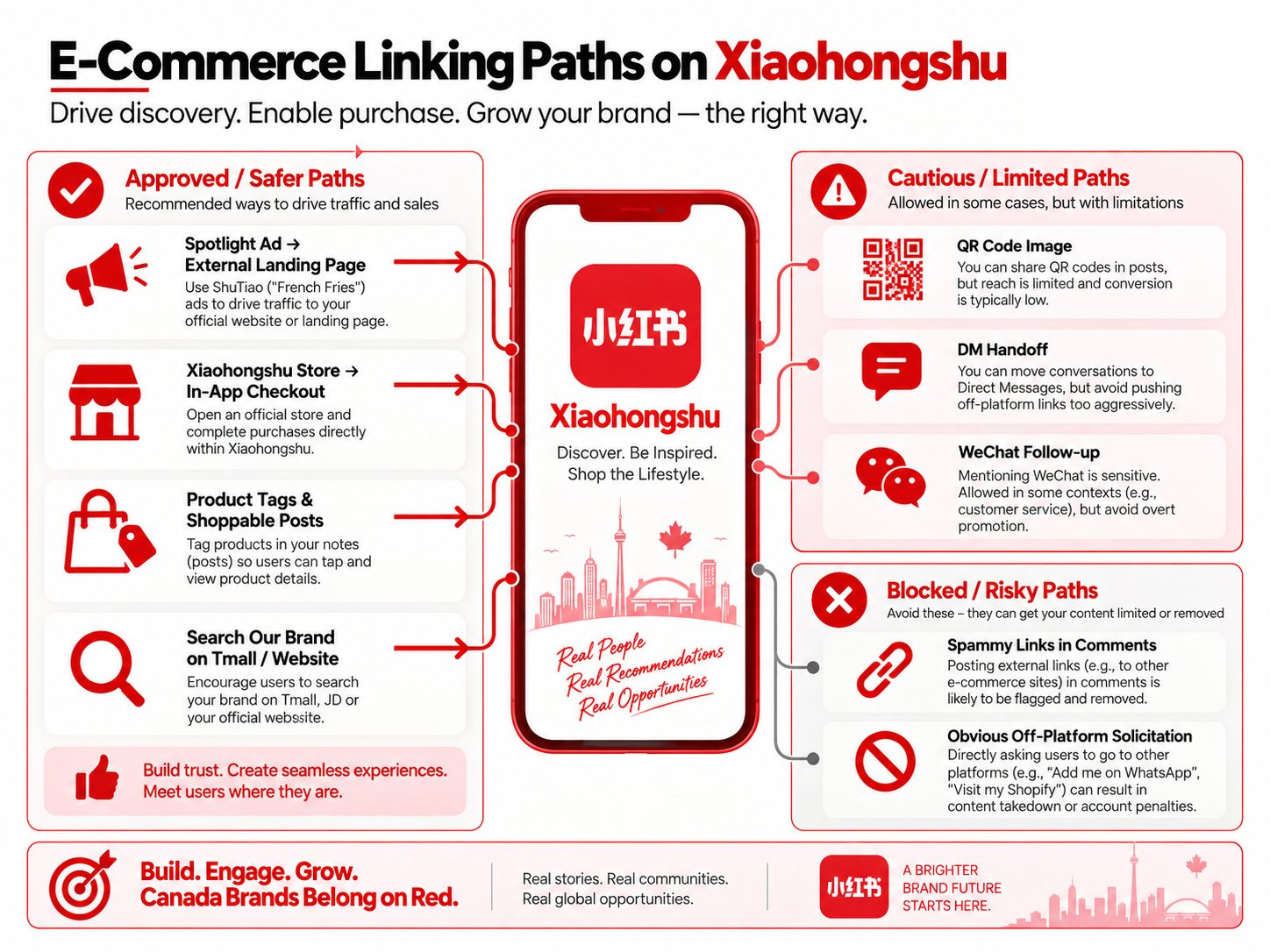
1. Use the Advertising Tools (Spotlight) for External Links: As covered in Section 3, the Spotlight ads allow adding an external link to a post/ad. For example, a sponsored post could have a button like “Learn More” or “Shop Now” that opens your Shopify site or Amazon listing or any URL. This is the cleanest method, as it’s officially supported and trackable. Referral traffic from Red can be measured – e.g., you’ll see in your web analytics how many users came from that campaign. Make sure to tag the URL with UTM parameters or tracking IDs to attribute sales to Xiaohongshu. Many brands run a small “awareness” campaign followed by a retargeting off-platform campaign: for instance, collect leads via Xiaohongshu then follow up with emails or WeChat contact to convert, since directly linking to an overseas payment page might have lower conversion if users aren’t ready. But if you do have an attractive landing page (like a Chinese-language landing with a welcome discount), driving XHS users there via ads can show direct sales impact.
2. Leverage the Xiaohongshu Store or Mini-Programs: If you want to avoid external links altogether, consider setting up an official store on Xiaohongshu. This keeps the user’s purchase journey inside the app – they can click on your product tagged in a post and buy it with one tap (like how Instagram Shopping or TikTok Shop works). As noted, you can open a RED store after verification. For Canadian brands, Xiaohongshu’s store system supports cross-border e-commerce, meaning you don’t need a local entity in China; you can ship from Canada to Chinese buyers and the transaction is handled in-app (there are cross-border logistics providers to help). One 2024 analysis even highlighted that Xiaohongshu stores don’t require a China license and can ship from overseas with smooth payment processing. If selling to China is your aim, this is worth exploring. The advantage is that you can directly link your posts to your Xiaohongshu store products (like tag a product card in the note), creating a seamless shopping experience. The disadvantage is you have to manage cross-border fulfillment and perhaps customs, and users in Canada can’t buy from that store (it’s China-facing). If your focus is Chinese in Canada or the US, driving them to your North America e-commerce site might make more sense – in that case, the advertising link-out or simply building awareness so they later search your site is the route.
3. Profile link? Unlike some platforms, Xiaohongshu still does not really allow a clickable link in bio for business accounts (as of latest info). Some brands try to put a URL in text, but it’s not user-friendly. A workaround seen is putting a Linktree-like QR code image in one of your posts or in your account gallery (since images can contain QR codes). For example, you might post an image that’s a QR code to your WeChat mini-program or website, perhaps mixed in with content (some brands hide a QR in a carousel). Users could scan that. But be cautious: Xiaohongshu might detect and downrank posts with QR codes that obviously lead off-site. They prefer you use their own e-commerce. If you do this, don’t make it spammy – maybe during a campaign you say “scan the code in the picture to get a coupon on our WeChat store” or something. It’s a bit of a gray area.
4. Indirect funnels: Some creative approaches include using Xiaohongshu to drive people to follow your WeChat official account (which then does the selling), since WeChat is more commerce-friendly. Directly posting WeChat IDs is often blocked (XHS doesn’t want to be an ad billboard for WeChat). But subtlety can work: e.g., posting an image with your WeChat ID, or telling users “private message us for purchase details” and then in DM share your WeChat or site (with careful wording or as an image to avoid detection). As Octoplus noted, you can send a WeChat number in private chat one-off, but if you do it frequently the system may flag you. So manual off-platform handoff is possible for small scale interactions, but not scalable.
5. Content CTAs: Even without links, your content can include a call-to-action to search/buy elsewhere. For instance, some brands might say in a note “Available on Tmall Global – search ‘BrandName’ on Tmall.” This doesn’t violate as an explicit link and informs interested users where to buy. Or “Available at Sephora Canada stores” if targeting those in Canada. It’s not as guaranteed as a direct link, but truly interested users will make the effort. Another tactic: mention a campaign on another platform – e.g., “Follow our Weibo for a special giveaway” – if multi-platform strategy is in play. Just be cautious not to overly do outbound promotions, as the platform’s algorithms could throttle reach if a post looks purely like an ad to leave XHS.
Real-world example – Vitaly’s cross-channel approach: The Canadian jewelry brand Vitaly ran a successful lucky draw on Xiaohongshu that gained 600+ new followers, and notably, the prize was a ¥500 gift card for their WeChat mini-program store. By doing this, they killed two birds with one stone: they grew their RED following and funneled Xiaohongshu users toward their WeChat (since winners would redeem on WeChat, and presumably others saw that and learned Vitaly has a WeChat store). This is a clever indirect method to link audiences to another commerce channel without posting a direct link on XHS. It’s a good case of how cross-platform strategy can work – use Xiaohongshu for what it’s great at (community and content), but then lead users to where the transaction can happen (WeChat, Tmall, your website, etc.) via incentives.
Summary of linking options:
- Organic posts: no clickable external links (and don’t try to sneak them in text – they’ll either be unclickable or filtered).
- Profile: no clickable link field provided.
- Paid ads: yes, you can include external links on sponsored posts.
- In-app store: yes, keep users inside and link to your products internally.
- Manual or creative methods: possible but use sparingly (QR codes, telling them to search your brand on another app, etc.).
Platform restrictions reminder: Xiaohongshu explicitly forbids posting “follow me on [other platform]” or external promos in obvious ways. They want brands to utilize their features (like the Dandelion collab platform and in-app stores) rather than bypassing them. So, whenever possible, work within the Xiaohongshu ecosystem – e.g., host giveaways on XHS rather than trying to send users off to a Gleam giveaway page, etc. It will pay off with better reach and less risk of content removal.
Analytics usage: Use your analytics to inform your linking strategy. For instance, if you see a particular product is getting a lot of saves or mentions on XHS, maybe it’s worth investing to add that product to your Xiaohongshu Store or making a special landing page just for XHS users highlighting that product (and link to it via ads). If you see most followers are in China, maybe prioritize enabling a cross-border purchase method. If many are in Canada, ensure your posts mention where in Canada they can buy or find you.
In essence, Xiaohongshu is a top-of-funnel platform with some middle-funnel capabilities. It’s fantastic for influencing purchase decisions with content and community interaction. The actual purchase (bottom-of-funnel) can happen on Xiaohongshu (if you set up a shop or use ads to link to a site) or off it. But you must respect how and when to insert that purchase link. A good rule of thumb is: content first, selling second. Earn the trust and interest of users with engaging posts; once they’re interested, make the path to purchase clear either through your profile info (e.g., “Officially available on Tmall Global”) or a one-click ad. And then track everything: if you run a campaign, check the analytics and your web store data to calculate conversion. Over time, you’ll see how effective Xiaohongshu is in driving sales versus just awareness, and you can adjust investment accordingly.
5. Common Mistakes and Pitfalls for Western Brands on Xiaohongshu
Entering a new social media ecosystem can be daunting, and many Western brands stumble by applying the wrong playbook. Xiaohongshu has its own community norms and policies. Here we outline some frequent mistakes foreign brands make on RED – so you can avoid these pitfalls:
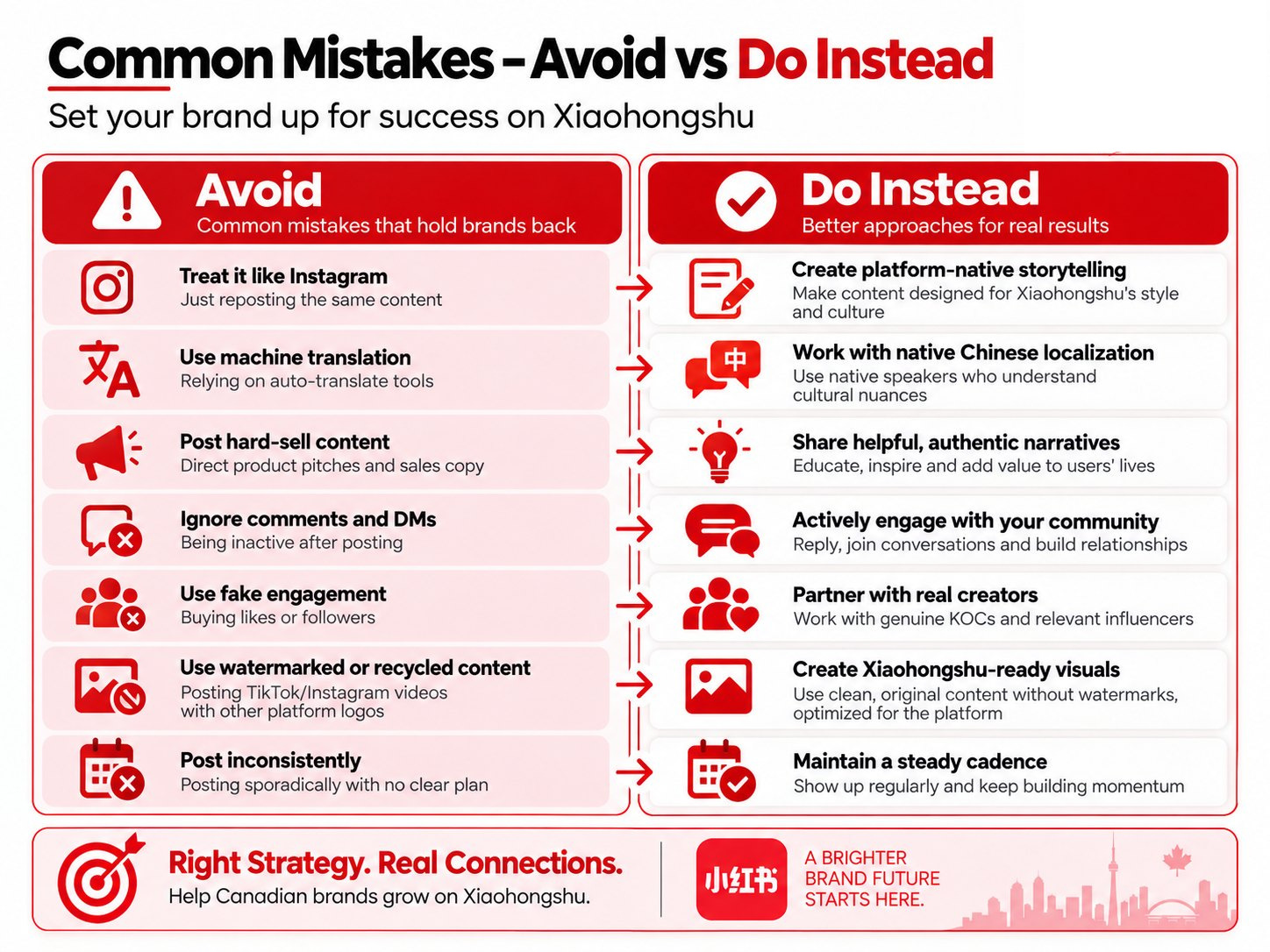
Treating Xiaohongshu like Instagram (Overt Branding & No Community Integration)
A classic mistake is to approach RED as just another Instagram – posting only polished product photos or ads and expecting to grow. Brands that “shout with glossy, studio-perfect content” and broadcast one-way messages often find that growth is slow or flat. Remember, on XHS users crave peer content over brand content. A Western brand that only posts slick ads will be viewed as out of touch or just ignored.
Fix: Embrace the community spirit – incorporate user-generated content, engage in the comments, and make your posts feel like personal stories or useful tips rather than advertisements. Localize the style: for instance, instead of a generic product promo, share a short diary-style note from an employee or fan of the product, or a behind-the-scenes anecdote. Be a participant on the platform, not just a broadcaster.
Ignoring Localization (Language and Culture Missteps)
Poor localization can doom your efforts. This ranges from bad translations (e.g., using machine-translated text that reads awkwardly, or leaving English text that many users won’t understand), to missing cultural context (e.g., referencing Western pop culture or jokes that Chinese users won’t get), to failing to adapt to local holidays and trends. For example, a Western brand might launch a summer campaign in July, oblivious that Chinese netizens were all fixated on discussions about the 618 shopping festival in June or planning for Qixi (Chinese Valentine’s Day) in August.
Fix: Invest in quality translation and transcreation – your captions and articles should be written by a native-level Chinese copywriter for authenticity. Use Chinese holidays and memes in your content calendar: show you’re aware of things like Lunar New Year, Mid-Autumn, Singles’ Day, etc., and, where appropriate, tailor promotions around them. Also, ensure units, currency, etc., are localized (CAD$ or inches won’t mean much; use RMB and cm where relevant). A good practice is to have culturally savvy team members or agencies review content for any inadvertent faux pas or just to add a local touch that makes your posts feel more relatable.
Over-promotional Tone / Hard Selling
Content that reads like an outright ad or is overly self-promotional tends to flop on Xiaohongshu – or worse, get flagged. This includes using exaggerated marketing language (“the most amazing product ever!!!” kind of hype) which users find inauthentic. Xiaohongshu actually has “sensitive advertising words” that are best avoided. Posts that look like pure commercials (with big logos, slogans, ‘buy now’ messaging) will get low engagement and could be de-prioritized by the algorithm.
Fix: Adopt a softer sell, storytelling approach. Instead of “Our cream will eliminate wrinkles guaranteed!” (which might trigger ad word filters and skepticism), you could post “I tried this Canadian cream for 30 days, here’s what happened” with a diary of results – subtly showing your product’s benefits through a narrative. This way you comply with platform preference for authentic content. Also, balance content: not every post should be about your product. Mix in posts about lifestyle, industry tips, or user stories that provide value without directly selling. For example, if you’re a Canadian outdoor apparel brand, share a note “Top 5 Autumn Hikes in Canada 🍁” – it’s relevant to your brand’s ethos and interests of your audience, even if it doesn’t push a jacket. It builds brand goodwill and follows the ethos “educate/entertain first, sell second.”
Neglecting Engagement and Customer Service on the Platform
One pitfall is treating Xiaohongshu as a one-way publishing platform and not engaging with users. Western brands sometimes post and then fail to answer comments or messages. On XHS, users often ask questions in comments expecting the brand or others to answer. If those go ignored, it leaves a bad impression (or simply causes potential customers to lose interest). Additionally, not monitoring what others post about your brand is a miss – there could be negative reviews snowballing without you even knowing.
Fix: Dedicate resources to community management. Respond to comments on your own posts – even a simple “Thanks for your feedback!” or answering a product query can delight users (and more importantly, it boosts your post’s comment count and favor in the algorithm). Also, monitor brand mentions: search your brand name (in Chinese) periodically to see if anyone posted about you. If someone posted a great review, maybe comment to say thanks. If someone had a complaint, you can comment or reach out to address it. Unlike some Western social media where brands sometimes stay hands-off, in China consumers expect brands to be quite responsive and service-oriented on social platforms. Private messages (DMs) should also be checked – a user might DM asking how to buy or for advice; treat it like a customer service channel (bearing in mind any link sharing rules – e.g., you might guide them to your Tmall store if they ask where to buy, which is usually fine in a one-on-one chat).
Violating Platform Policies (and Getting Shadowbanned)
Xiaohongshu strictly enforces content rules to maintain trust. Western brands unfamiliar with Chinese internet regulations or RED’s rules can inadvertently violate them. Common pitfalls:
- Using banned words/claims: As mentioned, phrases like “最高级” (top class), “国家级” (national-level [implying endorsed or best]), “无敌” (invincible), etc., can be considered false advertising if not proven. Likewise, certain health claims (anything bordering on medical efficacy) can be sensitive. If you sell a supplement and say it “治愈失眠” (cures insomnia), that’s a red flag without SFDA approval. Result: Post might be taken down or never pass review.
- Mentioning competitors or pricing in improper way: Some platforms disallow directly naming competitors in ads or content in a disparaging manner. Not a huge issue but something to note.
- Politics or other taboos: It should go without saying, but steer clear of any political or socially sensitive commentary. Western brands have sometimes stepped on landmines in China (e.g., territorial issues, etc.). Keep content apolitical and focused on lifestyle and products.
- External link spam: Posting external links or frequent mentions to add on WeChat, etc., we covered – this can lead to content being blocked or account restricted.
- Off-platform influencer payments: If you work with influencers off the books and they don’t disclose it, you both risk penalties. The platform encourages using Dandelion; doing a paid post under the table might be seen as “false marketing” if discovered.
- Fake engagement: Buying fake likes or comments (“水军”) will backfire. Xiaohongshu’s crackdown on brands employing “internet water army” to fabricate buzz has been fierce. Brands caught doing so had their accounts severely limited (not showing up in search, killing their reach). So don’t even think about inflating your numbers artificially – it’s not worth the risk.
Fix: Read Xiaohongshu’s official guidelines (they do publish rules in Chinese – have a native speaker parse them). Use tools like the Lingke prohibited word checker – input your Chinese caption to see if any banned terms are present, and adjust accordingly. When in doubt about a claim, tone it down or rephrase to sound more like personal experience than absolute fact. And absolutely avoid any shady growth hacks like buying followers or fake notes – the platform’s AI is quite good at detecting patterns of inauthentic activity. It’s better to have 5k real followers than 50k ghost ones (besides, if you had 50k but low engagement, users can tell something’s off – which hurts credibility).
Overlooking Aesthetic Norms of RED
Another subtle pitfall is not aligning with the visual and tonal aesthetic that Xiaohongshu users are accustomed to. For instance, posts on RED often have a clean look: images without heavy watermarks or borders, text overlays in Chinese if needed, etc. If a brand reposts an image with an Instagram watermark or non-Chinese text all over it, it feels out of place and may be scrolled past or even downranked (XHS algorithm tends to demote content with visible watermarks from other platforms). Also, things like aspect ratio – XHS favors either square (1:1) or vertical (like 3:4) images that fill the phone screen nicely. If you post an awkward horizontal photo, it’s not utilizing screen real estate well.
Fix: Tailor your creative assets to XHS. Ensure images are high-resolution, correctly sized, and don’t carry logos or watermarks from elsewhere. Adapt any text on images to Simplified Chinese. Look at popular posts in your category to gauge the style – some use collage layouts or cover images with a title text. Emulate what works, while maintaining your brand identity.
Inconsistency and Impatience
Some Western brands set up an account, post a couple times, and then go dormant when they don’t see immediate results – or conversely, they dump a flurry of content and then stop. Inconsistent posting is a mistake; so is expecting viral growth with minimal effort. Xiaohongshu requires a sustained, consistent approach (it values regular activity – accounts that post at least weekly tend to grow faster).
Fix: Commit to a content schedule (e.g., 1-2 posts per week as recommended). Even if early traction is slow, keep going – growth is often exponential once a critical mass of content and followers is reached. Use the slow start period to experiment with content types. And keep the quality up; don’t sacrifice quality for quantity, but find a rhythm that doesn’t let your account gather dust. Also, continue engaging elsewhere on the app (comment on others’ posts if relevant as the brand, etc.) to stay visible.
In summary, avoiding these pitfalls comes down to being culturally sensitive, platform-savvy, and community-driven. Successful Western brands on Xiaohongshu do their homework – they often have local teams or advisors guiding content, they focus on storytelling rather than selling, and they actively engage and build trust over time. By learning from the missteps of others, Canadian brands can fast-track their success on RED.
6. Additional Strategic Opportunities (Livestreaming, Giveaways, and Content Formats)
Beyond the foundational tactics we’ve covered, there are a few more frontiers on Xiaohongshu that Canadian brands should consider. These can provide an extra edge or reach new segments of the audience:
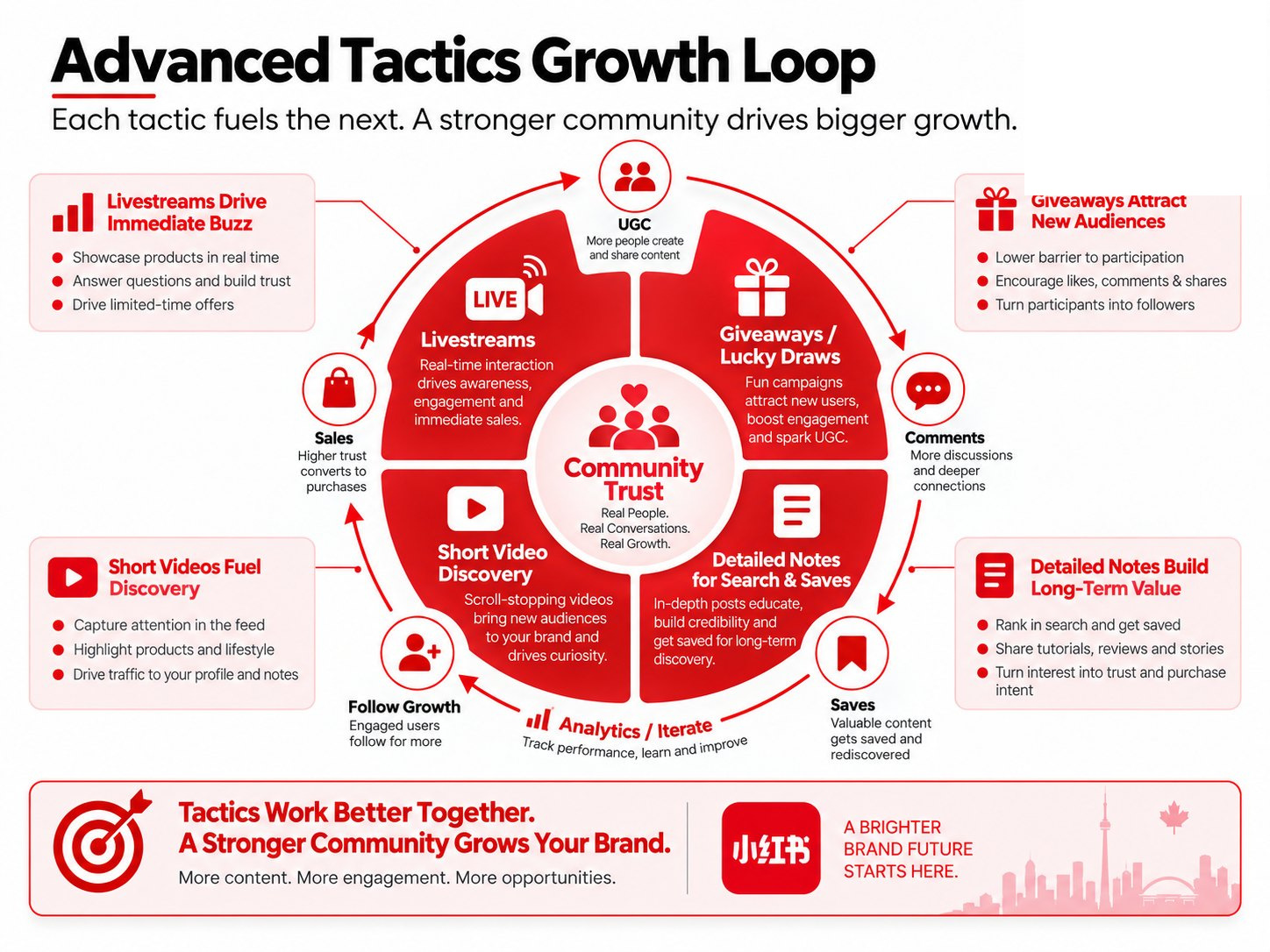
Livestreaming on Xiaohongshu
Live commerce is a massive trend in China’s digital landscape (pioneered by Taobao Live, Douyin, etc.), and Xiaohongshu joined the livestreaming wave in 2020. While RED’s livestreaming came later than others, it has been growing quickly in popularity. Xiaohongshu’s live-stream feature allows real-time video broadcasts where brands or influencers can demonstrate products, talk to viewers, and drive sales or follows.
What’s unique about RED livestreams? Xiaohongshu has cultivated a reputation for a more “calm and sophisticated” livestream style, often appealing to a slightly upscale, educated female audience. Whereas on some platforms you’ll see super-hyped, fast-talking sellers yelling “Buy now! Limited time!”, RED streams are comparatively relaxed. For example, a famous actress or a lifestyle KOL on Xiaohongshu might host a one-hour session discussing her skincare routine or doing a makeup demo in a tranquil setting, interacting with viewers’ questions in a measured way, and subtly recommending products (including, perhaps, a brand’s product if it’s a sponsored stream). This format aligns with Xiaohongshu’s overall ethos of thoughtful recommendations over aggressive selling.
Why it matters for Canadian brands: Livestreaming can humanize your brand and allow deeper engagement. For instance, a Canadian cosmetics brand could do a livestreamed makeup workshop targeting Chinese viewers – with a bilingual host or a Chinese beauty expert demonstrating looks with the brand’s products, giving live tips, and answering questions (“Is this foundation good for oily skin?”, “What’s the undertone of shade 2?” etc.). This not only educates consumers but builds trust. Also, livestreams can drive immediate sales if you have your e-commerce hooked up – viewers can click on product links during the stream to buy in real-time. Even if you’re not directly selling, it can drive people to follow your account or consider your product later.
How to leverage livestreams:
- Plan content that fits the platform: Ideas include tutorials, Q&As, behind-the-scenes (e.g., a tour of your Canadian store or factory – Chinese viewers might love seeing a maple syrup farm or a design studio in Toronto live), or event-based streams (like launching a new collection with a live fashion show). Keep it interactive – polls, taking requests (“which color would you like to see next?”), shoutouts to viewers, etc.
- Find the right host: If you have Mandarin-speaking staff or ambassadors in Canada, they could host (authentic brand voice). Alternatively, collaborate with a KOL to host a livestream on their channel featuring your brand (often more effective since the KOL has the audience; you’d likely arrange this via Dandelion or an agency). Another way is to have a dual-host format: one host could be in China (to manage the chat and conversation in Chinese smoothly) and another in Canada (to provide the on-site visuals or expertise), and they co-stream.
- Promote the livestream beforehand: Use your account to announce the upcoming stream, maybe post a teaser note (“We’ll be live next week to show you around Vancouver’s top coffee shops and our new coffee product launch!”). The platform might also notify your followers when you go live, but build anticipation to get a good turnout.
- Timing: Consider China time zones for scheduling. Evenings (e.g. 7-9pm Beijing time) or weekends might get more viewers since people are free then. If targeting diaspora in North America, you might choose a time accordingly (but likely, you’re still mainly hitting China-based users).
- During the stream: Encourage viewers to follow your account (if it’s not on your channel, ensure the KOL host reminds people of your brand). If allowed, share a QR code or link to your product purchase page. Offer a special livestream-only deal or giveaway (“Everyone watching gets a 10% off code, and one lucky viewer will win a gift at the end!”). This increases engagement and retention. The host should continually interact – greet new joiners, answer questions. If language is a barrier, have a moderator to translate key questions from the chat to the host if needed.
- Post-stream: Save the live (if the platform allows) and repurpose highlights. You could edit a short “best of” video from the stream and post it as a separate note for those who missed it, along with a summary of questions answered.
Livestreaming is resource-intensive (needs planning and a good presenter) but can yield high rewards in brand warmth and even direct sales. Xiaohongshu is actively promoting livestreaming features, and it even has celebrity livestreamers like Hong Kong actress Teresa Cheung who garnered lots of attention with her RED live debut. Brands that hop on this trend early can stand out. For example, imagine a Canadian winery doing a RED livestream tour of their vineyard during harvest, with an influencer host translating – Chinese wine enthusiasts would find that novel and engaging, potentially boosting the winery’s positioning as a premium, transparent brand.
Giveaways and Lucky Draws (抽奖活动)
Giveaways (raffles, lucky draws) are a tried-and-true growth hack on Chinese social platforms, and Xiaohongshu is no exception. Users love the chance to win freebies, and brands benefit from the burst of engagement and followers these contests can generate.
How raffles work on XHS: Usually, a brand (or influencer) will create a giveaway post outlining the rules and prize. Commonly the rules are: follow the account, like the post, and comment (sometimes tag friends) to enter, and after a set time, winners are randomly drawn from the participants. Xiaohongshu’s Business Pro accounts have a built-in feature to randomly select winners from those who completed the required actions, making it fair and transparent. Often a special hashtag is used for the campaign and winners are announced in a follow-up post.
Why do this? A successful giveaway can rapidly boost your follower count and engagement rate (your post could hit trending due to the influx of interaction). It’s also a way to generate buzz – people share or mention the giveaway to friends. And if the prize is your product, it puts your product in the hands of more potential reviewers (the winners) who hopefully will then post about it or at least become advocates.
Best practices for giveaways:
- Offer desirable, relevant prizes: Make sure the giveaway prize is something that attracts your target audience and relates to your brand. Ideally, your own product or a bundle of products. For example, a Canadian skincare brand might give away a full winter skincare set (cleanser, serum, cream, etc.) valued at, say, ¥1000. The prize should be attractive enough to motivate action (and mention the RMB value or exclusivity to entice). Some brands do multiple winners – e.g., “5 winners will each get…”, which can encourage more participation since chances of winning feel higher.
- Lower the entry barrier: Requiring a follow + like + comment is standard and not too much to ask. If you require people to also repost to their feed or do more complicated tasks, you might get fewer participants. Many brands stick to just follow-and-comment. The comment can be prompted like “Comment your skin type and why you want to try these products” – which can double as market research and user insight gathering. Do not ask people to click external links or anything; keep it all within XHS.
- Promotion & duration: Advertise the giveaway in your other channels if possible (if you have WeChat followers or Weibo, let them know to join on XHS). Typically, a giveaway might run for 1-2 weeks to gather entries. Too short and you miss potential participants; too long and people lose excitement. During that period, respond to some comments, keep the hype up. You can even pin the giveaway post on your profile for visibility.
- Transparency: Use Xiaohongshu’s draw tools or clearly explain how winners will be picked (e.g., using a random number generator on comment IDs). After the deadline, announce the winners publicly (often tagging them). This openness builds trust that your giveaway is legit. A note from Dragon Trail observed that giveaway winners often become enthusiastic brand advocates and share their positive experience – which is the word-of-mouth you want, so treating the process sincerely helps that outcome.
- Aftermath: Follow up with winners via DM to get their shipping info, etc. Deliver prizes promptly. You could kindly ask winners to share their feedback or a picture when they receive the prize (not mandatory, but if they do it voluntarily it’s great UGC). Also, welcome new followers gained from the giveaway – now you need to keep them interested with solid content after the contest, so they don’t all unfollow. One way is to immediately follow the giveaway with other engaging posts or even a small exclusive promo (“Since so many of you participated, those who didn’t win can still enjoy a 20% off code on our store as a thank you!”).
Examples: As mentioned, Vitaly’s lucky draw of a gift card brought in 600+ followers. Another scenario: If a Canadian fashion brand runs a giveaway for a new handbag line, they might see hundreds or thousands of comments, and a big spike in followers during that campaign. Many Chinese users actively scout RED for giveaways (some accounts exist just to list current brand giveaways). So it’s an established way to boost presence. The key is to ensure you attract relevant followers – which goes back to prize selection. If your prize is too generic (e.g., an iPhone, which some brands do to maximize participation), you’ll get tons of participants, but mostly freebie hunters who might not care about your brand long-term. Better to give away your own branded value.
Paid raffles vs. organic: The term “paid raffles” might imply you can also promote or sponsor a raffle post – yes, you can combine strategies. For instance, you could run a giveaway and also throw a Shu Tiao promotion on that post to get it seen by even more users. That could amplify the reach significantly (people see a promoted post offering free goodies – who wouldn’t tap?). Just be prepared to handle the volume if it goes viral. Finally, ensure you’re not doing giveaways too frequently. If your page turns into constant contests, it may attract a large but hollow following. Use them as periodic boosts (for example, around new product launches, anniversaries, or holidays) to inject growth.
Content Formats: Vlogs (Video) vs. Notes (Image/Text) – Finding the Right Mix
Xiaohongshu started as a heavy text-and-image platform (akin to a blogging community), but video content is rapidly on the rise. The platform supports both short videos and longer videos (up to 15 minutes if you activate the “video channel” feature after hitting 500 followers). It also still heavily features notes – which can be images + text. So what format should Canadian brands focus on? The answer: likely both, in a balanced way.
Why use video (vlogs): Video has higher potential for virality nowadays. The algorithm is increasingly surfacing short videos as they grab attention quickly. A snappy, well-edited video can convey a ton of information or emotion in 30-60 seconds – which suits the fast-scrolling user. For younger users especially, video is more engaging. For example, a quick before-and-after video of a skincare product, or a 1-minute cafe tour in Montreal, can captivate and get lots of reshares. Additionally, some content is just better in video (makeup tutorials, product application demos, travel sights with sound/motion).
RED’s Video Channel: Achieving 500+ followers unlocks the “视频号” (video channel) which lets you upload longer videos up to 15 min and supposedly grants some algorithmic boost for video content. If you have the ability to produce quality longer videos (like mini-documentaries, interviews, full product guides), this is a great feature. For instance, a Canadian education institution could post a 10-minute campus tour or alumni testimonial video – something substantial that interested viewers will appreciate. The trick is, long videos should be used sparingly and only when the content is truly engaging throughout; otherwise, as XHS notes, viewers lose patience beyond 5 minutes if it’s not captivating.
Why still use notes (images + text): Don’t write off the classic “note” format! Many Xiaohongshu users love reading detailed posts. Especially for topics like product reviews, travel itineraries, recipes, the depth of a text write-up combined with photos is invaluable. Notes are also more searchable. XHS is often called a search engine for lifestyle – users might search something like “Toronto must-visit coffee shops” or “best vitamins for hair”. The results will include notes (which likely have those keywords in title or content). A text note that lists “Top 5 cafes in Toronto” with addresses and tips will be saved by lots of travelers. A video covering that might be entertaining but some info could be missed if not transcribed. Moreover, Chinese users are accustomed to getting detailed information on RED – many will read long posts (the recommended length is around 600-1000 characters which is a few paragraphs). It’s not all short attention span; when researching a purchase, they want to read thorough comparisons and see clear photos. So, if a Western brand only does videos and neglects written content, they might lose out on those research-minded users.
Find the synergy: The ideal strategy is to mix formats and even cross-pollinate them. For example:
- Create a short engaging vlog (30-60s) showing a use-case of your product or a teaser of a topic. Post it and grab attention.
- In the caption of that video, you can still include text (though typically shorter than a full note, but you might say “For full details, check out our in-depth guide in the next post”).
- Then make a detailed note on the same topic with images and text. For instance, video shows “5 secs each of 5 coffee shops in Toronto” with cool music; the note lists the 5 coffee shops with addresses, best drinks, and nice photos. The video hooks the audience; the note provides the value and gets saved. You can even comment on your own video post with a link to the note (or vice versa) as a subtle way to connect them.
Interactive content: Don’t forget features like polls or the “#小红书视频#” challenges if any are trending. Sometimes doing a challenge (like a viral hashtag trend) in video form can get you on the discovery page for that trend.
Consistency in branding: While formats vary, keep some consistency – like a similar tone or visual style. If you have a signature color or intro, incorporate it in both video and image posts. Over time, followers recognize your content whether it’s a video or note.
Leverage UGC in both formats: Encourage users to post video reviews of your product (maybe feature the best ones on your page or in a compilation video). Also encourage them to write notes. Some brands run campaigns asking users to share stories (with a hashtag) in exchange for a chance to win – effectively crowdsourcing a mix of notes and videos.
Monitor performance: Check your analytics to see if your audience leans more toward video or images. If you notice your videos routinely outperform notes in reach and engagement, tilt more that way (but still maintain some notes for the SEO and detail). Or vice versa. It may depend on your product category too; e.g., fashion and beauty often do well with video try-ons and tutorials, whereas something like travel might see notes doing well because people plan trips by reading.
Emerging formats: Keep an eye out for any new content features. Xiaohongshu might introduce things like “小红书故事” (stories) or other features (they tested a Stories-like feature called “瞬间” in the past). As of 2025, main ones are notes and live/video. If they allow more interactive content or AR filters etc., those could be new opportunities.
In conclusion, the best strategy is a hybrid one: Use short videos to capture attention and ride the video wave, but support it with rich note content that builds trust and stays discoverable. A Western brand that can produce compelling bilingual video content and write informative Chinese posts is set to win on Xiaohongshu.
Key Takeaways
To wrap up Part 2, let’s quickly recap the key takeaways for Canadian brands:
- Get verified to unlock all features (yes, you can use your Canadian business license).
- Collaborate with influencers for authentic content – they are the bridge to your audience’s heart. Use official channels like Dandelion and consider micro-influencers for relatability.
- Use ShuTiao boosts and Spotlight ads wisely: Boost good content for reach, and deploy targeted ads for conversions, remembering their limitations and costs.
- Leverage analytics to continuously learn and adjust – track what content or campaign drives follower growth and engagements, and note that verified status allows linking out via ads for direct conversion tracking.
- Avoid pitfalls: Be culturally sensitive, don’t overtly hard-sell, speak the platform’s language (both literally and figuratively), and strictly adhere to community rules to avoid getting penalized.
- Explore advanced tactics: Host livestreams for real-time engagement (with a calm, informative style suited to RED’s audience), run giveaways to spike engagement and follower counts (a well-run raffle can net hundreds of followers and enthusiastic new fans), and diversify your content formats to include both eye-catching videos and insightful notes for maximum impact across user preferences.
By implementing these strategies and learnings, Canadian brands can significantly accelerate their growth on Xiaohongshu and build a loyal community of Chinese-speaking fans. The key is to be patient but persistent – success on RED is often a cumulative result of consistent, quality content and genuine engagement. Part 1 gave you the “why” and “what,” and with this Part 2 “how-to” guide, you’re now equipped to navigate Little Red Book’s ecosystem more confidently and effectively. Happy “grass planting” (种草) – may your brand flourish on Xiaohongshu’s fertile ground!
Sources
- Dragon Trail – Guide to registering & verifying a Xiaohongshu account from overseas
- Octoplus Media – Xiaohongshu FAQs for international brands (account limits, store requirements, etc.)
- LAT Multilingual – “All About RedNote” insights (Canadian brand examples, Spotlight ads importance, etc.)
- LinkedIn Pulse (Tiffani Y.) – Xiaohongshu marketing overview (ShuTiao vs Information Flow ads details)
- Brands Without Borders Agency – Xiaohongshu Juguang (Spotlight) Ads Guide 2024
- WalktheChat – 2024 RED Marketing Complete Guide (ad targeting limitations, budget advice, Vitaly case)
- HotPot China – “Biggest mistake brands make on Little Red Book” (importance of KOL seeding and peer content)
- Dao Insights – Xiaohongshu cracks down on false marketing (water army fake reviews penalty news)
- Prizm Digital – Xiaohongshu tools & features 2025 (ShuTiao requirements, Dandelion platform details)
- Various Xiaohongshu marketing articles (Influchina, Emerging Comms) – (general best practices like raffle usage, local engagement, etc.)