Why Some Audiences Can't Be Targeted — and How to Reach Them Anyway
By Ethnique Media · October 8, 2026
Summary
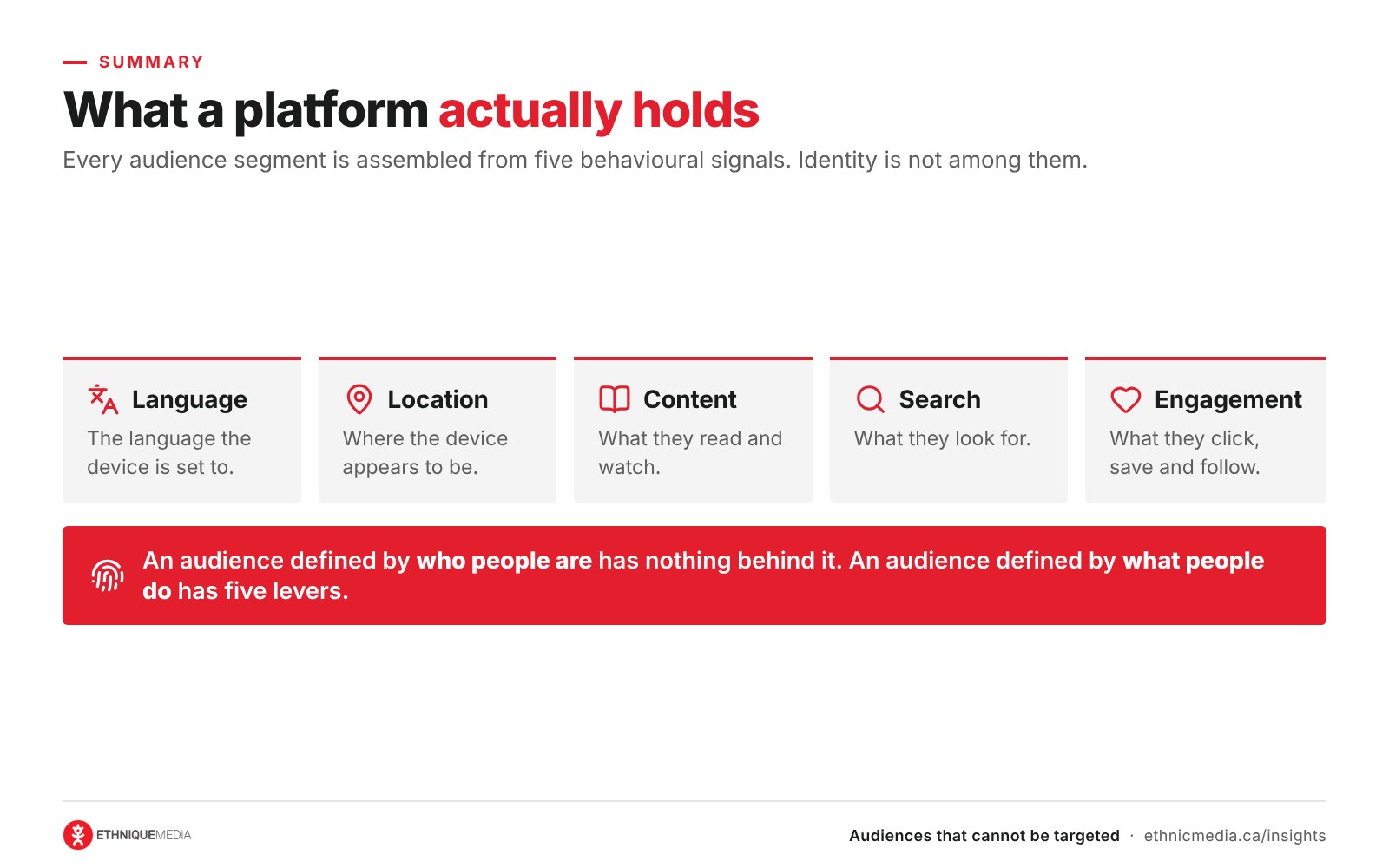
Clients describe their audience correctly. They say they want people of a particular community, people with a particular condition, people of a particular orientation. The description is right; what does not exist is a mechanism to buy it. No platform knows who anyone is. What it records is what a person does: the language their device is set to, where they appear to be, what content they consume, what they search for, what they engage with. Every audience segment is assembled from those signals. Using three examples — Black Canadians, people living with a medical condition, and LGBTQ+ audiences — this article sets out how a plan gets to these audiences when the platform will not sell them directly. Each one is unavailable to reach directly, for a different reason, which is why each is approached a different way.
1. Black Canadians
Clients ask to reach Black Canadians all the time, and it is a perfectly ordinary brief. The community is large, well defined and a sensible audience for a great many campaigns.
What it is not is targetable the way Chinese, Vietnamese, Punjabi or Tamil audiences are targetable. Language targeting is the workhorse of multicultural media, and it performs well for those communities because the language is itself the signal — selecting it selects the community with real precision.
It does nothing for communities whose language is English or French.
A French-language placement in Montréal reaches a Haitian household in Montréal-Nord and a Québécois household in Trois-Rivières in exactly the same way, because the platform observes a language setting and nothing more. There is no lever that distinguishes francophone from francophone. The same applies to Black Canadians in English Canada, and in both directions to anglophone Caribbean communities.
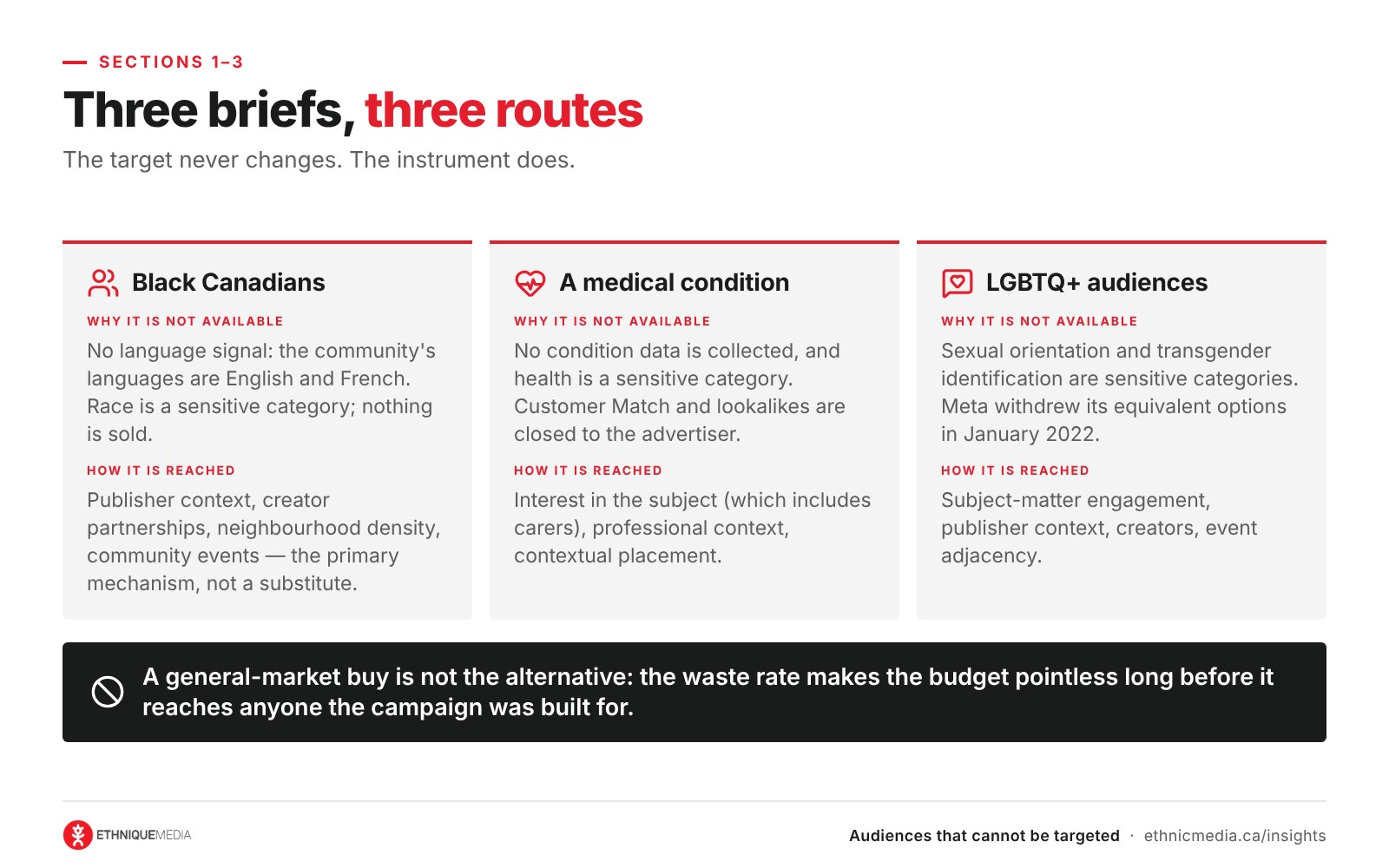
Nor is there an identity lever behind it. Race and ethnicity sit on Google's list of sensitive interest categories, and Google's own audience segments are configured with those signals deliberately excluded. Meta withdrew its equivalent detailed targeting options in January 2022. There is nothing to select.
The target does not change. What changes is which instrument carries the plan. Where language cannot distinguish an audience, publisher context, creator partnerships, neighbourhood density and community events do the work language does elsewhere — the outlets a community reads, the people they follow, the neighbourhoods they live in, the events they attend.
For these communities that is not a lesser substitute. It is the primary mechanism, and a plan built without it is reaching the right language and the wrong people.
2. People living with a medical condition
This is an equally common brief, and the audience is just as real. The route to it is different again.
Nobody is recorded as having a condition. No advertising platform holds a list of people with a chronic illness, because it is not collected and could not lawfully be traded if it were.
It is also restricted. Google treats health as a sensitive interest category, covering physical and mental health conditions including chronic ones, and products or services to treat or manage them — treatments for diabetes and arthritis appear as named examples. Google's predefined audiences are built with those sensitive signals deliberately excluded, so no such audience exists to buy. Advertisers promoting within the category face a further limit: they cannot use advertiser-curated audiences such as Customer Match, their own data segments or lookalikes. Meta removed its equivalent health targeting options in January 2022.
The patient remains the target. Nothing about the brief changes. What changes is the route, because a general-market buy is not a serious alternative — the waste rate makes the budget pointless long before it reaches anyone the campaign was built for.
What is available is proximity, by two routes.
Interest in the subject. People who read about a condition, follow treatment developments, search for management advice. That group contains the patient. It also contains the spouse doing the grocery shopping and the adult child researching on a parent's behalf — people who are frequently the ones making the purchase or the appointment.
Professional context. People working in the relevant field, reached through the signals that identify a professional audience rather than a patient one. Google's health policy distinguishes content directed at healthcare professionals acting in their professional capacity from content directed at patients, so the professional route sits in different territory from the patient route, for the advertiser as well as the planner.
Contextual placement remains available alongside both, putting the message beside the subject rather than following a person who has it.
The honest description for a plan is therefore not "people with the condition." It is the narrowest reachable group that contains them.
3. LGBTQ+ audiences
A brief naming this audience describes a real group with real purchasing behaviour, and the description is accurate. Here the restriction comes first rather than last.
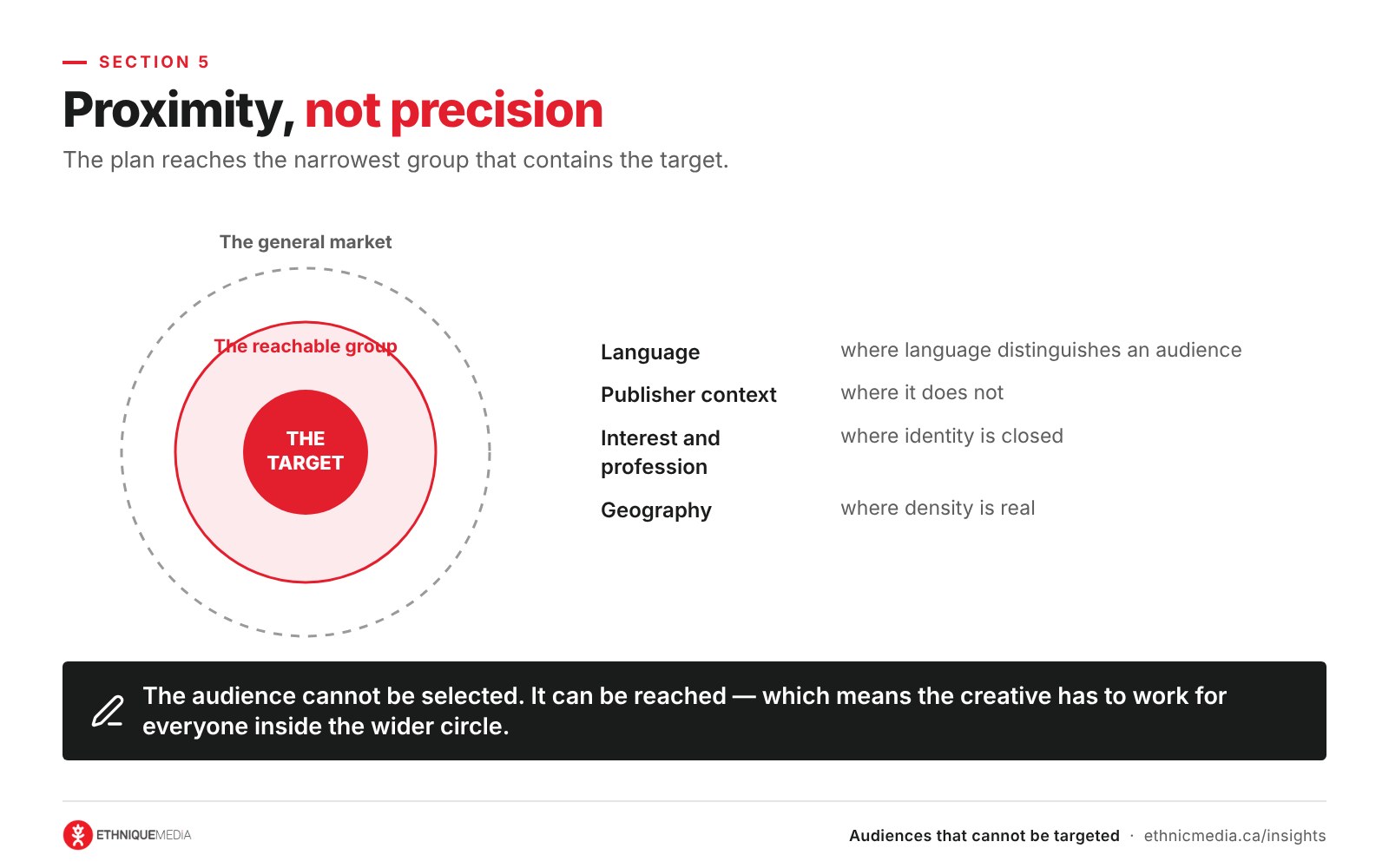
Sexual orientation sits on Google's list of sensitive interest categories, as do race and ethnicity, religious beliefs and transgender identification. Google's own audience segments are configured without those signals, and Meta withdrew its equivalent detailed targeting options in January 2022. There is nothing to buy, and an advertiser promoting within the category also loses access to advertiser-curated audiences.
What remains is engagement with the subject matter, publisher context, creator partnerships and event adjacency. The target has not moved. The route to it has.
4. Why the restrictions exist
It is worth being direct about this rather than treating the restrictions as an obstacle.
Google maintains a second framework alongside the sensitive categories, covering housing, employment and consumer finance in Canada and the United States, which it describes as designed to ensure equitable access to opportunities. Advertisers in those categories cannot target by gender, age, parental status, marital status or postal code.
Canada has a specific carve-out worth knowing: the first three characters of a postal code — the forward sortation area, or FSA — remain acceptable for targeting, as does radius targeting at a minimum of one kilometre, and city and country targeting.
The principle behind both frameworks is the same. Targeting that selects or excludes people by who they are, rather than by what they are interested in, has a history of being used to deny opportunity. That history is why the identity levers are closed, and it applies to this trade as much as any other: neighbourhood density is a legitimate reach tool for a grocery promotion and a different thing entirely when the product is a mortgage. The distinction is the use, not the technique.
5. Reaching them anyway
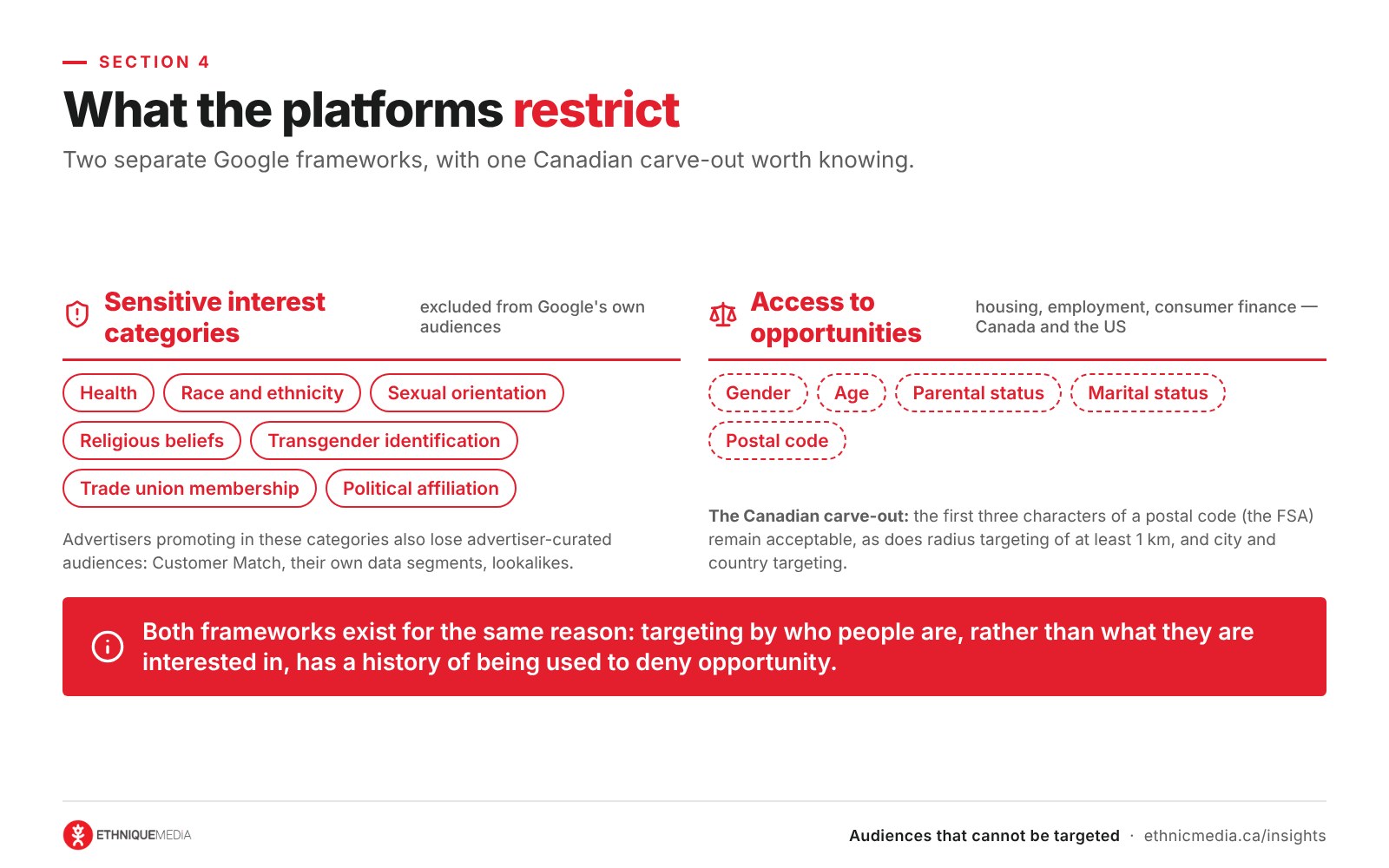
The accurate answer is not that the audience cannot be reached. It is that the audience cannot be selected, and that the plan therefore works by proximity rather than precision.
That answer holds three parts. The target in the brief does not change. The platform cannot deliver it directly, and in several cases is not permitted to. The plan reaches it by combining the signals that do exist — language where language distinguishes an audience, publisher context where it does not, professional and interest proximity where identity is closed, geography where density is real — into the narrowest reachable group that contains the people the campaign is for.
The creative then has to account for the width of that group. An interest segment contains the person managing a condition and the person caring for someone who is. A community publisher's audience contains the community and the people around it. Copy written as though every viewer belongs to the group will misfire on the portion who do not — a creative problem produced by a media constraint, and worth naming in the brief rather than discovering in market.
Sources
- Google Ads policy, Restricted targeting in Personalized advertising — sensitive interest categories (health, race and ethnicity, sexual orientation, religious beliefs, transgender identification, trade union membership); restrictions on advertiser-curated audiences; the Access to opportunities framework for housing, employment and consumer finance in Canada and the United States, including the Canadian FSA allowance.
- Google Ads policy, Health in personalized advertising — scope of the health category, with treatments for diabetes and arthritis as named examples, and the distinction for content directed at healthcare professionals.
- Meta, removal of detailed targeting options relating to health, race or ethnicity, political affiliation, religion and sexual orientation, effective 19 January 2022.