The Station Your Audience Actually Trusts: Why Ethnic Radio Still Outperforms in a Digital Plan
By Ethnique Media · October 20, 2026
Summary
Ask a mainstream media planner about radio in 2026 and the answer concerns declining share, ageing audiences and streaming substitution. Ask a Punjabi family in Surrey, a Cantonese-speaking retiree in Richmond Hill or a Haitian taxi driver in Montréal-Nord, and the answer is different. Radio is on in the kitchen, in the car, in the shop and on the phone, in their language, with hosts they know by first name, and it has been for decades. Canadian radio overall is holding up better than the obituaries suggest: Numeris reports that about 81 per cent of Canadians still listen to AM/FM weekly. Ethnic radio is not merely holding up. In the communities it serves, it is the most trusted commercial medium, and it is the channel most often underweighted by planners who build multicultural plans from a digital-first template. This article sets out what ethnic radio in Canada is, why it still works, and how to buy it properly.
1. What ethnic radio in Canada is
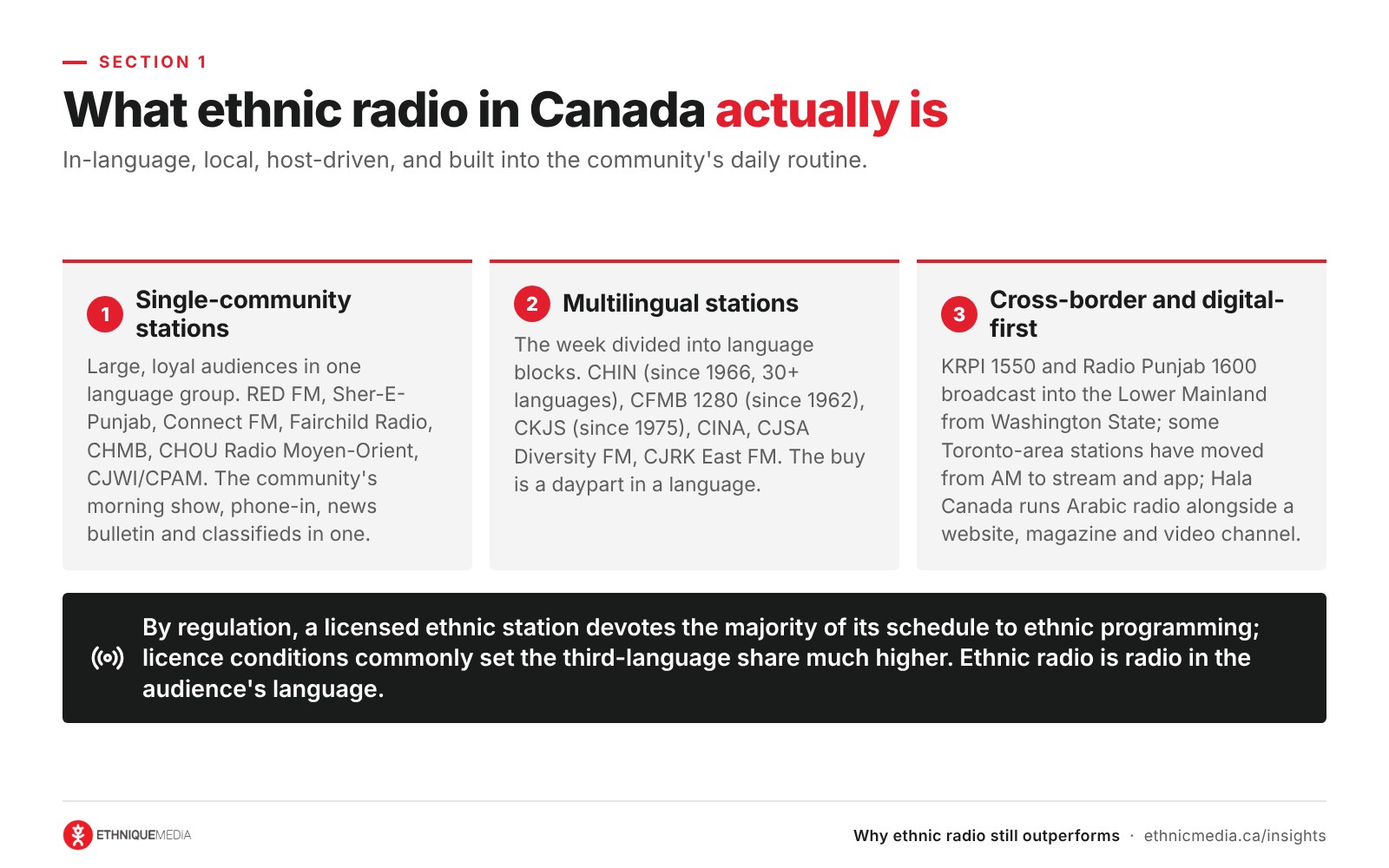
Of roughly 716 broadcast radio stations in Canada, 27 are licensed as ethnic stations, and several dozen more community and campus stations carry third-language blocks. The CRTC's ethnic broadcasting policy requires a licensed ethnic station to devote the majority of its schedule to ethnic programming, and individual licence conditions commonly set the third-language share much higher; non-ethnic stations are capped at 15 per cent ethnic programming unless they obtain specific approval. Ethnic radio is, by regulation, radio in the audience's language.
The landscape divides three ways.
Single-community stations with large, loyal audiences. RED FM in Vancouver (Punjabi, Hindi, Urdu) and its Calgary sister; Sher-E-Punjab (AM 600) and Connect FM (91.5) in Surrey; Fairchild Radio and CHMB AM 1320 in Cantonese and Mandarin in Vancouver; CHOU Radio Moyen-Orient (Arabic, Armenian) and CJWI/CPAM 1410 (Haitian Creole) in Montréal. These stations are the community's morning show, phone-in, news bulletin and classifieds in one.
Multilingual stations that divide the week into language blocks. CHIN Radio in Toronto and Ottawa (on air since 1966, in more than 30 languages), CFMB 1280 in Montréal (since 1962), CKJS in Winnipeg (since 1975), CINA Radio in Mississauga, CJSA Diversity FM 101.3 and CJRK East FM 102.7 in Toronto. Here the buy is a daypart in a language: the Tamil evening block, the Tagalog Sunday morning, the Portuguese afternoon.
Cross-border and digital-first players. KRPI 1550 and Radio Punjab 1600 broadcast into the Lower Mainland from Washington State; several Toronto-area stations have moved from AM to stream and app; Hala Canada runs Arabic radio alongside a website, magazine and video channel.
The pattern is the same everywhere: in-language, local, host-driven, and tightly woven into the community's daily routine.
2. Why it still works: five reasons
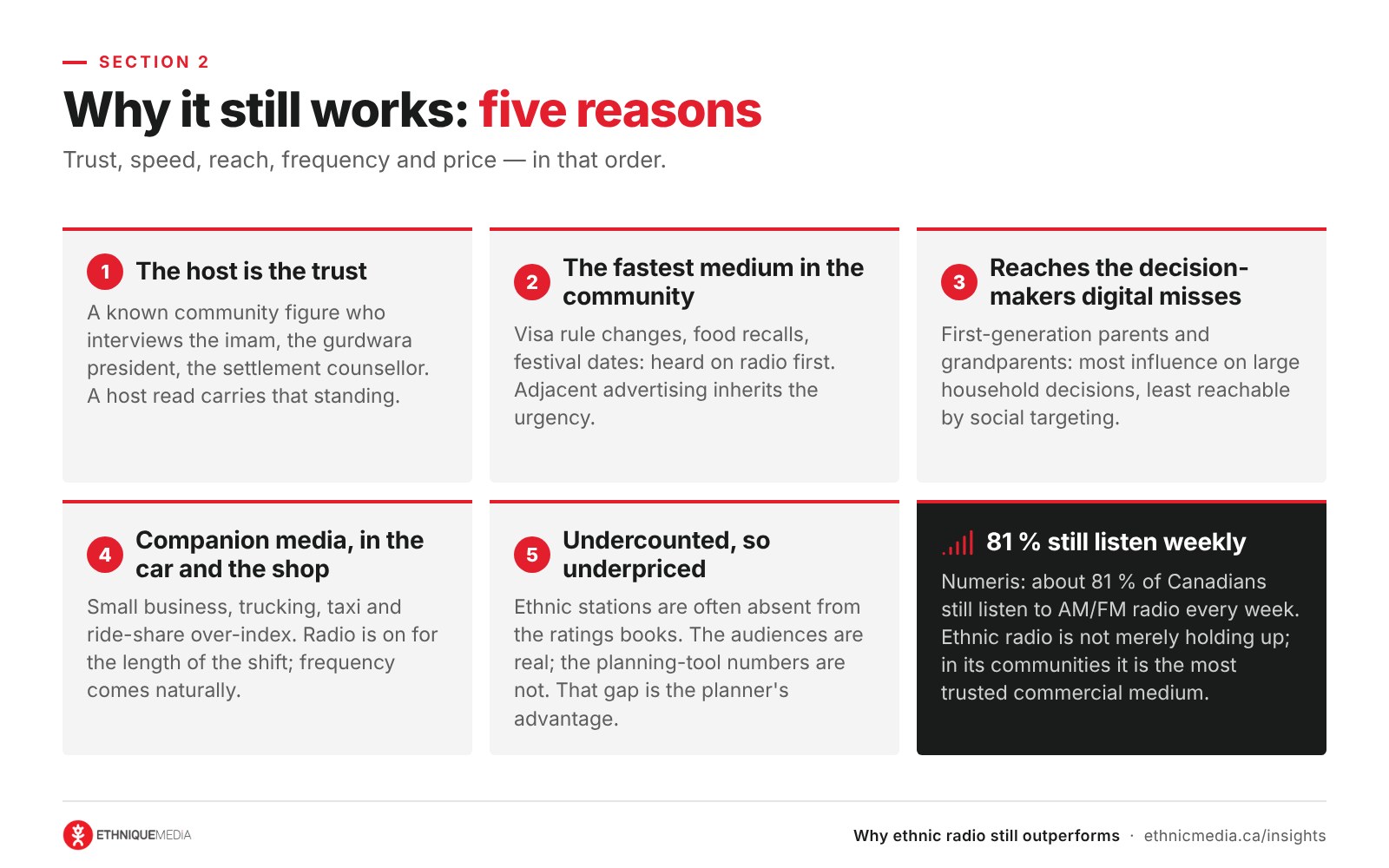
2.1 The host is the trust
On mainstream radio, the advertisement is an interruption between songs. On ethnic radio, the host is a known community figure, often an immigrant from the same region, who interviews the imam, the gurdwara president, the settlement counsellor and the local MP. A host-read endorsement carries that standing with it. Advertisers who have run both a produced spot and a host read on the same station see the difference in call volume the same week.
2.2 It is the fastest medium in the community
New Canadian Media has documented how ethnic reporters surface community stories months or years before mainstream outlets pick them up; RED FM's news director described being surprised to hear his station's stories appear in mainstream coverage long after they aired. When something matters to the community — a visa rule change, a food recall, a festival date — radio is where it is heard first. Advertising adjacent to that news inherits its urgency.
2.3 It reaches the household decision-makers digital misses
First-generation parents and grandparents, the audience most likely to influence large household decisions and least likely to be reached by social media targeting, are radio's core listeners. For financial services, health, pharmacy, auto, real estate and government communications, this is often the only efficient way to reach them at scale.
2.4 It is companion media, in the car and in the shop
South Asian and Chinese Canadian communities over-index in small business ownership, trucking, taxi and ride-share driving. Radio is on for the length of the shift. Frequency, the thing digital buys struggle to deliver without irritation, comes naturally.
2.5 It is undercounted, which means it is underpriced
Standard audience measurement has historically weighted third-language listening only in markets where the third-language population passes a threshold, and ethnic stations are often absent from the ratings books planners use. The audiences are real; the numbers in the planning tool are not. That gap is the planner's advantage: ethnic radio typically delivers a cost per thousand well below mainstream radio for an audience mainstream radio cannot reach at all.
3. How to buy it properly
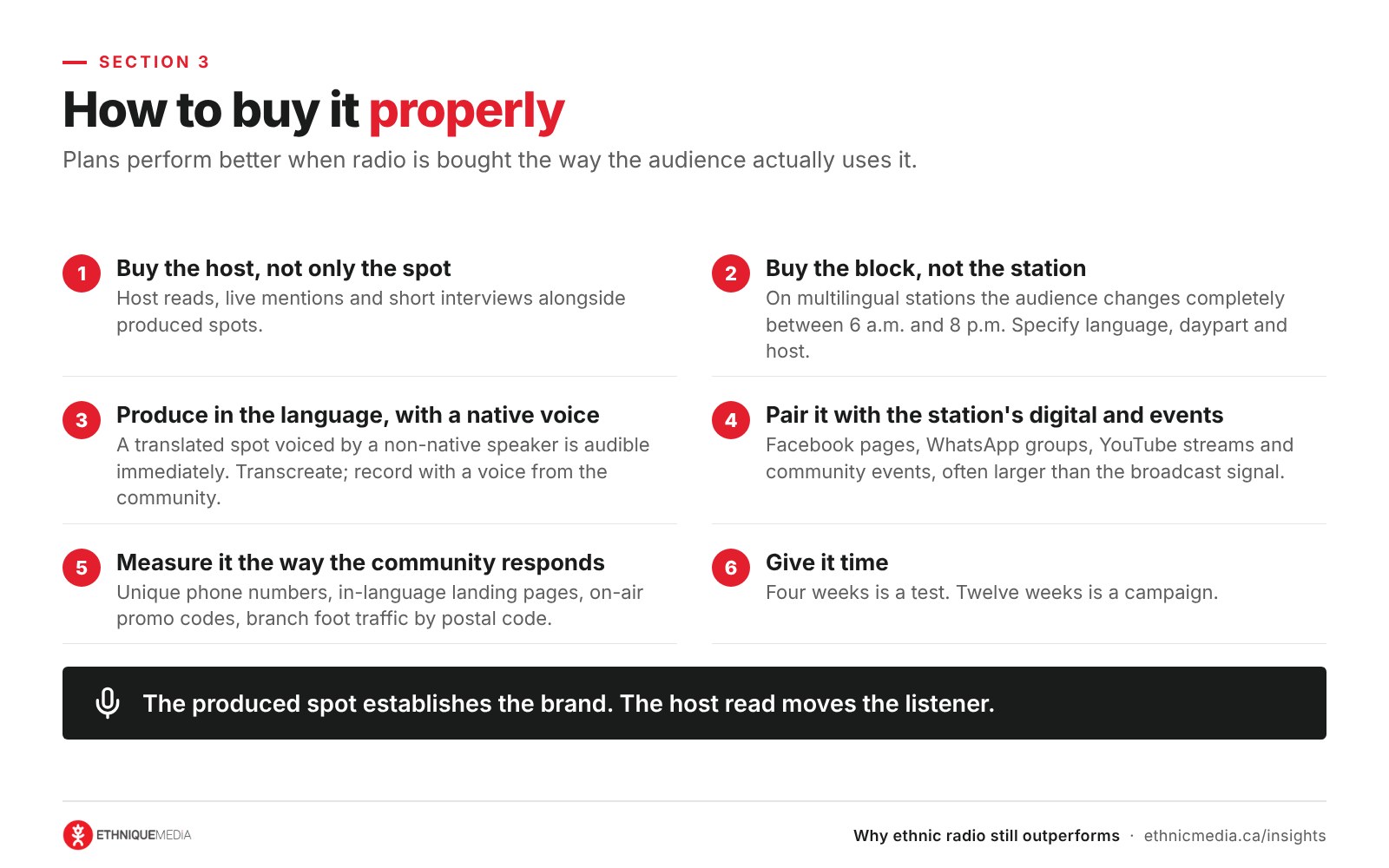
Ethnic radio is not bought the way mainstream radio is bought, and plans that treat it as a line of GRPs usually underperform.
- Buy the host, not only the spot. Budget for host reads, live mentions and short interviews alongside produced spots. The produced spot establishes the brand; the host read moves the listener.
- Buy the block, not the station. On multilingual stations, the audience changes completely between 6 a.m. and 8 p.m. Specify the language block and the daypart, and confirm the host.
- Produce in the language, with a native voice. A spot translated and voiced by a non-native speaker is audible immediately and damages the host's credibility along with the brand's. Transcreate the script; record with a voice from the community.
- Pair it with the station's digital and events. Most ethnic stations run Facebook pages, WhatsApp groups, YouTube streams and community events with audiences larger than their broadcast signal. Buy the package.
- Measure it the way the community responds. Use unique phone numbers, in-language landing pages, promo codes announced on air, and dealer or branch foot traffic by postal code. Standard digital attribution will show nothing; the response is real.
- Give it time. Ethnic radio builds through repetition and familiarity. Four weeks is a test; twelve weeks is a campaign.
4. Where it fits in a 2026 plan
Ethnic radio is not the whole plan, and it is rarely the largest line. In the integrated plans we build, it typically carries a quarter to a third of a multicultural budget, alongside community print, in-language digital display, sponsored content and connected TV. Its role is specific: it is the channel that reaches first-generation decision-makers, delivers frequency efficiently, and gives the brand a trusted voice in the community rather than a presence in a feed.
As immigration levels flatten and communities mature, the first-generation audience that ethnic radio serves is not going away; it is getting older, wealthier and more settled. The stations that have served it for forty or sixty years are still on the air, still trusted and still underpriced. The planner who puts them back in the plan is buying the one medium the audience would name first.
Sources
- Numeris, reported in Billboard Canada, Canadian radio listening habits 2025 (81 per cent weekly AM/FM reach).
- Radio Connects, Fast Facts About Live Radio 2024 (119 AM and 597 FM stations; 27 ethnic; source CRTC 2022).
- CRTC, Ethnic Broadcasting Policy (Public Notice CRTC 1999-117) and subsequent licence decisions on third-language programming conditions.
- New Canadian Media, Ethnic media: trusted by community, hobbled by lack of resources.
- Brioux.tv (2019), Ratings: why OMNI numbers never add up (Numeris third-language weighting).