Retail Media Networks and the Multicultural Shopper: Canada's Fastest-Growing Channel Has a Blind Spot
By Ethnique Media · October 27, 2026
Summary
Retail media is the fastest-growing advertising channel at scale in Canada. eMarketer puts Canadian retail media spending at about C$3.8 billion in 2026 — roughly one digital ad dollar in five — growing more than twice as fast as digital overall, and ranks Canada second in the world, behind only China, for retail media's share of digital spend. Loblaw Advance, Walmart Connect, Canadian Tire's Triangle Retail Media and Amazon Ads now sit on most CPG media plans. The gap is this: the shoppers who over-index in exactly the categories retail media sells best — rice, cooking oil, spices, infant formula, over-the-counter health, remittance-adjacent financial products — are multicultural households, yet almost nobody is planning retail media with a multicultural lens, and the networks themselves offer little in the way of cultural or language segmentation. This article is about how to close that gap without waiting for the networks to do it.
1. Why multicultural shoppers matter more in retail media than anywhere else
Retail media's proposition is closed-loop measurement: the advertisement is served to a loyalty-card holder, and the purchase is recorded on the same card. That makes it the first channel in which a brand can see, in sales data, whether a culturally adapted message outperforms a generic one.
Multicultural households are the shoppers for whom that test pays off most.
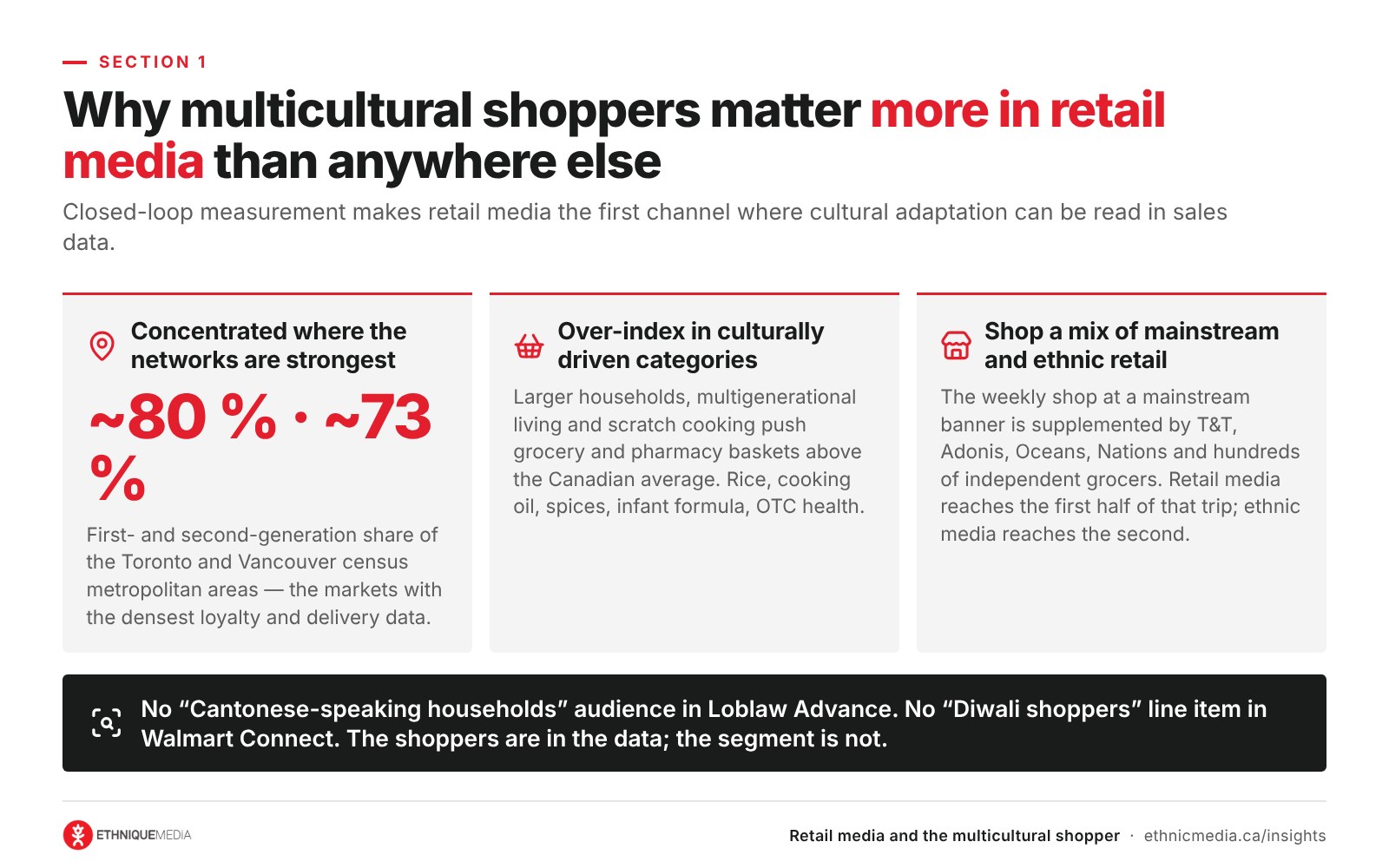
They are concentrated where the networks are strongest. First- and second-generation Canadians make up about four fifths of the Toronto census metropolitan area and close to three quarters of Vancouver's, the two markets where Loblaw, Walmart and Amazon hold the densest loyalty and delivery data.
They over-index in basket size and frequency in culturally driven categories. Larger households, multigenerational living — between 60 and 94 per cent of racialised second-generation Canadians live with a first-generation family member — and scratch cooking push grocery and pharmacy baskets above the Canadian average. These statements are directional; the networks' own data will quantify them for a given category.
They shop a mix of mainstream and ethnic retail. The weekly shop at a mainstream banner is supplemented by T&T, Adonis, Oceans, Nations and hundreds of independent ethnic grocers. Retail media reaches the first half of that trip; ethnic media reaches the second.
2. The blind spot in the networks
Canadian retail media networks segment on purchase behaviour, loyalty tier, geography and, increasingly, modelled demographics. What they do not offer as a standard segment is language or culture. There is no "Cantonese-speaking households" audience in Loblaw Advance. There is no "Diwali shoppers" line item in Walmart Connect.
The result is that multicultural shoppers are in the data but invisible in the targeting. A brand running a Lunar New Year promotion through retail media will reach them only by accident, through category affinity, and will measure the lift as a generic category result rather than a cultural one.
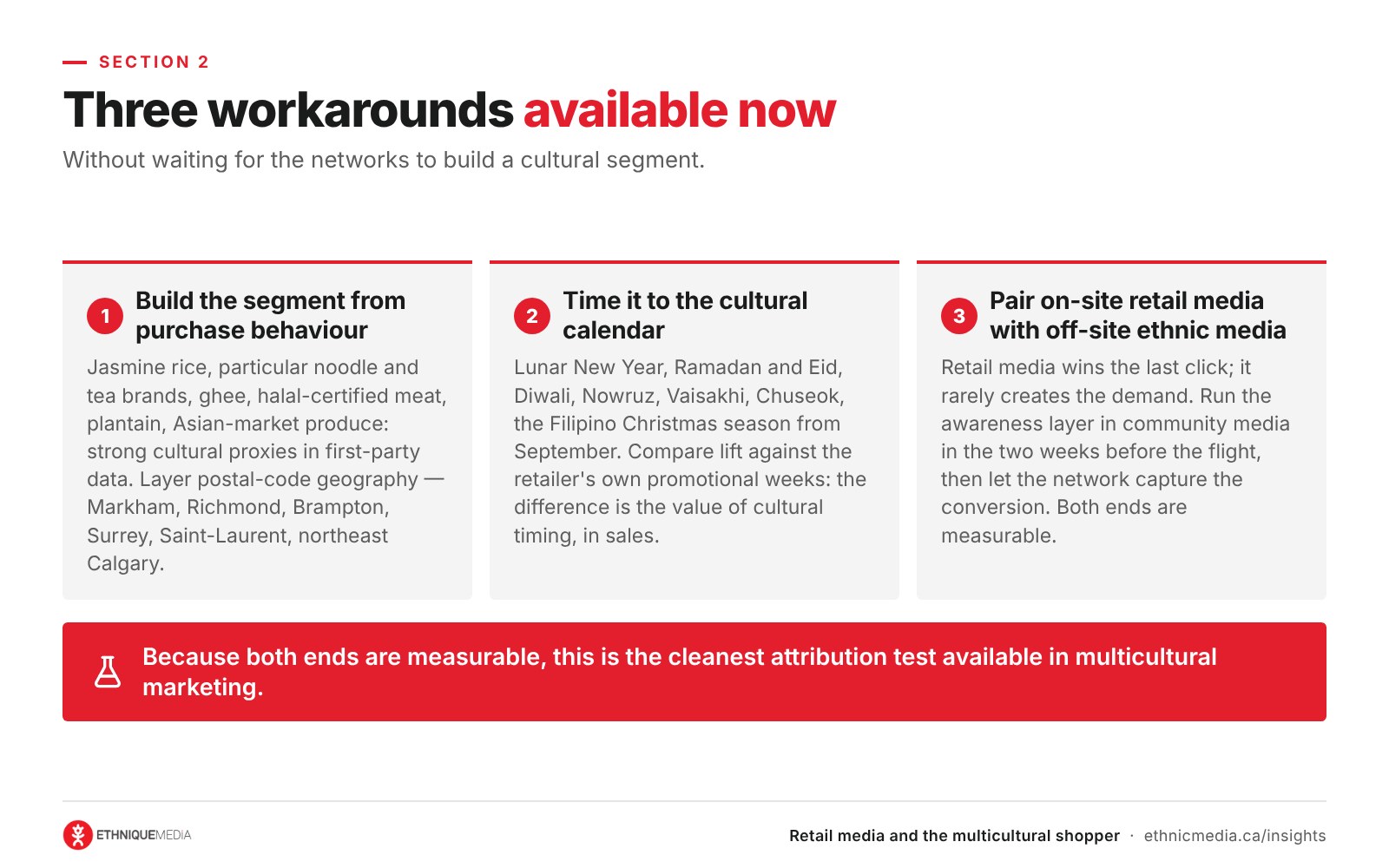
Three workarounds are available now.
2.1 Build the segment from purchase behaviour
Category and brand affinities are strong cultural proxies. Buyers of jasmine rice, particular noodle brands, ghee, halal-certified meat, plantain, particular tea brands or Asian-market produce are identifiable in retailer first-party data. Ask the network to build custom audiences from those SKUs, then layer postal-code geography from our community profiles — Markham, Richmond, Brampton, Surrey, Saint-Laurent, northeast Calgary — to tighten them.
2.2 Time it to the cultural calendar
Retail media flights are usually planned around retailer promotional weeks. Multicultural shopping peaks follow a different calendar: Lunar New Year, Ramadan and Eid, Diwali, Nowruz, Vaisakhi, Chuseok, and the Filipino Christmas season that begins in September. Align retail media flights with those peaks and compare lift against the retailer's own promotional weeks. The difference is the value of cultural timing, measured in sales.
2.3 Pair on-site retail media with off-site ethnic media
Retail media wins the last click; it rarely creates the demand. The brands getting the best closed-loop results run the awareness layer in community media — in-language radio, community press, diaspora news sites, WeChat and Xiaohongshu for Chinese audiences — in the two weeks before the retail media flight, then let the retail network capture the conversion. Because both ends are measurable, this is the cleanest attribution test available in multicultural marketing.
3. A planning framework
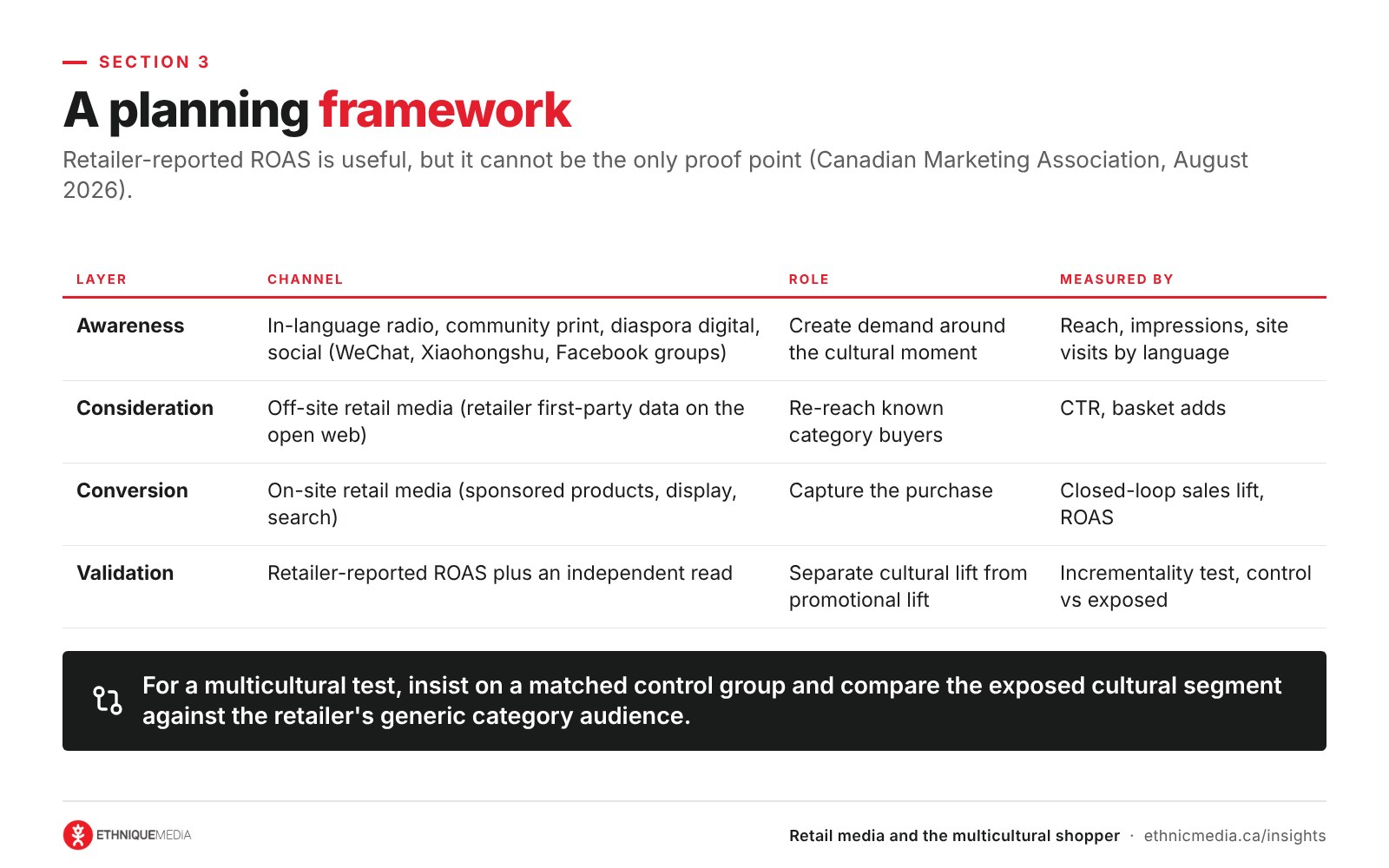
| Layer | Channel | Role | Measured by |
|---|---|---|---|
| Awareness | In-language radio, community print, diaspora digital, social (WeChat, Xiaohongshu, Facebook groups) | Create demand around the cultural moment | Reach, impressions, site visits by language |
| Consideration | Off-site retail media (retailer first-party data served on the open web) | Re-reach known category buyers | CTR, basket adds |
| Conversion | On-site retail media (sponsored products, display, search) | Capture the purchase | Closed-loop sales lift, ROAS |
| Validation | Retailer-reported ROAS plus an independent read | Separate cultural lift from promotional lift | Incrementality test, control versus exposed |
The Canadian Marketing Association's August 2026 review of retail media made a point that applies doubly here: retailer-reported ROAS is useful, but it cannot be the only proof point. For a multicultural test, insist on a matched control group and compare the exposed cultural segment against the retailer's generic category audience.
4. What to ask the retail media partner
- Can you build a custom audience from this list of culturally specific SKUs and brands?
- Can you overlay it with these postal-code clusters?
- Can you report lift for that segment separately from the category total?
- Can you flight around these dates rather than your promotional calendar?
- Can we run a holdout to measure incrementality for the cultural segment?
Where the answers are no, the network is not ready for multicultural shopper marketing, and the budget is better spent where the audience can be reached and measured.
5. The opportunity
Retail media is about to become the largest line on many CPG plans, and it is being planned as if Canada's shoppers were culturally uniform. They are not. The first brands to build cultural segments from purchase data, time flights to the cultural calendar, and pair the retail network with the community media that creates the demand will hold a measurement advantage their competitors cannot buy. They will also be able to show, in the retailer's own sales data, what multicultural marketing is worth.
Sources
- eMarketer (2026, January). Canada Retail Media 2026.
- eMarketer. Retail media is the fastest-growing digital advertising channel at scale in Canada.
- Canadian Marketing Association (2026, 5 August). Retail media in Canada: what's driving the growth?
- Environics Analytics (2022). Census 2021: Canada's cultural diversity continues to increase.
- Hou, F., Schimmele, C., & Stick, M. (2023). Changing demographics of racialized people in Canada. Statistics Canada.