Attitude in Multilingual Advertising: Why Grammatically Correct Copy Still Fails
By Ethnique Media · September 23, 2026
Summary
Multilingual advertising review processes are designed to verify accuracy. They are not designed to verify the interpersonal posture a sentence adopts toward its reader. This distinction is well established in linguistics but has no standard term in marketing practice, and the absence of that term explains a recurring and largely undetected category of failure. This paper describes the mechanism, identifies why standard quality assurance cannot detect it, and proposes two practical adjustments to the briefing and review process.
1. The problem
An agency delivers a Mandarin campaign. The copy passes grammatical review, terminological review and accuracy review against the approved English. Meaning is preserved without error. The work is approved.
A native speaker then reads the copy and identifies a problem that none of the preceding checks were capable of surfacing. The sentences instruct rather than invite. The brand addresses the reader from a position of authority it has not established. No individual word is incorrect, and the cumulative effect is nonetheless unsuitable.
This outcome is common, and it is not attributable to carelessness on the part of any participant in the process.
2. Attitude is distinct from tone of voice
Marketing practice already possesses a term that appears to describe this phenomenon, and the resemblance is misleading.
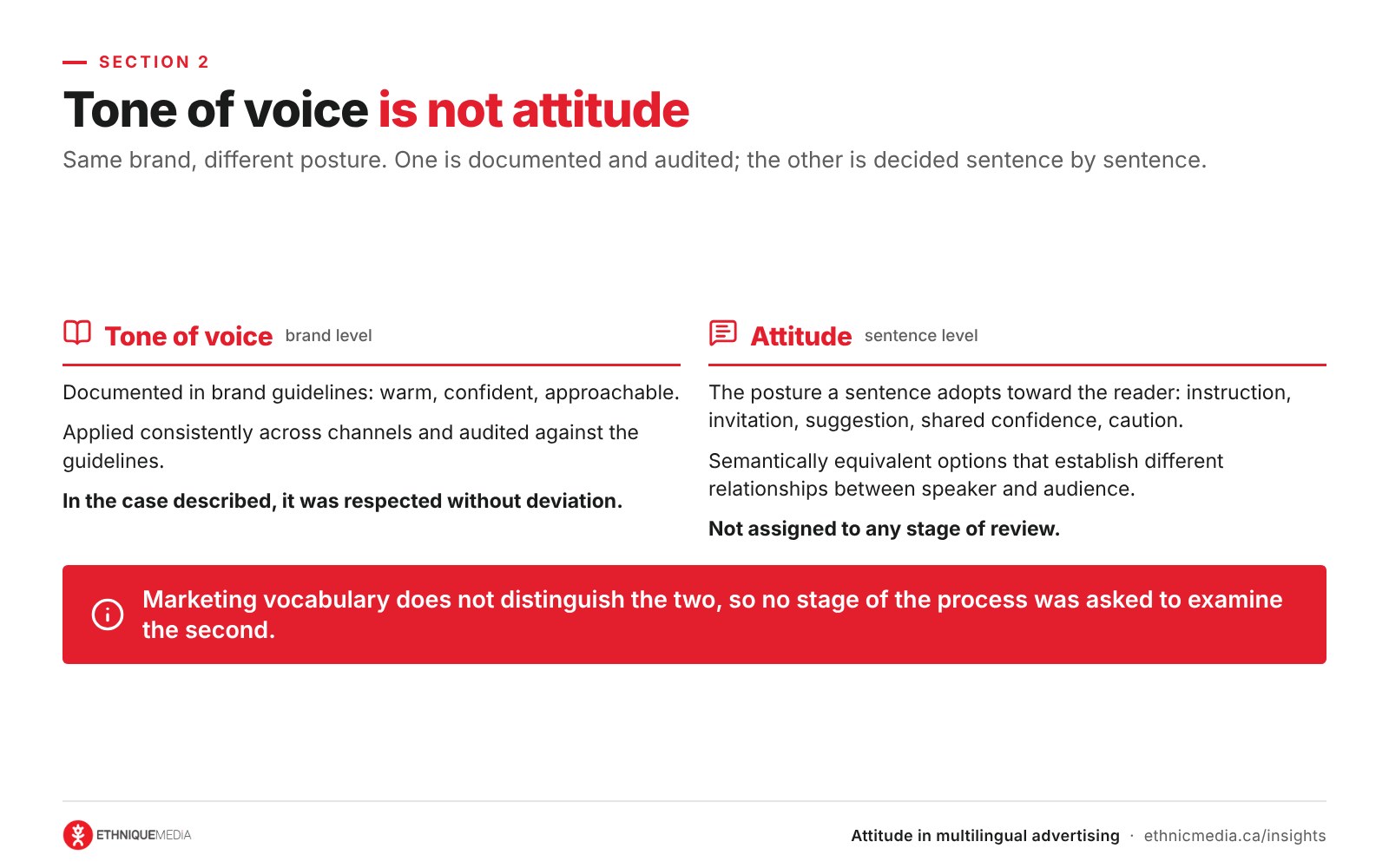
Tone of voice operates at brand level. It is documented in brand guidelines, applied consistently across channels, and audited against those guidelines. In the case described above, the copy conformed to the brand's documented tone of voice without deviation.
Attitude operates at sentence level. It describes the posture a given sentence adopts toward the reader: whether the message is delivered as an instruction, an invitation, a suggestion, a shared confidence, or a caution. These options are semantically equivalent. They are not functionally equivalent, because each establishes a different relationship between speaker and audience.
The brand voice was correct. The sentence attitude was not. Because marketing vocabulary does not distinguish between the two, no stage of the review process was assigned to examine the latter.
3. Mechanism
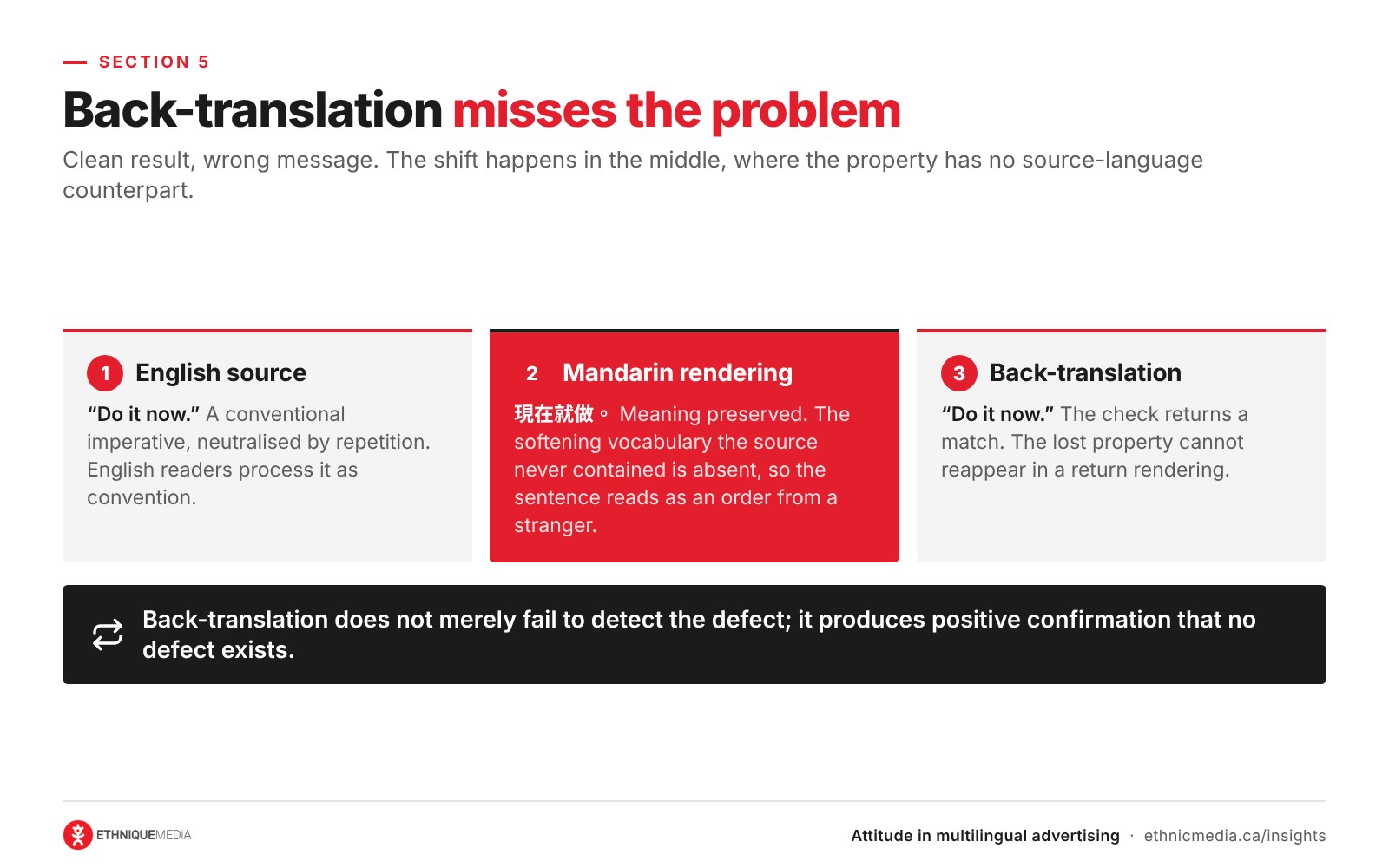
English advertising relies heavily on the imperative mood. Constructions such as get yours today, don't miss out and book before Friday are conventional to the genre, and English-language audiences process them as convention rather than as directives. The imperative has been functionally neutralised through repetition.
Mandarin has no equivalent neutralising convention. A directive issued by an unfamiliar party retains its force, and a commercial brand constitutes an unfamiliar party.
Three specific transfers occur when English advertising copy is rendered into Mandarin without adaptation.
3.1 Absence of softening vocabulary
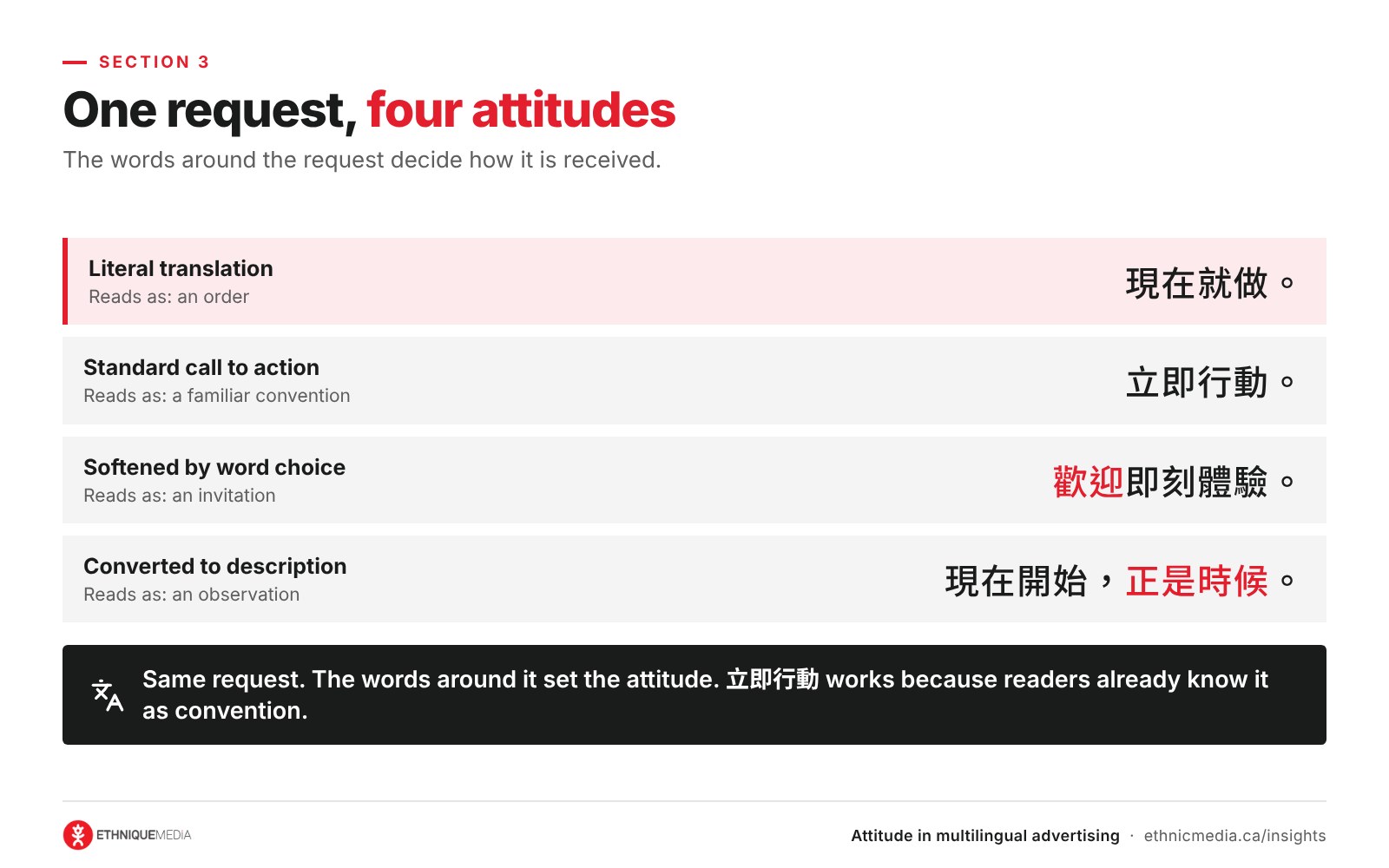
Written Mandarin advertising mitigates the force of a directive primarily through lexical choice. Terms such as 歡迎 (you are welcome to), 敬請 and 誠邀 (respectfully or sincerely invite), and the honorific 您 in place of 你 add little or no information to a sentence. Their principal function is to establish the relationship between brand and reader. An English source such as do it now contains no element that calls for any of them. A translator working at sentence level therefore renders it plainly, as 現在就做, rather than as 歡迎立即體驗. The request is the same in both versions, but the relationship implied is not: the first reads as an order, the second as an invitation.
3.2 Conversion of directive to description
Formal Mandarin copy frequently removes the directive altogether and conveys the request through a statement the reader can act on. 現在開始,正是時候 ("now is the right time to start") contains no instruction. It presents a fact and leaves the conclusion to the reader. English can achieve a comparable effect through indirectness (why not start today), but English advertising rarely needs to, because convention has already neutralised its imperatives. A sentence-level translation therefore carries the imperative across intact and does not consider the descriptive alternative.
3.3 Retention of source-language word order
Mandarin discourse commonly establishes context before introducing comment. English advertising copy is characteristically verb-initial and benefit-initial. Preserving English constituent order in Mandarin produces an abruptness that the source text does not have.
4. Terminological asymmetry
Chinese possesses an everyday term for the property in question: 語氣. The term encompasses both grammatical mood — the imperative is 祈使語氣 — and interpersonal stance, as in the description of a speaker addressing an audience 居高臨下, from a position above them. Mood and social posture are treated as a single category.
Chinese further possesses a term for the specific failure mode described here: 翻譯腔, commonly rendered as "translationese." Lu Gusun's English–Chinese Dictionary established this equivalence, and the concept has since been formalised sufficiently that machine-translation research employs a graded translationese scale, in which annotators rate output on a five-point Likert scale and identify the specific segments exhibiting the property. The published definition characterises it as word choice and word order visibly shaped by the translation process, producing expressions that deviate from native usage.
English-language marketing practice has no equivalent term. "Tone" denotes a different concept, and "register," while accurate, is not in general professional use.
This asymmetry is the operative explanation. A quality assurance process can only test for properties that have been named. The target language possessed a term for the defect; the source language did not; consequently no stage of the workflow was configured to detect it.
5. Why standard quality assurance cannot detect this
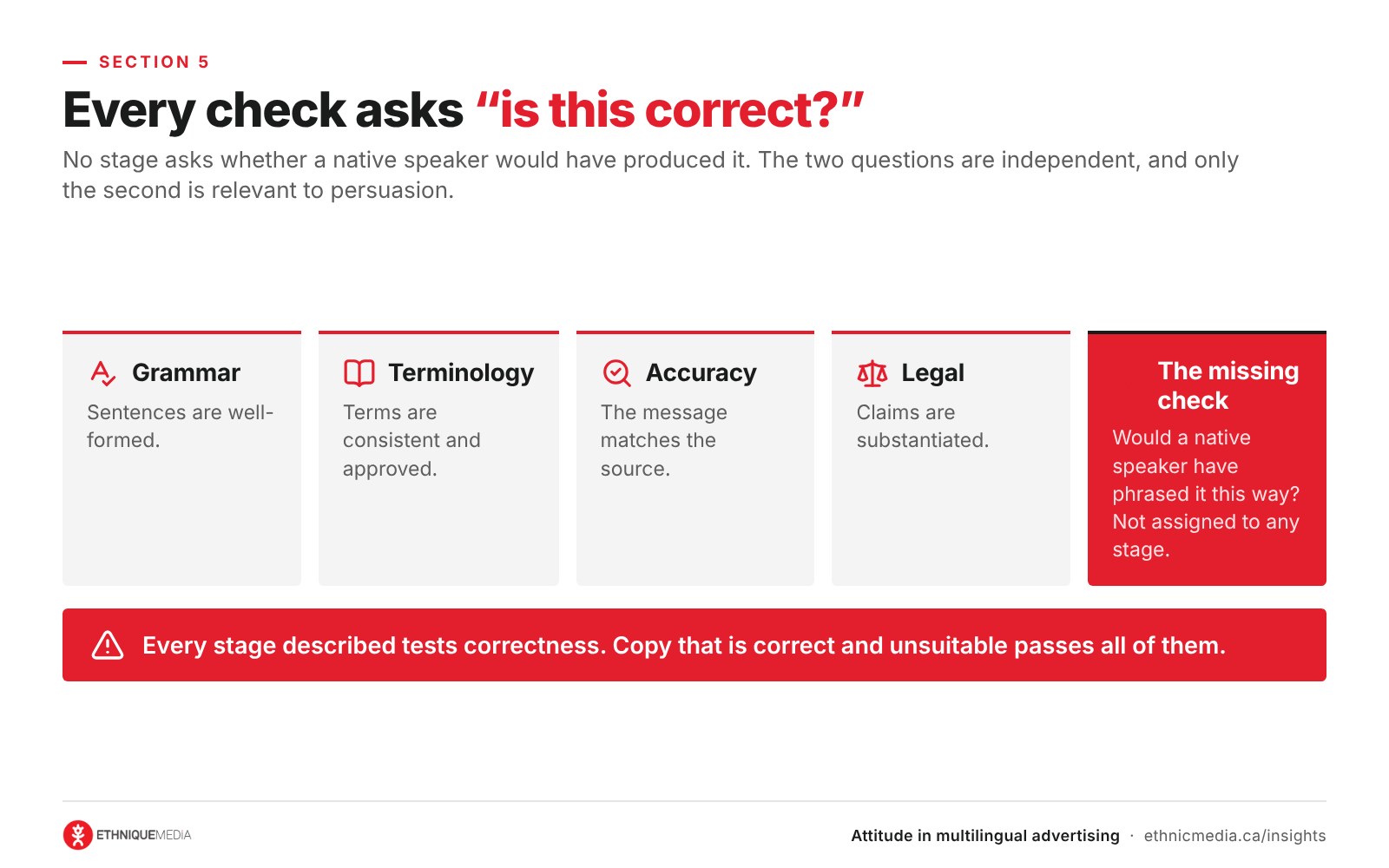
Each stage of a conventional translation review tests for correctness. Grammatical review confirms well-formedness. Terminological review confirms consistency. Accuracy review confirms semantic equivalence against the source. Legal review confirms claim substantiation. A bilingual client-side reviewer conducting a rapid check will generally confirm all of the above, because the copy is in fact correct.
Back-translation, the standard safeguard applied to translated advertising, presents a more specific difficulty. Back-translating an excessively directive Mandarin rendering into English produces text closely resembling the original English imperative. The check returns a match.
This is a structural limitation rather than a procedural failure. The property that has been lost has no source-language counterpart, and therefore cannot reappear in a return rendering. Back-translation does not merely fail to detect the defect; it produces positive confirmation that no defect exists.
Every stage described above tests the proposition is this correct. No stage tests the proposition would a native speaker produce this. The two are independent, and only the second is relevant to persuasion.
6. Theoretical background
The phenomenon is well documented outside marketing.
Systemic Functional Linguistics identifies the interpersonal metafunction as one of three simultaneous strands of meaning in any utterance, concerned specifically with the relationship between speaker and addressee and the speaker's stance, as distinct from the representation of experience and the organisation of information (Halliday & Matthiessen, 2014). Martin and White's Appraisal framework formalises a system designated ATTITUDE within this metafunction (Martin & White, 2005). Brown and Levinson's politeness theory accounts for the cost of unmitigated directives: an imperative constitutes a face-threatening act, impinging on the addressee's freedom of action, and the mitigating strategies available differ substantially across languages (Brown & Levinson, 1987).
Consumer research supports the commercial relevance of these findings. Puntoni, de Langhe and van Osselaer demonstrate across five experiments that marketing messages in a consumer's native language are perceived as more emotional than equivalent second-language messages, and establish that the effect is not attributable to comprehension differences (Puntoni et al., 2009). Luna, Ringberg and Peracchio demonstrate that language cues activate distinct culture-specific mental frames in bicultural consumers (Luna et al., 2008).
The relevant knowledge is established. It has not been incorporated into commercial briefing practice.
7. Recommendations
The adjustments that address this defect are modest in scope. Neither requires additional headcount, additional vendors, or a revised approval chain. Both operate by introducing a question that the current process does not ask, at points in the workflow where that question can still be answered cheaply.
7.1 Specifying attitude at the brief stage
Attitude is most reliably controlled before copy exists. Once a draft is circulating, reviewers respond to what is in front of them, and a discussion of interpersonal posture becomes a discussion of a particular sentence rather than of the intended relationship with the audience. Specifying attitude in the brief moves the decision upstream, where it is a strategic choice rather than a line edit.
In practice this takes the form of a short additional field, positioned alongside tone of voice rather than within it. The distinction is worth preserving in the document itself, since the two are frequently conflated once they share a heading.
The following comparison illustrates the difference in usable detail.
| Typical brief language | Attitude specification | |
|---|---|---|
| Tone of voice | Warm, confident, approachable | (unchanged — remains a brand-level property) |
| Attitude | (absent) | The message should read as a recommendation offered between peers. It should not read as an institution issuing instructions. Where a call to action is required, it should be framed as an invitation rather than a directive. |
Briefs that specify attitude in these terms give translators and in-market copywriters a criterion they can apply, and give reviewers a standard against which a draft can be assessed. Briefs that omit it leave the decision to be made implicitly by whoever writes the sentence, typically by carrying over the conventions of the source language.
A single line is generally sufficient. The requirement is that it be expressed as a relationship rather than as an adjective, since adjectives describe the brand and relationships describe the sentence.
7.2 Reframing the native-speaker review
Native-speaker review is already present in most multilingual workflows. The adjustment concerns the question put to the reviewer rather than the addition of a stage.
Reviewers asked to confirm accuracy will confirm accuracy, and will frequently notice an attitude problem without reporting it, on the reasonable assumption that it falls outside the scope of the task assigned to them. Reviewers asked directly about interpersonal posture answer immediately, because the judgement is intuitive to any competent speaker of the language.
Three questions have proved sufficient in practice:
- What attitude does this copy adopt toward the reader — instruction, invitation, suggestion, or something else?
- Does that correspond to the attitude specified in the brief?
- Would a native speaker producing this message independently have phrased it this way?
The third question is the one that distinguishes this review from every preceding stage. It is not a test of correctness, and reviewers should be told so explicitly, since a reviewer who understands the task as proofreading will return a clean result on copy that is correct and unsuitable.
It is also worth identifying who is best placed to answer. The relevant competence is social rather than technical: a reviewer who uses the language daily in ordinary conversation will detect attitude reliably, whereas a reviewer whose command of the language is primarily professional or academic may not. This distinction matters in markets where the written standard and the spoken variety diverge substantially.
7.3 Positioning within the workflow
The two adjustments function as a pair. Specifying attitude without reframing review produces a requirement that nothing tests. Reframing review without specifying attitude produces a judgement with no standard to measure against, and reviewers will default to personal preference.
Sequenced together, they occupy two existing points in the process:
- At briefing, alongside tone of voice, before translation or in-market copywriting begins.
- At native-speaker review, before internal approval and before the work reaches client review — at the stage where revision is still inexpensive.
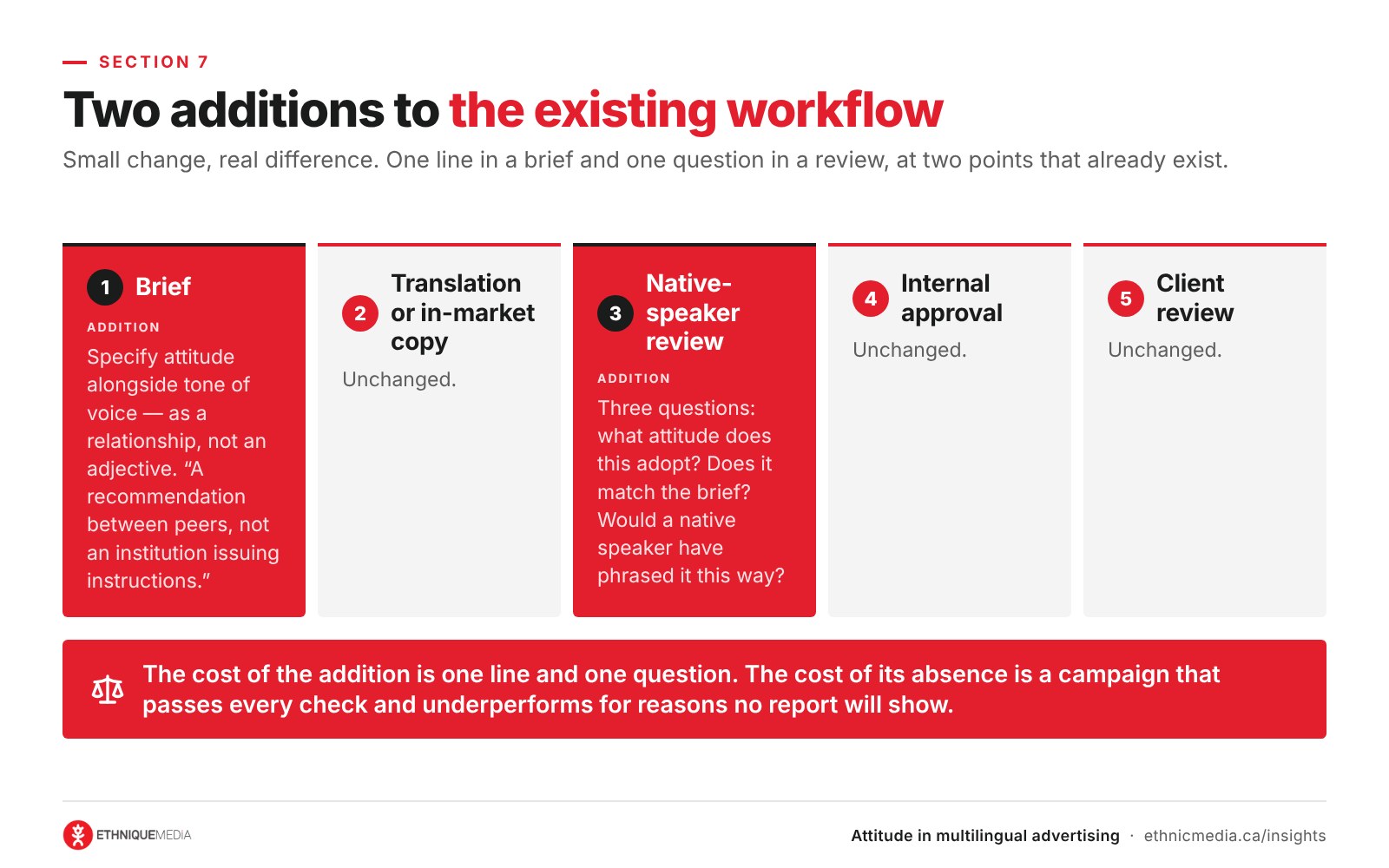
The cost of the addition is one line in a brief and one question in a review. The cost of its absence is a campaign that passes every check and underperforms for reasons that will not appear in any report, since copy that alienates its audience produces weak results rather than identifiable errors. That asymmetry is the principal argument for making the change.
8. Implications for machine translation
Improvements in machine translation quality will not resolve this category of defect. A system optimised for semantic equivalence omits modal particles for the same reason a human translator does: the source text contains no element requiring their retention. Increased fluency in output raises confidence in translations that remain interpersonally incorrect. The defect is located in the material that carries no meaning, and meaning-equivalence is the criterion such systems are built to satisfy.
References
- Brown, P., & Levinson, S. C. (1987). Politeness: Some Universals in Language Usage. Cambridge University Press.
- Cambridge Chinese (Simplified)–English Dictionary. Entry: 语气. [Source for 祈使语气 and 居高临下的语气.]
- China Daily language column (2008). 翻译腔在攻城掠地. [Records Lu Gusun's English–Chinese Dictionary rendering of "translationese" as 翻译腔.]
- Halliday, M. A. K., & Matthiessen, C. (2014). Halliday's Introduction to Functional Grammar (4th ed.). Routledge.
- Luna, D., & Peracchio, L. A. (2005). Advertising to bilingual consumers: The impact of code-switching on persuasion. Journal of Consumer Research, 31, 760–765.
- Luna, D., Ringberg, T., & Peracchio, L. A. (2008). One individual, two identities: Frame switching among biculturals. Journal of Consumer Research, 35(2), 279–293.
- Martin, J. R., & White, P. R. R. (2005). The Language of Evaluation: Appraisal in English. Palgrave Macmillan.
- Puntoni, S., de Langhe, B., & van Osselaer, S. M. J. (2009). Bilingualism and the emotional intensity of advertising language. Journal of Consumer Research, 35(6), 1012–1025.
- Translationese-index: Using likelihood ratios for graded and generalizable measurement of translationese. arXiv:2507.12260. [Source for the formal definition of 翻译腔 and the annotation protocol.]
- A cross-cultural analysis on the interpersonal meaning of attitude resources in Chinese and English online consumer reviews (2022). Frontiers in Psychology.
- Cheng, S. (2024). A review of interpersonal metafunction studies in systemic functional linguistics (2012–2022). Journal of World Languages, 10(3), 623–667.
- Bishop, M. M., & Peterson, M. (2010). The Impact of Medium Context on Bilingual Consumers' Responses to Code-Switched Advertising. Journal of Advertising, 39(3), 55–67.
Supplementary
- Chen, M. K. (2013). The effect of language on economic behavior. American Economic Review, 103(2), 690–731. [Subsequent work has raised methodological objections regarding language independence; cite with qualification.]