The Programmatic Paradox: How Brand Safety Settings Block the Ethnic Audiences You Are Paying to Reach
By Ethnique Media · October 16, 2026
Summary
A national brand approves a multicultural campaign. The plan includes a digital display layer targeting Chinese, South Asian and Arabic-speaking Canadians. The trading desk loads the campaign into the DSP with the agency's standard brand safety settings. Three weeks later, the delivery report shows strong viewability, clean brand safety scores, and almost no impressions on the ethnic news sites the plan was written to reach. We see a version of this several times a year. Nobody did anything wrong: the brand safety stack did exactly what it was configured to do. That is the paradox. The tools designed to keep a brand away from harmful content routinely keep it away from the community publishers whose audiences it is trying to buy. This article explains the mechanism, why it affects ethnic media more than mainstream media, and what to change before the next campaign goes live.
1. How the blocking happens
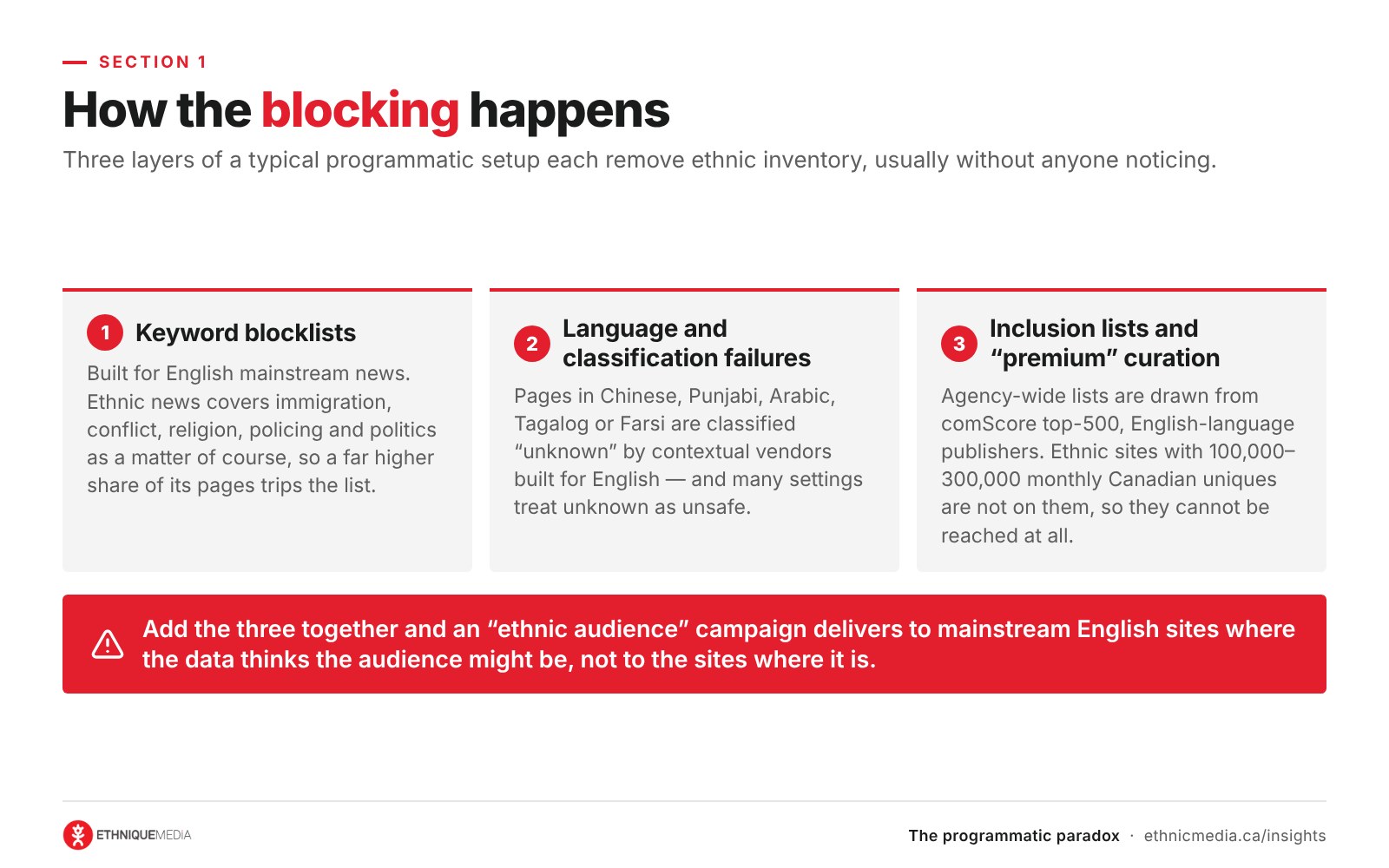
Three layers of a typical programmatic setup each remove ethnic inventory, usually without anyone noticing.
1.1 Keyword blocklists
Most agencies maintain a list of words that, when found on a page, block the ad from serving. The lists were built for English-language mainstream news, and they are long. A 2019 study by CHEQ and the University of Baltimore found that 80 per cent of ads served to premium publishers were subject to keyword blocking, and that incorrect blocking cost U.S. publishers about US$2.8 billion that year — roughly one programmatic dollar in four. The data are American and six years old; no Canadian equivalent has been published, and the mechanism has not changed.
Ethnic news covers immigration, conflict in home countries, religion, policing and politics as a matter of course, because those are the stories its audience needs. A Punjabi-Canadian news site covering farm protests in India, an Arabic site covering Gaza, a Chinese site covering Hong Kong: each trips the same keywords a mainstream site would, but a far higher share of its pages do, so a far higher share of its inventory is blocked.
1.2 Language and classification failures
Keyword tools work on text they can read. Pages in Chinese, Punjabi, Arabic, Tagalog or Farsi are frequently classified as "unknown" or "uncategorised" by contextual vendors built for English, and many brand safety settings treat unknown as unsafe. The result is a blanket block on in-language inventory regardless of content. The same applies to video and audio, where classification depends on titles and surrounding text. This failure is widely reported by publishers and vendors but has not been quantified; it is stated here as mechanism, not statistic.
1.3 Inclusion lists and "premium" curation
Agency-wide inclusion lists of approved domains are built from comScore-ranked, English-language publishers. Ethnic sites with 100,000 to 300,000 monthly Canadian uniques — substantial audiences in their communities — do not appear in the top-500 lists those inclusion lists are drawn from. A campaign running on an inclusion list cannot reach them at all, however the audience targeting is set.
Add the three layers together and an "ethnic audience" campaign often ends up delivering to mainstream English sites where the targeting data thinks the audience might be, rather than to the sites where the audience actually is.
2. Why ethnic publishers pay the price
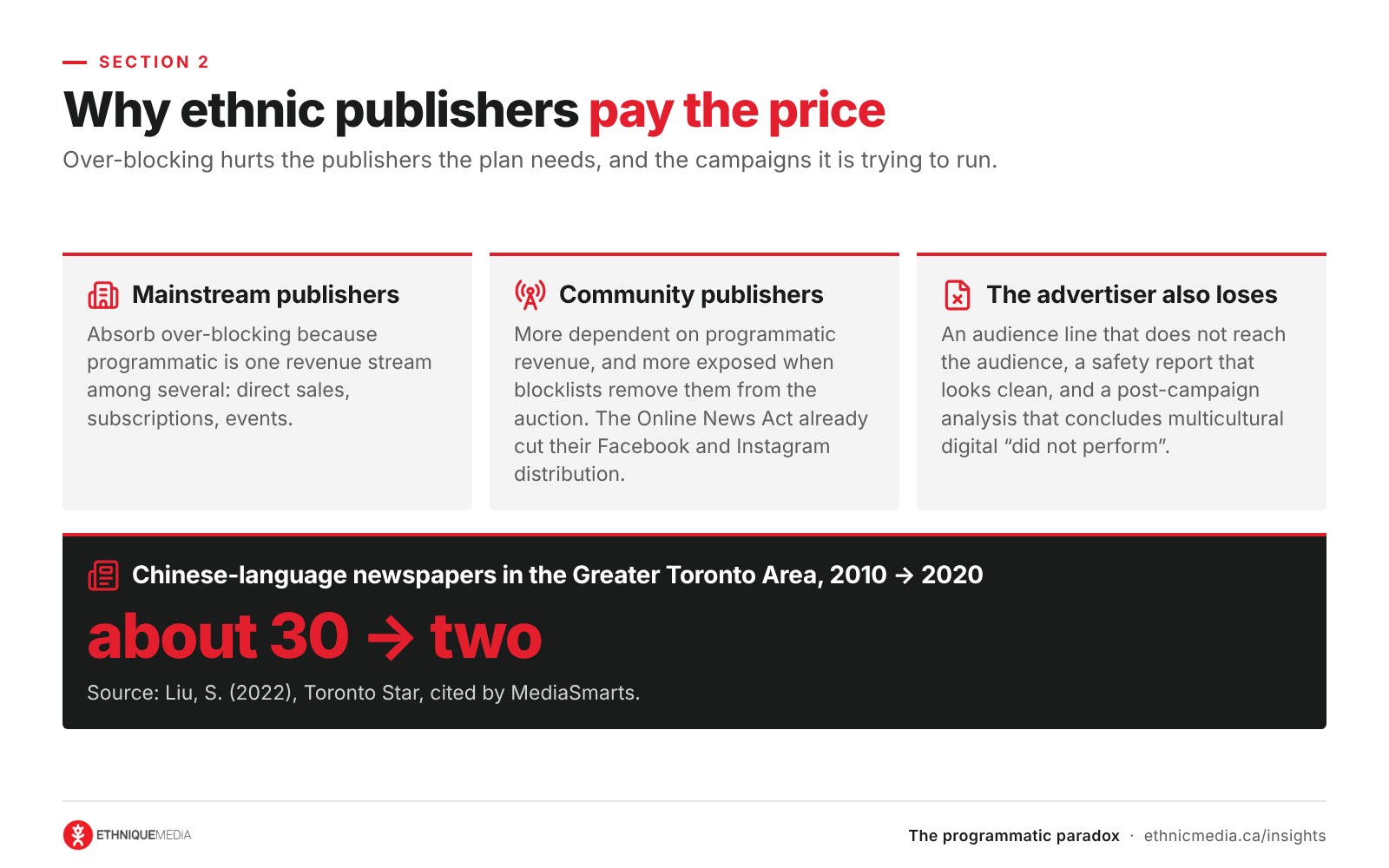
Mainstream publishers absorb over-blocking because programmatic is one revenue stream among several: direct sales, subscriptions, events. Community publishers have few of those cushions. Industry analysis of the same problem for LGBTQ+ and Black-owned media in the United States and the United Kingdom found that minority publications are more dependent on programmatic revenue and therefore more exposed when blocklists remove them from the auction.
In Canada, the damage compounds a structural squeeze. The Online News Act led Meta to remove news from Facebook and Instagram, which cut off a distribution channel that community outlets relied on more heavily than large newsrooms. Between 2010 and 2020, the number of Chinese-language newspapers in the Greater Toronto Area fell from about 30 to two. The publishers that remain are the ones with the audiences brands want; blocking their inventory starves the ecosystem a multicultural plan depends on.
For the advertiser, the cost is quieter but real: an audience line on the plan that does not reach the audience, a brand safety report that looks clean, and a post-campaign analysis that concludes multicultural digital "did not perform."
3. Six fixes for the next campaign
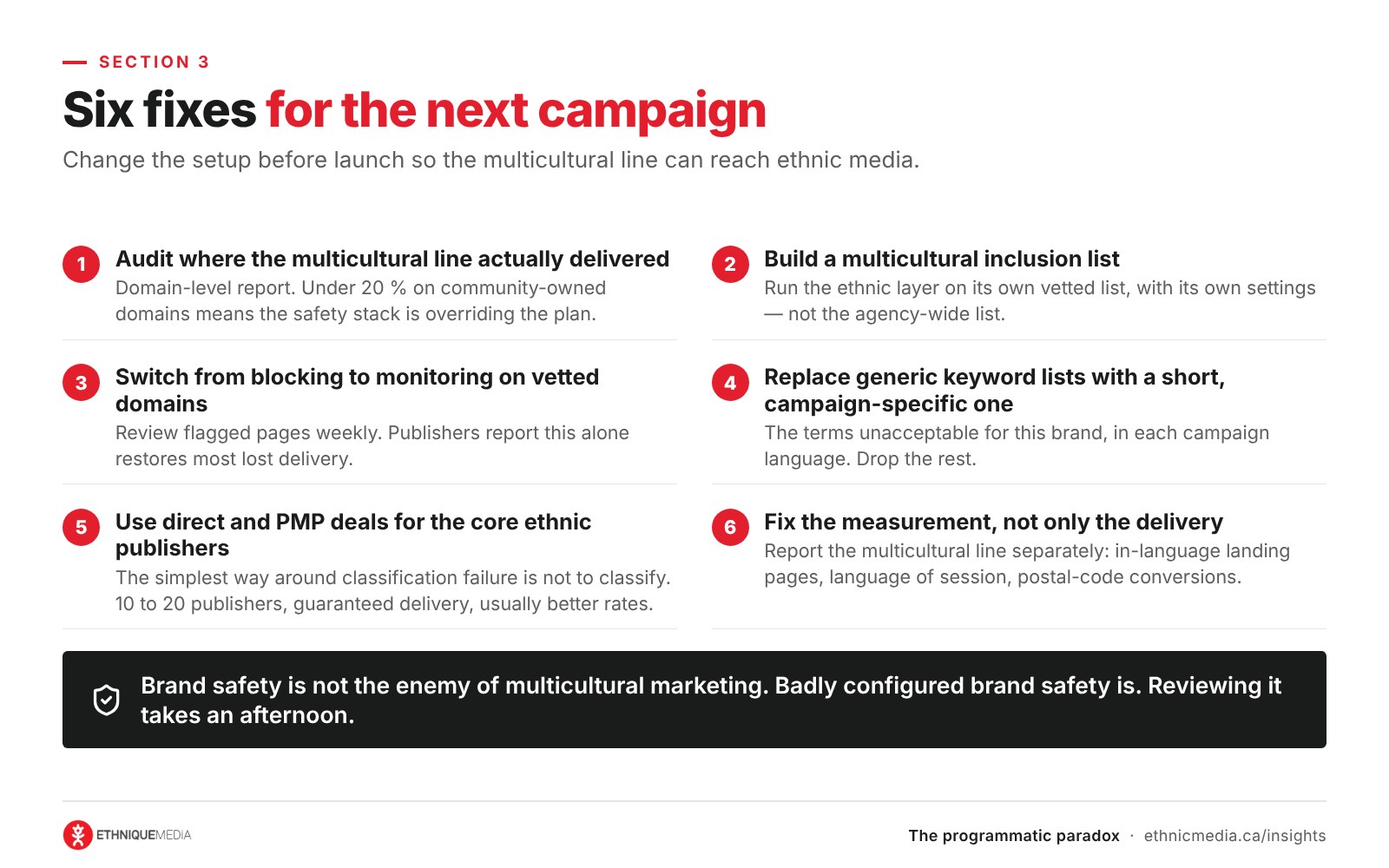
- Audit where the multicultural line actually delivered. Pull the domain-level delivery report for the last multicultural digital campaign. Count impressions on in-language or community-owned domains against mainstream domains. In our experience, an ethnic share under 20 per cent means the brand safety stack is overriding the plan.
- Build a multicultural inclusion list and run the ethnic layer on it. Do not try to get ethnic domains added to the agency-wide list. Create a dedicated inclusion list for the multicultural line, built from vetted community publishers, and run that line with its own settings. Our directory of 78 digital outlets, with traffic estimates, site type and editorial stance for each, is the starting point we use.
- Switch from blocking to monitoring on vetted domains. For publishers that have been reviewed and approved, set keyword tools to monitor rather than block, and review flagged pages weekly. Publishers quoted in the trade press report that this single change restores most of their lost delivery.
- Replace generic keyword lists with a short, campaign-specific one. A 2,000-word blocklist built in 2019 is not a brand safety strategy. Keep a short list of terms that would be unacceptable for this brand, in each campaign language, and drop the rest.
- Use direct and private-marketplace deals for the core ethnic publishers. The simplest way around classification failure is not to classify. Direct insertion orders and PMP deals with the 10 to 20 publishers that matter most for the community guarantee delivery, usually at better rates, and support the publishers whose audiences the brand wants to keep reaching.
- Fix the measurement, not only the delivery. Report the multicultural line separately, with in-language landing pages, language of session and postal-code conversion data. Judged on mainstream attribution, in-language display will always look weak; judged on reach into the community and downstream response, it usually looks strong.
4. What to ask the trading desk
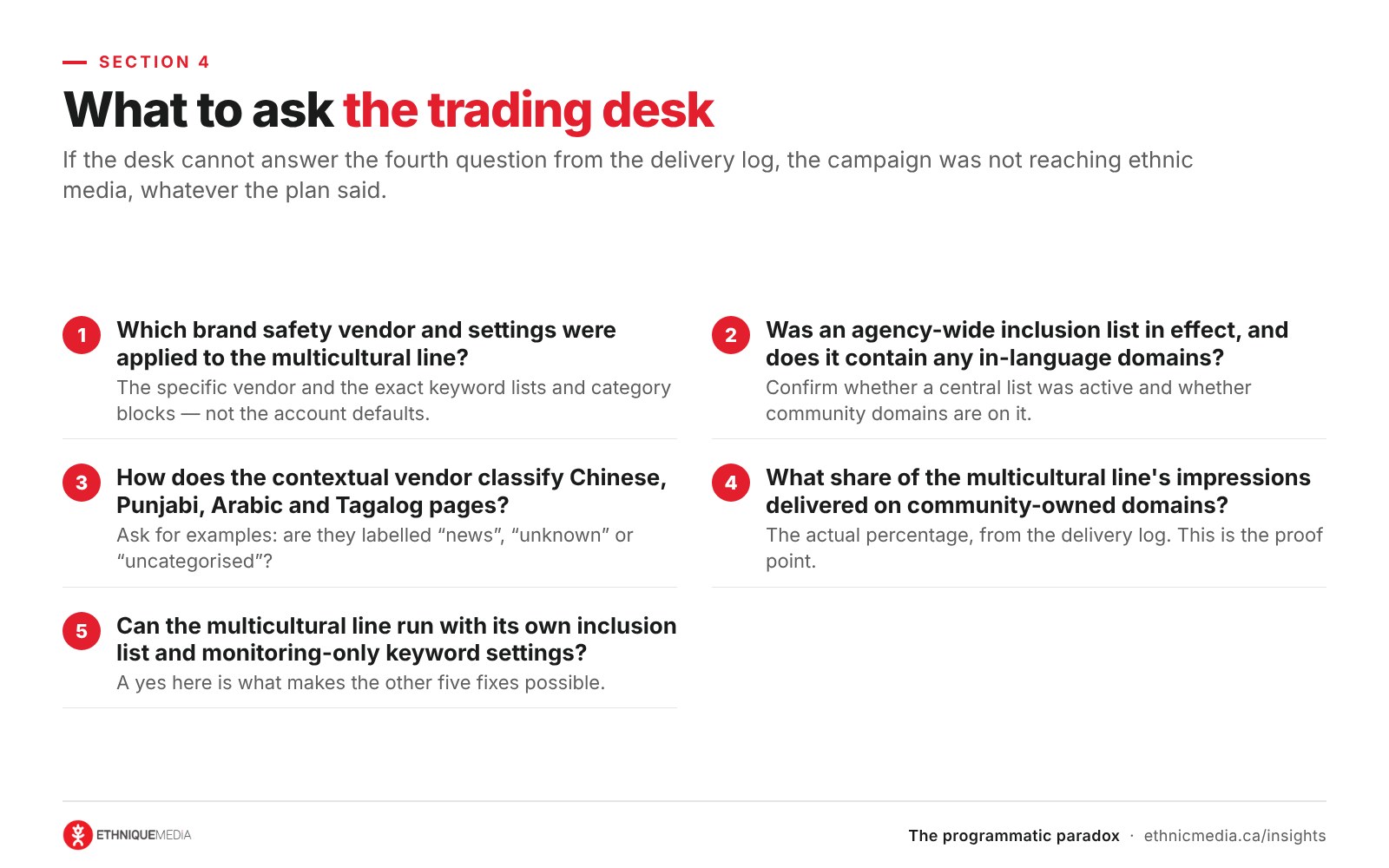
- Which brand safety vendor and settings were applied to the multicultural line?
- Was an agency-wide inclusion list in effect, and does it contain any in-language domains?
- How does the contextual vendor classify Chinese, Punjabi, Arabic and Tagalog pages?
- What share of the multicultural line's impressions delivered on community-owned domains?
- Can the multicultural line run with its own inclusion list and monitoring-only keyword settings?
If the desk cannot answer the fourth question from the delivery log, the campaign was not reaching ethnic media, whatever the plan said.
5. The point
Brand safety is not the enemy of multicultural marketing. Badly configured brand safety is. The settings that protect a brand from genuinely harmful content are a small part of most stacks; the rest is accumulated caution that was never designed with in-language publishers in mind. Reviewing it takes an afternoon. The alternative is to keep paying for an audience and never reaching it, while the publishers that serve that audience lose the revenue that keeps them on the air.
Sources
- CHEQ and University of Baltimore (2019). The Economic Cost of Keyword Blacklists for Online Publishers; reported in MediaPost, Incorrect keyword blocking costs U.S. publishers $2.8 billion.
- NBC News (2019). Ad blacklists deprive LGBTQ news of revenue, study says.
- Adapt Worldwide (2021). Discrimination in advertising: defunding diversity.
- Liu, S. (2022). "Entering a new era": What is the way forward for Chinese news outlets after Sing Tao Daily ceases publication? Toronto Star; cited in MediaSmarts, Navigating Digital Media Literacy.
- Ethnique Media outlet directory (78 digital outlets).